What happened
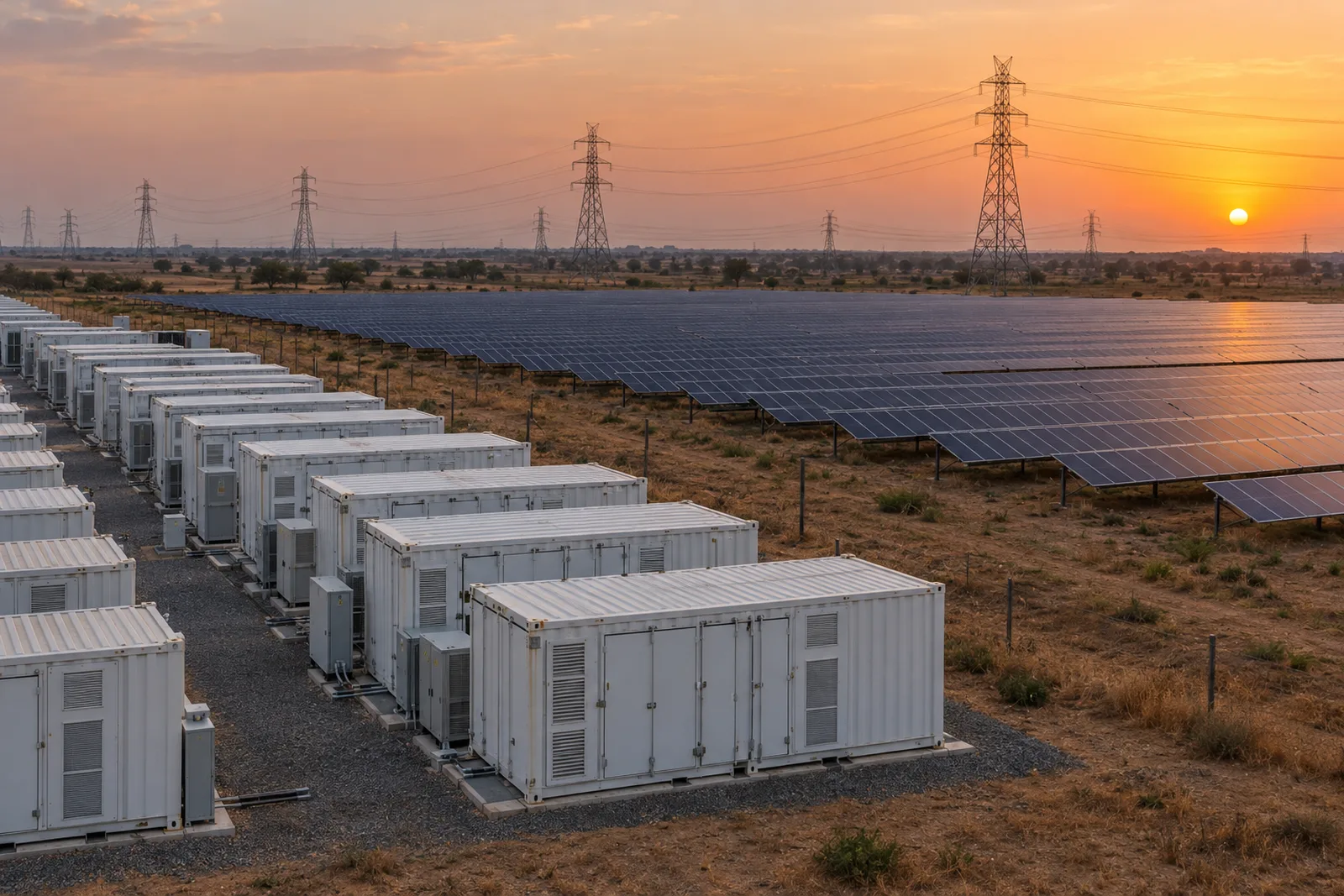
India has approved its largest support package yet for storing electricity. On 4 November the Union Cabinet, chaired by Prime Minister Narendra Modi, approved a Viability Gap Funding (VGF) scheme worth Rs 14,500 crore (145 billion rupees) to support 92 gigawatt-hours (GWh) of new grid-scale energy storage between the 2026-27 and 2030-31 financial years, the Press Information Bureau announced.
The scheme covers 60 GWh of pumped hydro storage, 30 GWh of battery energy storage systems and 2 GWh of alternative storage technologies, with a total estimated investment of Rs 97,600 crore. Capacity will be awarded through tariff-based competitive bidding. Public and private electricity distribution companies can receive support for battery and pumped hydro projects, and battery projects must meet a minimum domestic content requirement of 40 per cent, the government said.
Information and Broadcasting Minister Ashwini Vaishnaw announced the decision at a media briefing, Business Standard reported, citing the Press Trust of India.
Why it matters
Solar panels produce most in the middle of the day, and wind comes and goes. Storage lets a grid soak up surplus clean power and release it in the evening, instead of firing up coal plants to cover the gap. “Viability gap funding” means the government pays part of a project’s cost so that it can offer a competitive price.
The government says the 92 GWh is equivalent to 170 per cent of India’s current grid-scale storage capacity, and will help meet a required 411 GWh by 2031-32. Moneycontrol reported that, according to the Central Electricity Authority’s National Electricity Plan, India will need 411.4 GWh of storage by 2031-32, made up of 236.22 GWh of batteries and 175.18 GWh of pumped hydro.
In GGND’s view, this is the kind of unglamorous decision that decides whether a renewable build-out actually cuts emissions. Without storage, cheap midday solar is wasted, and coal keeps its place in the evening peak.
The scheme represents an important intervention towards building a flexible, resilient and future-ready electricity system.
Government of India, Cabinet decision released by the Press Information Bureau, 4 November 2026
The wider picture
This is the third round of support. Moneycontrol reported that in September 2023 the Cabinet approved Rs 3,760 crore for 4 GWh of battery storage, later expanded to about 13.85 GWh as battery prices fell, and that in June 2025 the Power Ministry extended support to another 30 GWh of batteries, worth Rs 5,400 crore from the Power System Development Fund. The new scheme is the first to include pumped hydro, which pumps water uphill when power is cheap and lets it flow back through turbines when power is needed.
The domestic content rule is aimed at building an Indian battery industry and reducing reliance on imported components, the government said. India Today reported that the scheme is intended to improve the integration of renewable energy and ensure reliable, affordable round-the-clock power. Business Standard linked it to India’s goal of 500 GW of renewable capacity by 2030.
Could it work elsewhere?
Many countries with fast-growing solar power face the same evening gap. In GGND’s view, India’s approach has two features worth copying: support is awarded by competitive bidding rather than handed out, and it supports several technologies at once rather than betting on batteries alone. The balance between local manufacturing rules and low prices is something each country would need to judge for itself.
What remains unresolved
- A fifth of the need. Moneycontrol calculated that 92 GWh meets only about 22 per cent of the storage India is projected to need by 2031-32. The rest must come from markets, other schemes or state programmes.
- Slow builds. Pumped hydro makes up almost two-thirds of the scheme, and such projects usually take years to plan and build, and can affect rivers and land. Whether 60 GWh can be ready by 2031 is an open question.
- Cost of local content. The 40 per cent domestic content rule for batteries may help industry but could make projects dearer while Indian supply chains are still growing.
- Delivery record. The government has not published, alongside this decision, how much of the battery capacity from earlier schemes is already running.
What happens next
The Ministry of Power is expected to issue detailed guidelines, after which distribution companies and developers will bid for support. The first auctions, and the tariffs they produce, will show whether the money is enough to make storage cheaper than burning more coal in the evening. GGND will report on the first awards.
Sources
- Press Information Bureau, Government of India Cabinet approves Rs.14,500 crore Viability Gap Funding Scheme for development of 92 GWh Grid-Scale Energy Storage Systems (4 November 2026)
- Moneycontrol Cabinet approves Rs 14,500-crore scheme to support 92 GWh energy storage capacity (4 November 2026)
- Business Standard / Press Trust of India Cabinet clears ₹14,500 cr funding scheme for battery energy storage systems (4 November 2026)
- India Today Cabinet approves Rs 14,500 crore scheme to boost grid-scale energy storage systems (6 November 2026)
Analysis and context are by The GGND Team. Where we draw our own conclusions, we say so. To report an error, contact us.