What happened
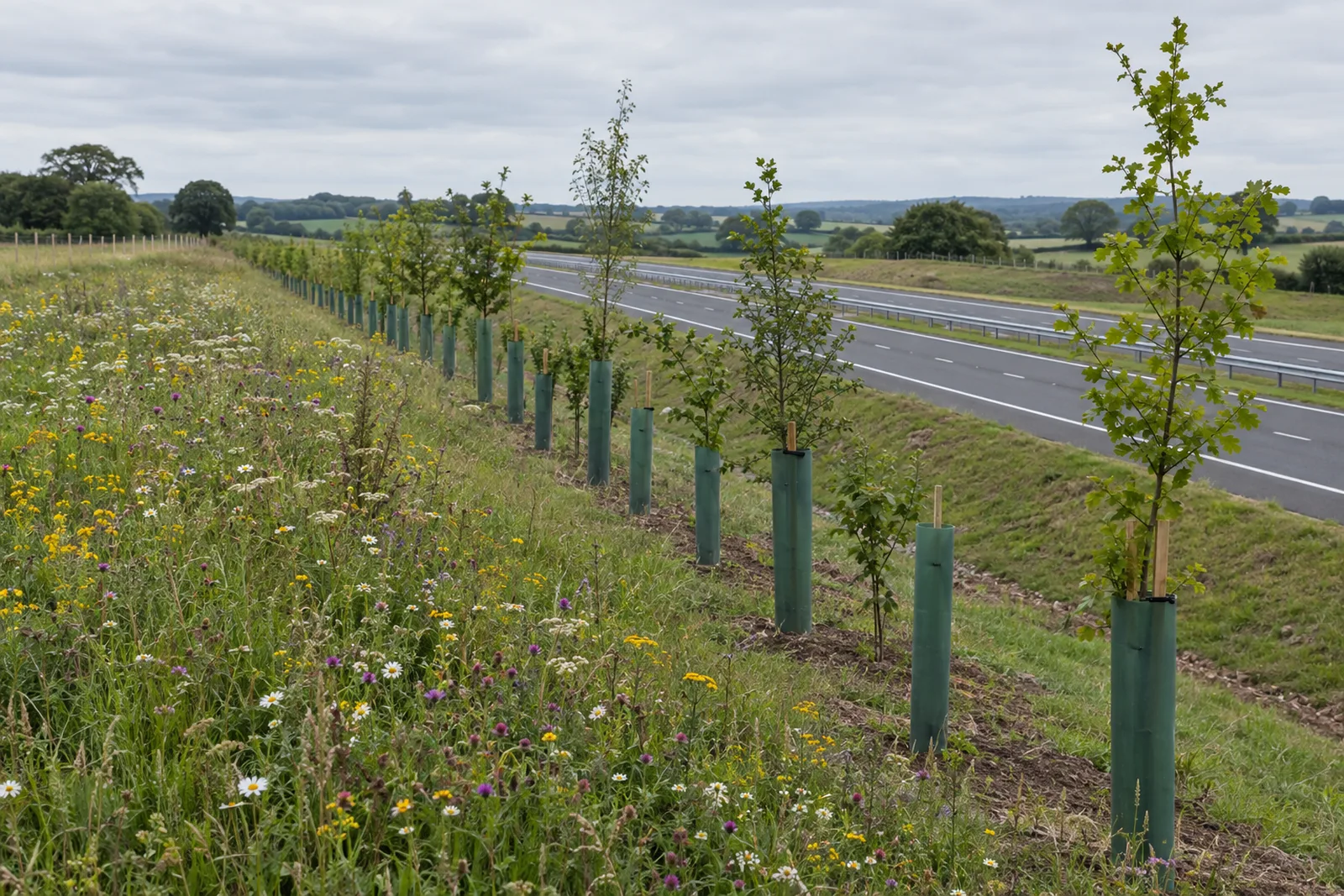
England’s largest building projects now have to leave nature in a better state than they found it. Biodiversity net gain (BNG) became mandatory for Nationally Significant Infrastructure Projects (NSIPs) on 2 November 2026, government guidance confirms. Developers who apply for a development consent order on or after that date must deliver at least a 10 per cent net gain in biodiversity.
NSIPs are the big schemes decided by ministers rather than local councils, such as major roads, power stations, large solar farms, power lines and reservoirs. The legal basis is Schedule 15 to the Environment Act 2021, which inserts a new Schedule 2A into the Planning Act 2008. The rule applies down to the mean low-water mark, including the intertidal zone but not the open sea, and it does not cover projects approved by other routes such as Hybrid Bills.
Positive News reported that BNG was already required for most small and major building projects, which must deliver the 10 per cent uplift and maintain it for 30 years.
Why it matters
Big infrastructure takes a lot of land. Until now, those projects were expected to consider nature, but there was no fixed legal target. Biodiversity is measured in standard “biodiversity units” using a statutory metric that looks at a habitat’s size, condition, location and type, the guidance explains. Developers must first avoid harm, then reduce it, and only as a last resort compensate for it.
Positive News reported that the government expects BNG to prevent 6,000 to 10,000 hectares of habitat loss a year, an area roughly the size of Nottingham. In GGND’s view, bringing in the largest projects matters because they often cross many miles of countryside, and gains can be planned along whole corridors rather than on small plots.
The schemes with the largest footprint on nature should contribute the most to its recovery.
Michael Copleston, Director, RSPB England, as reported by Positive News
The wider picture
The rules have been adapted for infrastructure. Not all land inside a project’s boundary has to be counted in the baseline, only habitats that will be harmed or used for gains, and habitat that is disturbed temporarily and restored within two or five years, depending on its value, can be counted as retained, the guidance says. The plan that secures the gains is handled in three stages rather than one, law firm TLT noted after an event with Natural England’s BNG lead, Nick White, and RWE’s lead DCO project manager, Mikyla Davidson.
TLT said the mandatory regime is nonetheless stricter than before on reaching 10 per cent, on trading rules and on paperwork. It noted that some projects, such as solar farms, have more room to create habitat on site, while others will need to buy off-site biodiversity units, which could make NSIPs significant new buyers in the habitat market.
The trade magazine edie said the change raises questions about the supply and demand of biodiversity credits and whether such large schemes can deliver real gains on site. Planning Resource also reported the start of the rule on 2 November.
Could it work elsewhere?
England’s BNG system has drawn international interest since it began for ordinary planning in February 2024, Natural England’s Nick White said, according to TLT. In GGND’s view, the idea is portable: measure nature before building, require a net improvement, and lock that improvement in for decades. The hard part is checking that promised habitats are created and looked after, which requires inspectors and public records, not just a spreadsheet at the planning stage.
What remains unresolved
- Exemptions. RSPB England’s Michael Copleston called for wider coverage, Positive News reported, noting that projects under 0.2 hectares, around half of residential developments, are exempt.
- A flexible baseline. Counting only impacted habitats and treating restored temporary damage as retained makes the rules workable for long projects, but it also means less land is in the calculation.
- The credit market. If big projects buy many off-site units, there may not be enough good-quality habitat for sale, edie suggested, and prices could rise.
- Thirty years of checking. Gains must last for 30 years. How closely they will be monitored and enforced across so many sites is not yet proven.
What happens next
The first applications under the new rules will come forward over the coming months, each with a biodiversity metric and an outline gain plan. Because major projects take years to examine, the first habitats created under the rule may not appear on the ground for some time. GGND will look at the first decisions to see how the gains are delivered.
Sources
- GOV.UK (Defra) Biodiversity net gain: nationally significant infrastructure projects (published 27 August 2026, updated 3 November 2026)
- Positive News What went right this week: the good news that matters (6 November 2026)
- TLT LLP BNG for NSIPs is here: what changes for infrastructure developers? (3 November 2026)
- edie Biodiversity Net Gain mandate enters into force for Nationally Significant Infrastructure Projects (2 November 2026)
- Planning Resource Biodiversity net gain requirement for major infrastructure projects comes into effect (2 November 2026)
Analysis and context are by The GGND Team. Where we draw our own conclusions, we say so. To report an error, contact us.