What happened
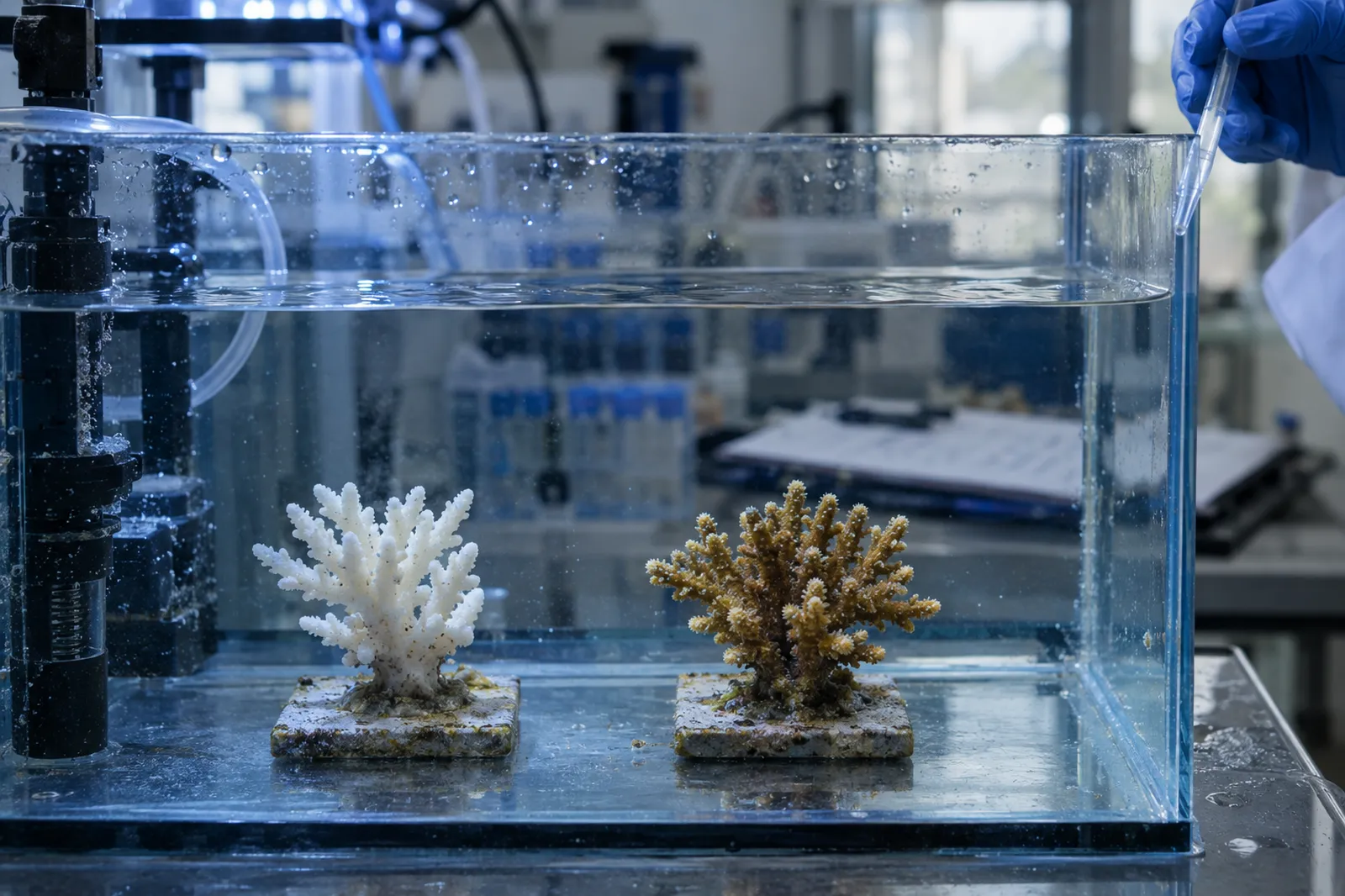
The discovery began with an accident. In 2025, Stanford marine scientist Steve Palumbi noticed that two coral fragments from the same colony, one bleached and one healthy, had tipped over in a tank and were touching. Where they touched, colour was returning to the bleached fragment.
His colleague Daniel Collins turned the observation into an experiment at Stanford’s Hopkins Marine Station. He set up ten pairs of bleached and healthy fragments from the same animal, with five pairs touching and five separated by a few millimetres. The bleached fragments in touching pairs fully recovered within seven weeks, while those without contact died. The results were published in Science Advances on 14 October.
Why it matters
Corals depend on microscopic algae, called symbionts, that live in their tissues and supply most of their food through photosynthesis. When the water gets too hot, corals expel the algae and turn white. This is bleaching. Without the algae, they starve or are overgrown, and many die. Corals that survive usually regain their algae slowly, over months, which is why severe bleaching events kill so many.
In the study, algae moved from healthy to bleached tissue within days. In the second week, the algae inside the bleached fragments were doubling about every four days, which Stanford says is roughly ten times faster than in wild corals. After about a week of contact, and in some cases less, the bleached fragments had enough algae to finish recovering on their own after being separated.
We were curious if we could harness that mechanism of contact, but instead of introducing bad guys that could cause disease, we could introduce good guys.
Daniel Collins, study lead author, speaking to KQED
The wider picture
The team traced the mechanism to tissue fusion. After contact, microscopic channels in the two corals’ tissues align, creating a path along which algae and the nutrients they produce can flow. That is also the source of the main limitation. Recovery by contact only worked between fragments of the same genetic individual. Pairs from different individuals triggered hostile reactions instead. A second, slower pathway, in which polyps take up algae directly, worked in both kinds of pairing, but was not enough on its own for recovery.
The authors describe their findings as a previously unrecognised natural process, and “a foundation for research into potential recovery interventions.” They do not present it as a ready-made treatment.
Could it work elsewhere?
The process itself seems to be biological rather than local, which is why it attracts attention. Whether it can help on a real reef depends on keeping healthy fragments of the same colonies on hand, and on a practical way to bring them into contact.
What remains unresolved
- Lab, not reef. The corals were sourced from aquariums and studied in tanks. Reefs bring currents, predators, disease and repeated heatwaves.
- The genetic match. Because recovery requires the same genetic individual, any reef use would need banked healthy tissue from specific colonies.
- Scale. Mass bleaching can affect huge areas of reef. A fragment-by-fragment method raises clear questions about labour and cost.
- The cause remains. Faster recovery does not address the ocean warming that causes bleaching in the first place.
What happens next
The next steps are tests with more species and, eventually, field trials to see whether the mechanism holds up outside the tank.
Sources
- Science Advances Rapid coral bleaching recovery via symbiont transfer from healthy corals (14 October 2026)
- Stanford Doerr School of Sustainability Stanford scientists discover a way to reverse coral bleaching at record speed
- KQED Stanford scientists find new way to revive bleached coral
Analysis and context are by The GGND Team. Where we draw our own conclusions, we say so. To report an error, contact us.