What happened
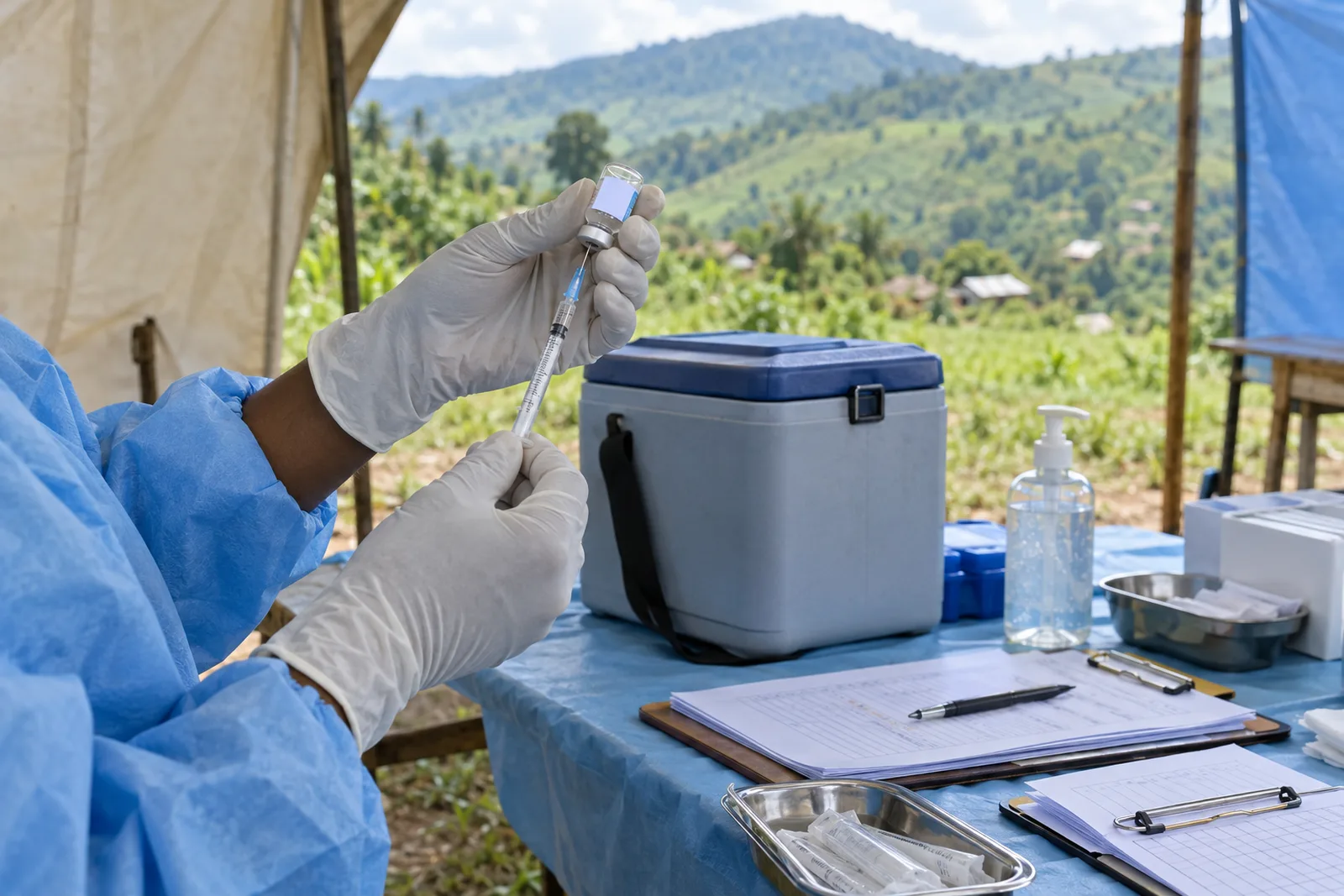
On 23 October 2026, the first participant was vaccinated in Bunia, in the Democratic Republic of the Congo’s Ituri province, in a trial called Tumaini, which means ‘hope’ in Swahili, the Institute of Tropical Medicine in Antwerp announced. The Phase 2/3 trial is testing vaccines against Bundibugyo virus, the species of Ebola behind the country’s current outbreak. There is no approved vaccine against it.
‘Science gives us hope,’ WHO Director-General Tedros Adhanom Ghebreyesus wrote on X as the first doses were given, AFP reported via Al Jazeera. The first vaccine in the trial is Ervebo, which is licensed against the more common Zaire ebolavirus. Two vaccines designed specifically for Bundibugyo, one from Moderna and one from the University of Oxford with the Serum Institute of India, both funded by CEPI, are being prepared to join shortly.
Why it matters
The outbreak, declared on 15 May 2026, is the largest Bundibugyo outbreak ever recorded and the second-largest Ebola outbreak of any kind. By 20 October, the DRC had reported 9,704 confirmed cases and 4,687 deaths across 66 health zones in eight provinces, a crude fatality rate of 48.3 per cent, the World Health Organization said. Imported cases have also been confirmed in Uganda, France, Kenya and Nigeria.
Without a vaccine or a specific treatment, responders rely on finding cases, isolating them, tracing contacts and safe burials. That is hard work. WHO reported that only 79.7 per cent of more than 30,000 contacts were seen in a single day, below the 95 per cent target, and that most recent deaths happened in the community rather than in treatment centres.
‘If successful, this would be the first time we have clear evidence of vaccine efficacy against Bundibugyo virus,’ said Dr Chikwe Ihekweazu, who leads WHO’s Health Emergencies Programme, in the trial announcement.
There is still no licensed vaccine against Bundibugyo virus, and the cost of that absence is being counted in the DRC every day, in lives lost and in health workers who go to work without protection.
Dr Richard Hatchett, Chief Executive of CEPI
The wider picture
Tumaini is designed to save time. It is an adaptive platform trial, which means several vaccines can be tested side by side under one plan, with new candidates added as they become ready. It uses ring vaccination, offering vaccine to the contacts of confirmed cases and others at highest risk. This is the approach used to show that Ervebo works against Zaire ebolavirus in earlier outbreaks. The trial is co-led and co-sponsored by Congo’s Institut National de Recherche Biomédicale (INRB) and the University of Antwerp, with the Ministry of Health providing national leadership.
The trial also includes groups that are often left out of research. Pregnant women and children aged 12 and over can take part, and children from one year of age can receive Ervebo. ‘Children are among those hardest hit by the Ebola outbreak in certain regions, yet they have historically been under-represented in clinical research,’ said Valérie Briand of Epicentre, the research arm of Médecins Sans Frontières. MSF is also involved in a separate trial, BRAVO, that focuses only on whether Ervebo protects against Bundibugyo.
Planning for success has started too. Gavi, the Vaccine Alliance, has committed up to US$40 million to prepare manufacturing so that any vaccine shown to work can be produced at scale, ITM said.
Could it work elsewhere?
In GGND’s view, the most important lesson is speed. Ring-vaccination trials only work while an outbreak is under way, so having ready-made WHO protocols, a pre-agreed way to choose candidates and funding in place lets researchers start within months rather than years. The same model could be used for other diseases without vaccines, such as Marburg or Lassa fever, if countries and funders prepare the groundwork before the next outbreak.
What remains unresolved
- Will Ervebo work? It was built for a different Ebola virus. Whether it gives any cross-protection against Bundibugyo is exactly what the trial must find out.
- Timing. The Bundibugyo-specific vaccines are still in earlier, smaller trials. They may arrive late in the outbreak, when there are fewer cases to show whether they work.
- Figures differ. The trial announcement gave 9,552 cases and 4,602 deaths as of 21 October; WHO’s update gave 9,704 cases and 4,687 deaths as of 20 October. Counts are being revised as data come in.
- Reaching contacts. Ring vaccination depends on finding contacts quickly, and contact follow-up is still below target, especially in Nord-Kivu.
What happens next
The trial is registered on ClinicalTrials.gov as NCT07842107. The two CEPI-funded vaccines are expected to join once regulators approve the protocol changes. GGND will report on when they enter the trial, on any early safety and immune-response data, and on whether the outbreak begins to slow.
Sources
- Institute of Tropical Medicine Antwerp First participant vaccinated in pivotal Phase 2/3 Bundibugyo vaccine trial in DRC (23 October 2026)
- World Health Organization Disease Outbreak News: Ebola disease caused by Bundibugyo virus, DRC, Kenya and Nigeria (23 October 2026)
- Médecins Sans Frontières Ebola: First person vaccinated in Tumaini clinical trial (26 October 2026)
- Al Jazeera / AFP WHO announces start of Ebola vaccine clinical trial in DR Congo (24 October 2026)
- AFP Ebola vaccine trial begins in DR Congo (24 October 2026)
Analysis and context are by The GGND Team. Where we draw our own conclusions, we say so. To report an error, contact us.