What happened
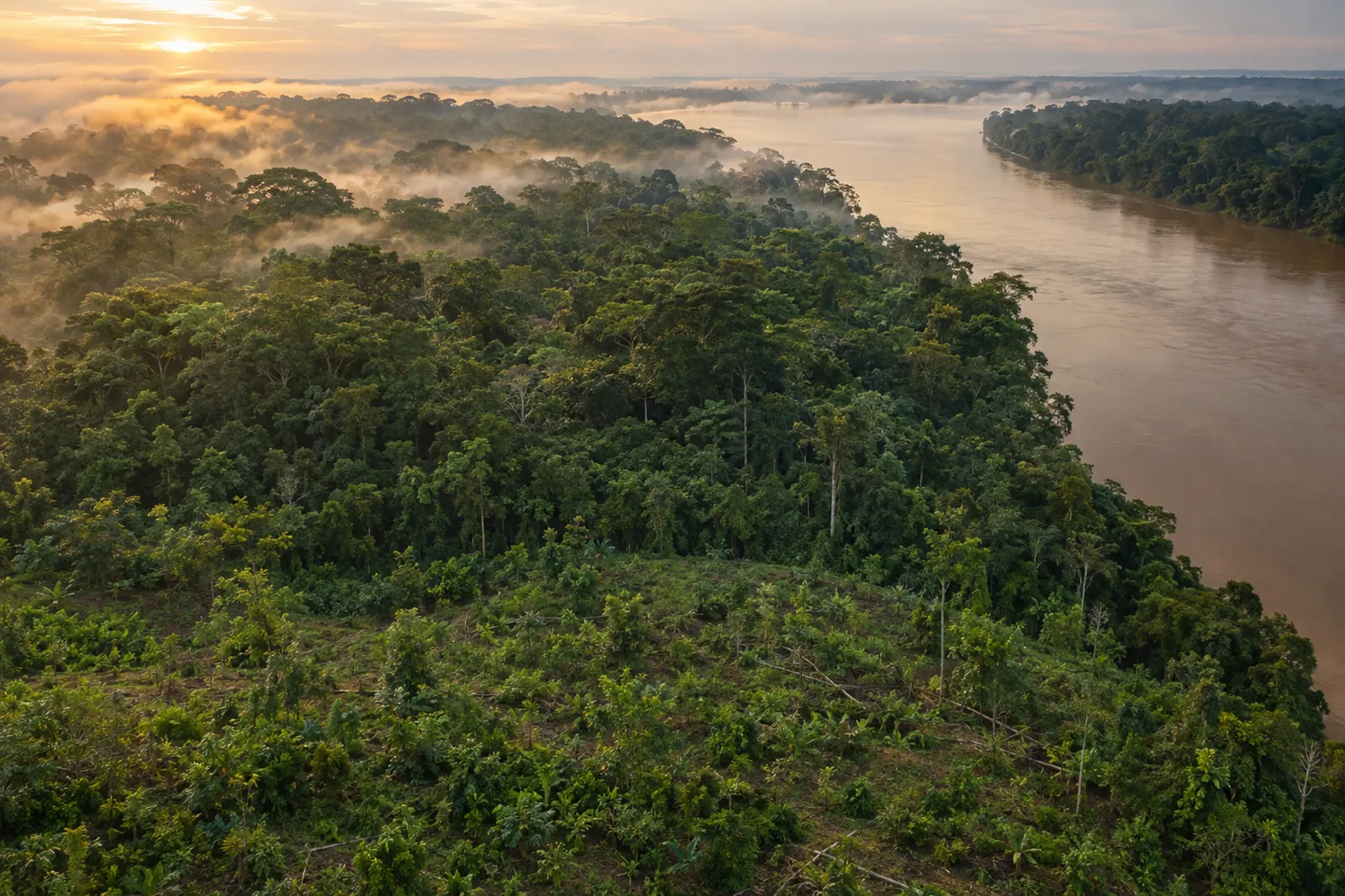
Brazil’s government announced on 16 October that the Amazon lost 3,335 square kilometres of forest between August 2025 and July 2026, down 41.8 percent from 5,731 square kilometres the year before. It is the lowest figure since official satellite records began in 1988 and, according to the BBC, the biggest one-year drop on record. Deforestation in the Cerrado, Brazil’s vast tropical savanna, fell 23.8 percent.
The government says Amazon deforestation has fallen 71 percent since 2023. That reverses a surge between 2019 and 2022, when, official data show, clearing rose by around 60 percent and more than 45,000 square kilometres were cleared.
Why it matters
About 60 percent of the Amazon, the world’s largest rainforest, lies in Brazil. A healthy forest absorbs large amounts of carbon dioxide and generates moisture that shapes rainfall far beyond South America. Deforestation and other land-use change are Brazil’s largest sources of greenhouse gas emissions, so the trend matters for the country’s climate commitments as much as for its biodiversity.
The figures also challenge a long-standing political argument. “Agriculture has been setting production and export records while deforestation has fallen,” Márcio Astrini of the Observatório do Clima, a network of Brazilian environmental groups, told AP. He argued that the data disprove the idea that protecting the forest holds back development.
With political will, it is possible to curb deforestation and greenhouse gas emissions.
Márcio Astrini, Observatório do Clima, as reported by the BBC
The wider picture
The decline was not an accident of the weather. In January 2023, President Luiz Inácio Lula da Silva revived the Action Plan for the Prevention and Control of Deforestation in the Legal Amazon, a blueprint first launched in 2004 and shelved under his predecessor. Euronews and AP describe four pillars: monitoring and enforcement, a sustainable economy, management of protected and undesignated public forests, and financial rules and incentives.
In practice that meant restoring penalties for illegal clearing detected by satellite, proposing to bar properties with illegal deforestation from bank loans, steering extra funding to Amazon municipalities that cut forest loss, and paying for efforts against environmental crime.
Could it work elsewhere?
Brazil’s experience suggests that the combination matters more than any single measure. Transparent satellite monitoring, credible penalties, and money that rewards local governments for results reinforce one another. Other forest nations can copy the tools, but the hard part is the political commitment that keeps them running.
What remains unresolved
- Clear-cutting is only part of the damage. Degradation from fire, logging and drought affects about 40 percent of the Amazon and has outpaced outright clearing in recent years, Euronews reports. A strong El Niño could bring hotter, drier conditions through 2026 and 2027.
- Fires have surged this month. Fire counts tripled after the first round of voting on 4 October, and authorities are investigating whether some fires were set deliberately. NASA scientists caution that standard satellite counts may understate the damage. One preliminary analysis around Santarém found about 40 percent more fires than the standard data showed.
- The election. President Lula faces Senator Flávio Bolsonaro in a run-off on 25 October. Lula has pledged zero net deforestation by 2030, with restoration offsetting all forest loss. Flávio Bolsonaro has pledged to end illegal deforestation by 2029 and, the BBC notes, to fight organised crime in the Amazon. Conservation experts quoted by Euronews warn that a change of government could reverse current policies.
What happens next
The run-off is on 25 October, and the dry-season fires will show over the coming weeks whether the year’s gains survive. The next annual deforestation figure, covering August 2026 to July 2027, will be the first full measure of whichever government takes office.
Sources
- Euronews / AP Amazon deforestation hits record low in Brazil, but El Niño and a tight election threaten progress (19 October 2026)
- BBC News Brazil sees record fall in Amazon deforestation as key election looms
Analysis and context are by The GGND Team. Where we draw our own conclusions, we say so. To report an error, contact us.