What happened
On 14 October, Indonesia’s Ministry of Primary and Secondary Education and the National Food Agency launched a guide to food and nutrition education based on local resources. Its central design choice is restraint: it adds no new subject. Instead, it gives teachers a competency map to weave food and nutrition into lessons they already teach, through classroom work, projects, extracurricular activities and school culture.
“The most important thing is how we incorporate this competency map into existing learning outcomes,” said Laksmi Dewi, head of the ministry’s Curriculum and Learning Center. Hamid Sangadji of the National Food Agency said the material can cover three elements, the availability, affordability and use of food, pitched to each age, from recognising foods grown locally to understanding what drives their price and supply.
Why it matters
Feeding children solves today’s hunger. Teaching them about food shapes what they will choose for decades. The ministry presents the guide as a companion to the Free Nutritious Meals programme, known as MBG, which serves meals at school. A meal can become a lesson, and a lesson can make the meal mean more.
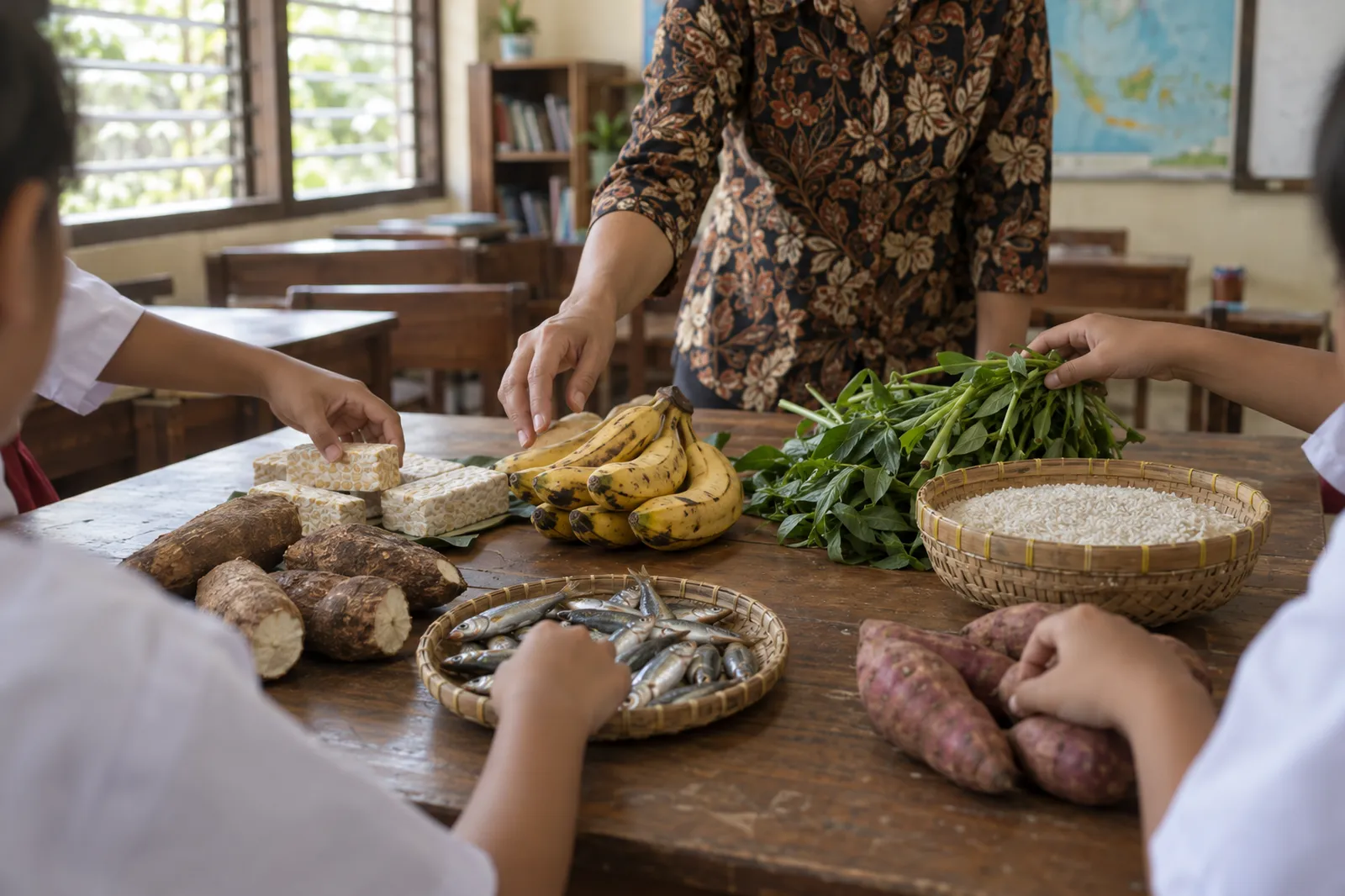
Building lessons around local foods also reflects Indonesia’s food diversity. Tempeh, cassava, sweet potato, greens and fish vary by island and region. Teaching with what grows nearby keeps lessons concrete and affordable, and it supports local farmers and food traditions rather than imported staples.
What we eat will determine our future.
Hamid Sangadji, National Food Agency
The wider picture
The scale of the meal programme gives the guide unusual reach. By 30 September, MBG had reached more than 57 million people, including students, pregnant and breastfeeding women and toddlers, through 27,486 kitchen units across 38 provinces, according to the state news agency ANTARA. The government is aiming for 72.4 million beneficiaries in 2027.
The National Nutrition Agency, which runs the programme, says the share of students arriving at school hungry has fallen from more than 56 percent to around 16 percent. These are the agency’s own figures rather than an independent evaluation, but they suggest the scale of what is changing in classrooms.
One development links the meals and the lessons directly. The agency is piloting buffet-style service, in which students serve themselves, and aims to extend it to 5,000 kitchen units by the end of 2026. Once children choose their own plates, nutrition education stops being theoretical.
Could it work elsewhere?
Many countries run school meal programmes, and fewer link them to the curriculum. Indonesia’s approach of using existing lessons and local produce, with no new subject, is a low-cost model that other school systems could adapt.
What remains unresolved
- Classroom practice. A guide is only as good as the teacher’s time and training to use it. The launch did not set out a training plan or a way to evaluate results.
- Habits at home. Lessons at school compete with what families can afford and what children see advertised. Whether learning changes eating outside school is unknown.
- Food safety. The nutrition agency has temporarily shut 1,276 kitchen units that had not yet obtained hygiene and sanitation certificates, in order to enforce stricter standards.
- Budget pressure. Spending had reached about 66.9 percent of the programme’s annual ceiling by September. Kompas reports that the 2027 expansion target comes alongside a cut of IDR 30 trillion in one budget component.
What happens next
The ministry is encouraging schools to adopt the guide now. Schools that already link learning to local food, such as SMKN 1 Kademangan in Blitar, East Java, whose principal spoke at the launch, offer early examples. The test will come in the next school year, as the programme grows toward its 2027 target and more children choose their own meals.
Sources
- Ministry of Primary and Secondary Education, Indonesia Ministry promotes food and nutrition education guidelines based on local resource potential (15 October 2026)
- ANTARA Indonesia’s Free Meal Program reaches 57 million
- ANTARA Indonesia’s Free Meal program cuts hungry students to 16 percent
- Kompas MBG approaches its third year: time to prioritize beneficiaries according to goals
Analysis and context are by The GGND Team. Where we draw our own conclusions, we say so. To report an error, contact us.