What happened
A paper in the New Zealand Journal of Zoology has documented one of the most comprehensive insect recovery programmes ever undertaken. Over 15 years, Butterfly Creek and Auckland Zoo bred tens of thousands of wētāpunga, enabling 45 translocations of about 11,000 insects to 10 new wild sites, the Department of Conservation (DOC) announced on 2 October. The species’ status has improved from Threatened – Nationally Endangered in 2004 to Threatened – Nationally Increasing in 2022.
The clearest sign of success is in the wild. Monitoring on the islands of Motuora and Tiritiri Matangi shows at least four generations of wētāpunga have been born there, which is internationally recognised as proof that a population has established, DOC says. Many of the other island populations are well on their way.
Why it matters
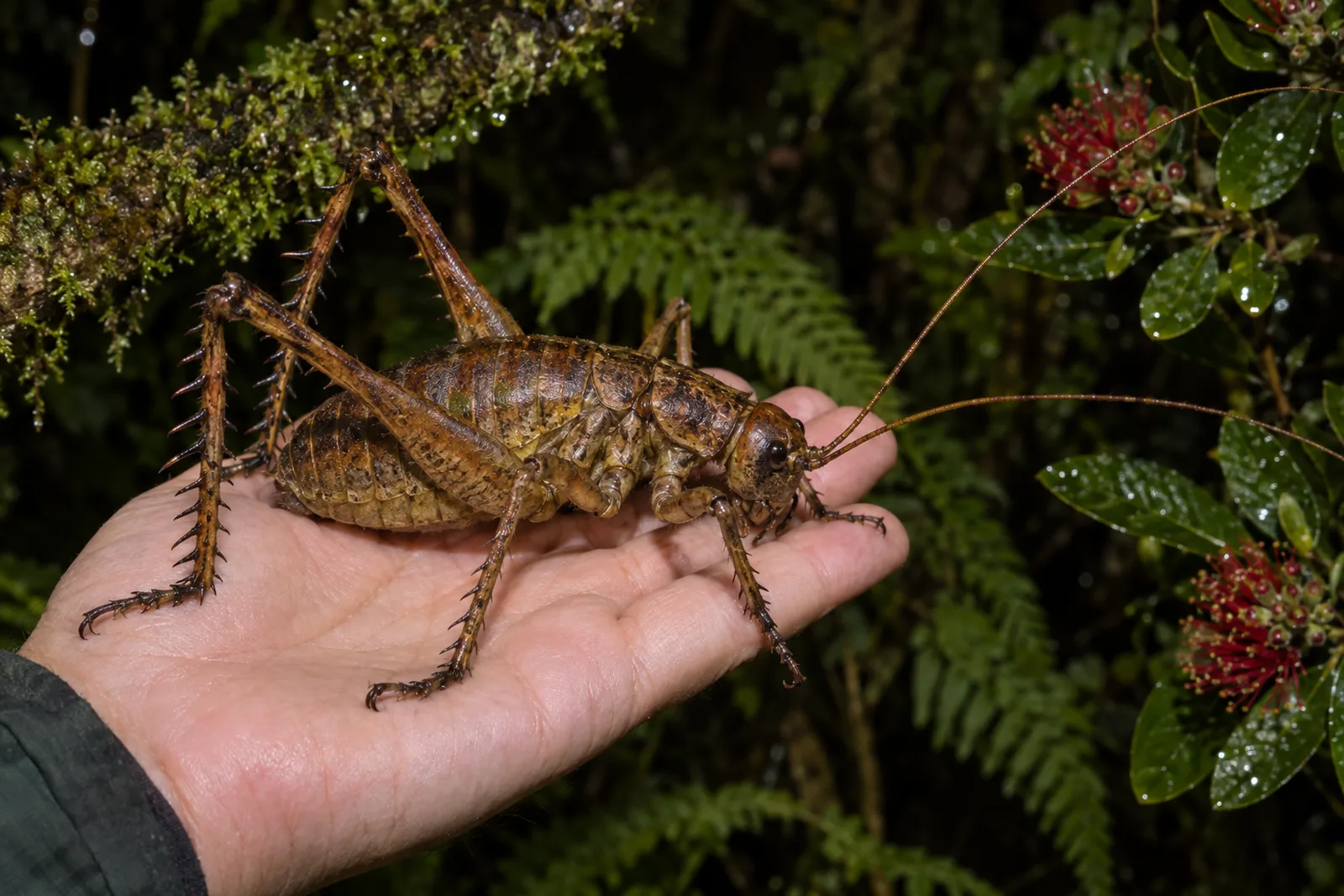
Wētāpunga are giants. The largest of New Zealand’s giant wētā and the heaviest insect of their order in the world, an adult female “would sit nicely on the entirety of your hand,” lead author Chris Green told RNZ. They once lived across Northland and Auckland. Forest clearance and introduced rats, stoats and cats wiped them out everywhere except Te Hauturu-o-Toi/Little Barrier Island.
Invertebrates make up about 95% of the animals on Earth, Auckland Zoo notes, yet they rarely get this kind of rescue effort. This one is now a blueprint. “By documenting this amazing conservation success story, we can share valuable knowledge on husbandry, release methods, and population persistence,” Green said in the DOC release.
This species was endangered at the start of the programme, it is now not endangered – it is recovering.
Dr Chris Green, lead author, speaking to RNZ
The wider picture
Even after rats were removed from Little Barrier in 2004, surveys found only 78 wētāpunga in 2005 and 171 in 2009, far too few to move directly to new islands, Earth.com reports. So in December 2008, six adults went to Butterfly Creek, a wildlife park in Auckland, to start a breeding colony. Auckland Zoo set up a second colony in 2012 and, from 2014 to 2025, bred and released 8,874 wētāpunga.
The keepers learned as they went. Eggs take about nine and a half months to hatch, and young wētā moult ten times over about 14 months. Raising nymphs together in large mesh cages, about 20 per cage and of similar ages, so the bigger ones did not eat the smaller ones, lifted survival to release to as high as 80%. One female produced as many as 1,350 young. Iwi Ngāti Manuhiri, kaitiaki (guardians) of the wētāpunga and mana whenua of Little Barrier Island, supported the programme throughout. Community restoration groups raised money and helped with releases and monitoring.
Could it work elsewhere?
It is already being copied. What the team learned is guiding the breeding of Māhoenui giant wētā at the Ōtorohanga Kiwi House. “There are many more critically endangered invertebrates that could benefit from similar programmes,” Green said, naming the Canterbury knobbled weevil and several native stag beetles.
What remains unresolved
- A narrow family tree. All the new populations trace back to a small number of founders. A study of another giant wētā recommended at least 70 unrelated founders to avoid genetic bottlenecks. DNA samples collected in 2018 and 2019 should show how healthy the populations are, but those results have not yet been reported, Earth.com notes.
- Living with mice. The two mainland sanctuaries are fenced against predators but still have mice. Whether wētāpunga can thrive alongside them is one of the questions the releases were designed to answer.
- Counting generations. Generation counts come from a model built on breeding data, and timing in the wild may vary.
- Still dependent on people. “Nationally Increasing” is a threatened category for species that are growing but still rely on conservation work. The programme has been resource-hungry and partly funded by community groups.
What happens next
Monitoring continues on the island and mainland sites, and other populations are expected to reach the four-generation mark. “The future of wētāpunga is looking bright,” Green said. The bigger hope is that its story changes how New Zealand, and the world, treats its rarest insects.
Sources
- Department of Conservation (NZ) Science paper outlines blueprint for successful giant wētā recovery (2 October 2026)
- New Zealand Journal of Zoology Green et al., Captive breeding programme enables a successful wētāpunga recovery programme (2026)
- 1News / RNZ ‘Amazing conservation success’: Zoologists celebrate wētā growth (4 October 2026)
- Earth.com Zoos bred and released 11,000 wētāpunga, helping New Zealand’s heaviest insect bounce back (6 October 2026)
- Phys.org A conservation success story for New Zealand’s heaviest insect (2 October 2026)
- Auckland Zoo New Zealand invertebrates: wētāpunga
Analysis and context are by The GGND Team. Where we draw our own conclusions, we say so. To report an error, contact us.