What happened
On 6 October, the Royal Swedish Academy of Sciences awarded the 2026 Nobel Prize in Physics to Francis Halzen of the University of Wisconsin–Madison, “for decisive contributions to the IceCube Neutrino Observatory and the discovery of high-energy neutrinos of astrophysical origin.” Halzen, born in Tienen, Belgium, in 1944, is the first sole winner of the physics prize since 1992, C&EN notes.
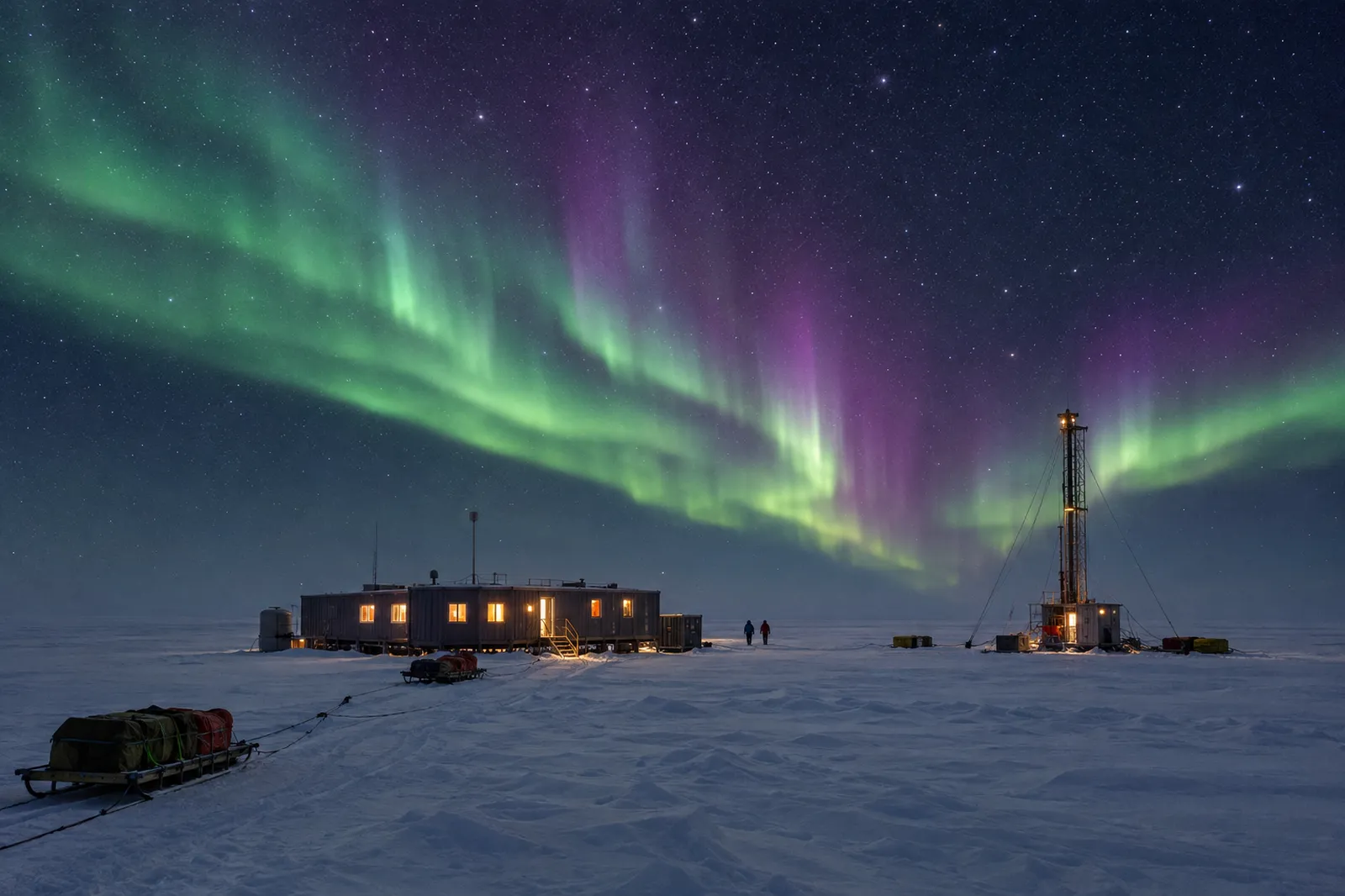
IceCube is an unusual telescope. It has no lens or mirror. It is a cubic kilometre of glacial ice at the South Pole, fitted with 5,160 light sensors on 86 cables placed between 1,450 and 2,450 metres below the surface. It reached full size in 2011.
Why it matters
Neutrinos are the shyest particles in the universe. They carry no electric charge and almost no mass, and they pass through matter almost without trace. The Nobel Committee notes that about 65 billion neutrinos from the Sun pass through your fingernail every second.
That shyness makes them uniquely useful. The universe is crossed by cosmic rays, mostly protons, some with far more energy than any particle accelerator on Earth can produce. Where they come from has been one of the cosmos’s best-kept secrets. Magnetic fields bend the paths of protons, so they cannot be traced back to their source. Neutrinos are made by the same violent processes and travel in straight lines. Unlike light, they are not absorbed along the way, so they can carry news from places hidden behind dust or too far away for other signals to reach us.
His tenacity and scientific vision has paved the way for a new kind of astronomy.
Mark Pearce, chair of the Nobel Committee for Physics, as reported by NPR
The wider picture
The idea dates to the 1980s. Halzen heard of Soviet plans to listen for neutrino radio signals in Antarctica and wondered whether light sensors in the ice could catch the faint blue flashes produced when a neutrino strikes an atomic nucleus. With John Learned, he first presented the concept in 1988. The South Pole offered a working research station, constant darkness at depth, no living creatures to interfere, low radioactivity and stable ground.
It was not easy. Teams melted kilometre-deep holes with hot-water drills and lowered strings of sensors into them before the water refroze. The first results disappointed: bubbles in the upper ice scattered the light. But below about 1,400 metres the ice turned out to be exceptionally clear, and light could travel 300 metres before being absorbed. A forerunner, AMANDA, led to IceCube. In 2013 the team reported the first evidence of neutrinos from beyond our galaxy, and within a couple of years they were certain.
IceCube is also an achievement of cooperation. Sweden, for example, built and validated around 1,000 of the sensors and made the cables that power them. That fits Antarctica’s history as a place for shared science. The 1967 Outer Space Treaty was modelled on the 1959 Antarctic Treaty, and the continent has long been a proving ground for meteorite science, astronomy and equipment bound for the Moon and Mars.
Could it work elsewhere?
The deeper lesson is about imagination: using a natural feature of the planet as part of an instrument. A similar idea, the DUMAND project, aimed to use deep ocean water off Hawaii. IceCube shows that this kind of idea can succeed when a patient international team stays with it for decades.
What remains unresolved
- Which sources? IceCube has found a few candidate sources, including the active galaxy NGC 1068, the direction from which 79 of its neutrinos appear to come. The Nobel Committee says that evidence is not yet robust enough to confirm it. More detections are needed.
- The cosmic-ray mystery. Neutrinos are a route to finding where the most energetic cosmic rays are accelerated, but that question is not yet answered.
- A short working season. Travel to the South Pole is impossible for much of the year. All practical work has to be done in the brief summer, from November to February.
What happens next
IceCube has just been upgraded. Drilling and installation were completed during the 2025/26 Antarctic summer. The upgrade aims to give more precise measurements of neutrino properties and a better understanding of the ice, which may also sharpen analysis of data already collected.
Elsewhere on the continent, another long-awaited decision is due. Governments meeting in Hobart from 19 to 30 October under the Commission for the Conservation of Antarctic Marine Living Resources are being urged to adopt a 456,000 km² marine protected area around the Antarctic Peninsula, proposed by Chile and Argentina. No new Southern Ocean protected area has been designated since 2016.
Sources
- NobelPrize.org Press release: The Nobel Prize in Physics 2026 (6 October 2026)
- NobelPrize.org Popular information: Ice at the South Pole reveals cosmic particle accelerators
- NPR Francis Halzen wins Nobel Prize in physics for work on high-energy neutrinos from space
- C&EN 2026 Nobel Prize in Physics awarded for investigations of fundamental particles
- Swedish Polar Research Secretariat South Pole ice opens a window on the universe
- Phys.org / The Conversation Physics Nobel highlights Antarctica’s role in exploring the cosmos
- Antarctic and Southern Ocean Coalition CCAMLR 2026 opening press release
Analysis and context are by The GGND Team. Where we draw our own conclusions, we say so. To report an error, contact us.