What happened
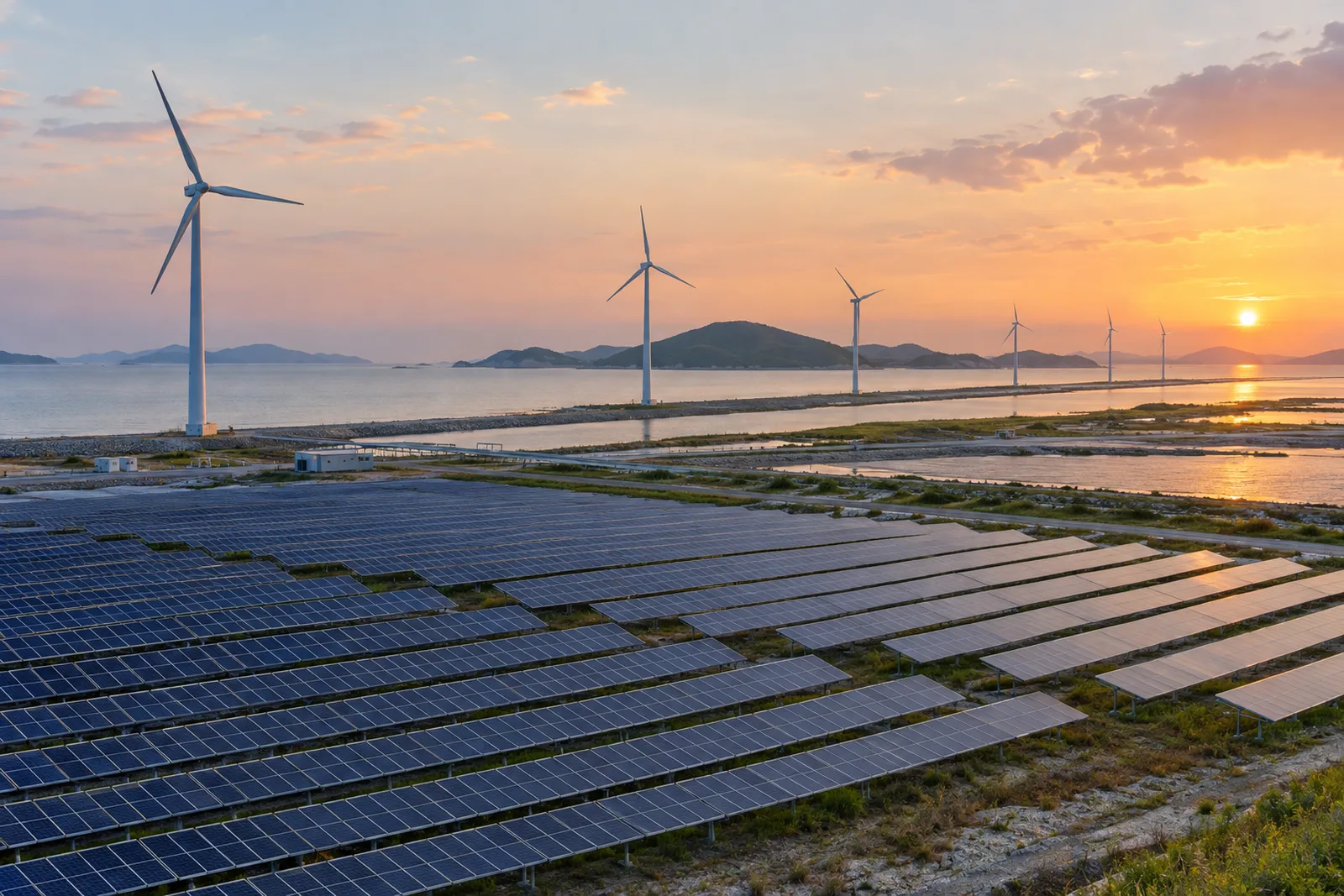
On 21 October 2026, South Korea’s installed renewable energy capacity reached 41,040 megawatts, 283 MW more than the country’s 40,757 MW of coal-fired capacity, the Korea Power Exchange (KPX) said. It is the first time renewables have passed coal on this measure. Renewables now make up 25.4 per cent of all installed generating capacity, second only to liquefied natural gas (LNG) at 46,788 MW.
The gap with gas is narrowing. Between the end of 2020 and the end of 2025, renewable capacity grew by about 3,504 MW a year, around 4.3 times the 807 MW a year added for LNG, pv magazine reported. KPX said that if both trends continue, renewables could become the largest source of installed capacity within two to three years.
Why it matters
South Korea is one of the world’s most industrial economies, with big steel, chip and car industries that need a lot of power. It has long relied heavily on coal and imported gas. Passing coal in capacity is a symbolic moment that reflects more than a decade of building solar farms and, more recently, wind.
The growth is also steadier than it once was. At the pace seen over the past five years, renewable capacity would catch up with LNG around August 2028, Seoul Economic Daily reported. An industry official told the paper that at least 10 GW of renewables would have to come online next year to stay on course for the government’s target.
If this trend continues, renewable energy could surpass LNG and become the largest power source in South Korea in terms of installed capacity within 2–3 years.
Korea Power Exchange, as reported by The Chosun Ilbo
The wider picture
Capacity is not the same as electricity produced. Solar panels only work in daylight and turbines only when the wind blows, so a megawatt of solar produces much less power over a year than a megawatt of coal. Renewables still account for only about 10 per cent of the country’s power generation market, Asia Business Daily reported.
The grid is the biggest worry. There are currently 283 delayed transmission and substation projects, 136 for transmission and 147 for substations, according to Korea Electric Power Corporation data obtained by Democratic Party lawmaker Eoh Kiy-ku, The Chosun Ilbo reported. ‘Special measures must be prepared to resolve the power grid delays,’ Eoh said. Former KPX chairman Cho Young-tak told the paper that complementary infrastructure, such as grids and energy storage, is essential alongside new solar and wind.
The government is responding. It plans to raise transmission-level hosting capacity for renewables from 119 GW to 171 GW by 2030, and KPX opened a tender in September for 1,100 MW of six-hour battery storage on the mainland and 80 MW on Jeju Island, with winners due in November, pv magazine reported.
Could it work elsewhere?
Japan and Taiwan share many of South Korea’s challenges: dense populations, little flat land and heavy industry. In GGND’s view, South Korea’s experience shows that steady, year-after-year building adds up, but also that grid investment has to keep pace, or new solar and wind end up waiting for a connection.
What remains unresolved
- Generation, not just capacity. Coal still produces far more electricity than renewables. The real test is when renewables’ share of power produced catches up.
- The 2030 target. Reaching the government’s goal of 100 GW of renewables by 2030 would need about 15 GW a year from 2027, around four times the recent pace.
- Grid delays. Hundreds of transmission and substation projects are behind schedule, which could hold back new connections.
What happens next
Winners of the battery storage tender are due in November 2026, and from January 2027 grid connection rights will be linked to a reformed renewable portfolio standard, with access granted through competitive bidding, pv magazine reported. GGND will follow whether coal’s share of actual generation starts to fall.
Sources
- Korea Power Exchange Press release: Renewable capacity overtakes coal for the first time (in Korean, 21 October 2026)
- pv magazine South Korea’s renewable energy capacity overtakes coal for first time (23 October 2026)
- The Chosun Ilbo Report on renewables overtaking coal in installed capacity (21 October 2026)
- Seoul Economic Daily Renewables Overtake Coal as Korea’s No. 2 Power Source (21 October 2026)
- Asia Business Daily Report on renewable capacity surpassing coal (21 October 2026)
Analysis and context are by The GGND Team. Where we draw our own conclusions, we say so. To report an error, contact us.