What happened
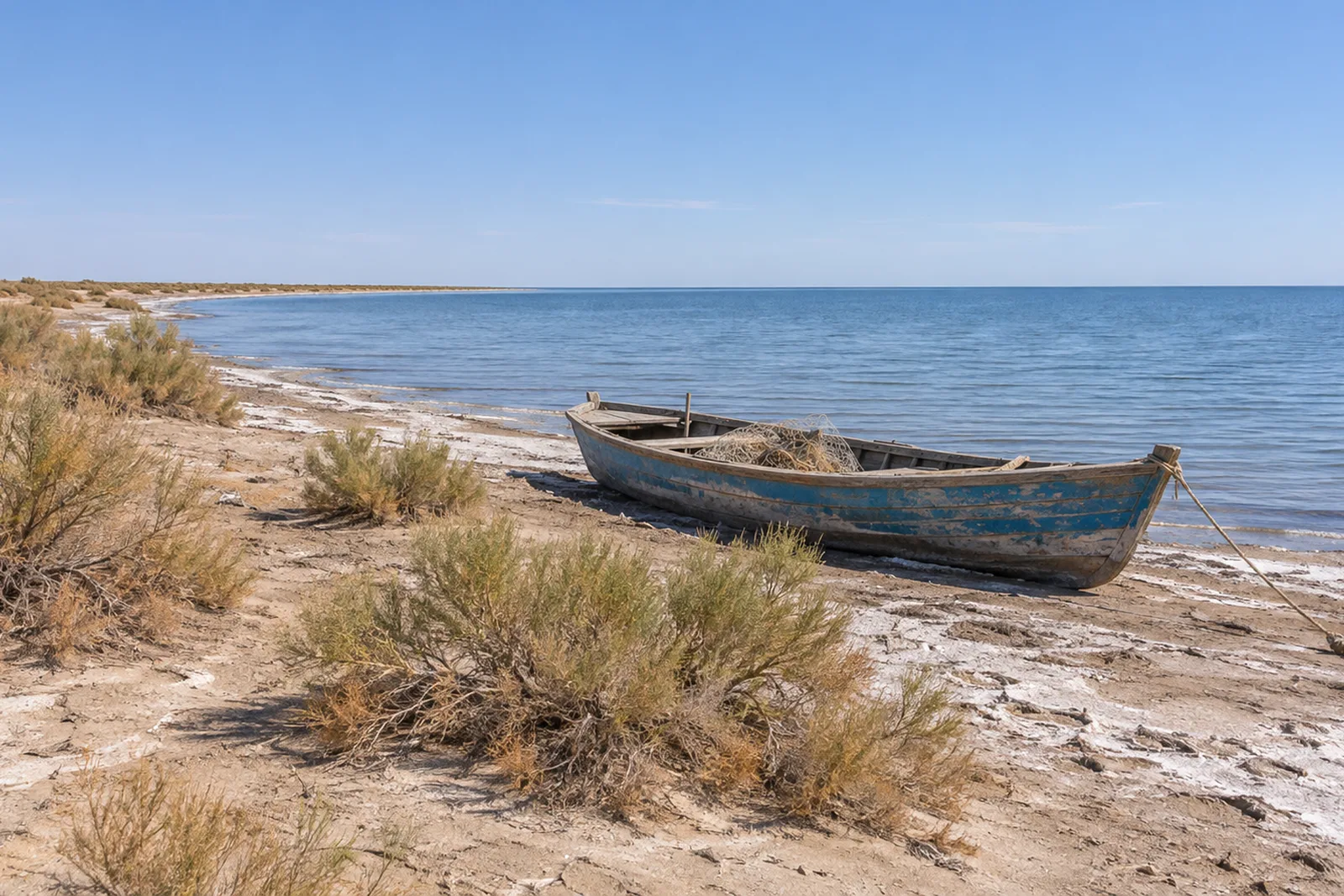
Kazakhstan used the COP31 climate conference in Antalya, Türkiye, to present its work to bring back the North Aral Sea. At a panel at the Kazakhstan pavilion, Vice Minister of Ecology and Natural Resources Mansur Oshurbayev said the sea’s volume had risen from 18.9 billion to more than 23 billion cubic metres in recent years, The Astana Times reported on 10 November.
The government’s official figures show steady growth: 18.9 billion cubic metres in 2022, 21 billion in 2023, 22 billion in 2024 and 23.4 billion by the end of 2025, with about 1.5 billion more cubic metres sent into the sea in 2026. That is a rise of about 24 per cent since 2022, as AnewZ reported. Over two decades, the government says, the northern sea’s surface area has grown by 36 per cent, its volume has nearly doubled and its salinity has halved.
Why it matters
The Aral Sea was once one of the largest lakes in the world. From the 1960s, its feeder rivers, the Amu Darya and the Syr Darya, were diverted to irrigate crops, and the sea began to shrink fast. In 1989 it split into a northern and a southern part, Fergana notes. The disaster ruined fishing towns and left a dry seabed that blows salt and dust across the region.
The turning point for the north was the Kokaral Dam, built with the World Bank, which holds water from the Syr Darya in the northern basin instead of letting it drain away south. According to the Astana Times, Oshurbayev said water projects including the dam have helped preserve the northern part of the sea. In GGND’s view, the North Aral is one of the clearest examples anywhere of a damaged ecosystem recovering because people changed how they manage water.
For Central Asia, climate change adaptation is first and foremost a matter of water.
Mansur Oshurbayev, Vice Minister of Ecology and Natural Resources, Kazakhstan
The wider picture
Kazakhstan now plans a second phase with the World Bank. It would rebuild the Kokaral Dam and raise the water level to 44 metres above sea level. Over the next five to six years, the sea’s surface would grow to about 3,900 square kilometres and its volume to 34 billion cubic metres, the government says. AnewZ reported that the first phase of the wider programme is planned for 2027 to 2030.
Keeping the water coming matters as much as the dam. The Ministry of Water Resources and Irrigation sends at least 2 billion cubic metres a year down the Syr Darya to the sea. More than 160 projects to modernise and automate irrigation in the Turkestan and Kyzylorda regions are meant to save water and send it on to the sea. On the dry seabed, the government says it has sown 3,400 tonnes of saxaul and other seeds and planted 56.2 million saxaul seedlings, with work covering 1.1 million hectares. These hardy shrubs help hold down sand and salt.
Oshurbayev also said: “The history of the Aral Sea illustrates this better than anything else: when a water ecosystem is lost, the stability of the land, climate, human health and the economy of an entire region are also affected.”
Could it work elsewhere?
Other shrinking lakes in dry regions face similar pressures from irrigation and drought. In GGND’s view, the North Aral shows that recovery is possible when a government can hold water in place and agree with upstream neighbours on how much flows down. Kazakhstan signed an agreement with Uzbekistan in 2025 on managing shared water bodies, after ten years of talks, the government says.
What remains unresolved
- Independent checks. The volume figures come from Kazakhstan’s government. Independent measurements, for example from satellites, would make them stronger.
- The southern sea. This recovery concerns only the northern basin. The much larger southern part, mostly in Uzbekistan, is not part of these figures.
- River flows. The sea depends on the Syr Darya, which crosses several countries. Drought or more water taken upstream could reverse the gains.
- Money for phase two. The rebuilt dam and higher water level depend on financing and construction that have not yet begun.
What happens next
The first phase of the wider restoration and irrigation programme is planned for 2027 to 2030, according to AnewZ. At COP31, Oshurbayev called for more international cooperation, climate finance and joint scientific monitoring across Central Asia. GGND will watch whether the 34 billion cubic metre target is reached.
Sources
- Government of Kazakhstan Government intensifies efforts to restore the Aral Sea and preserve the Caspian Sea (7 October 2026)
- The Astana Times Kazakhstan highlights North Aral Sea restoration at COP31 in Türkiye (10 November 2026)
- AnewZ Kazakhstan reports 24% rise in North Aral Sea water volume as restoration advances (10 November 2026)
- Caspian Post Kazakhstan highlights Aral Sea recovery efforts at COP31 (10 November 2026)
- Fergana Kazakhstan plans to raise North Aral Sea level to 44 metres (7 October 2026)
Analysis and context are by The GGND Team. Where we draw our own conclusions, we say so. To report an error, contact us.