What happened
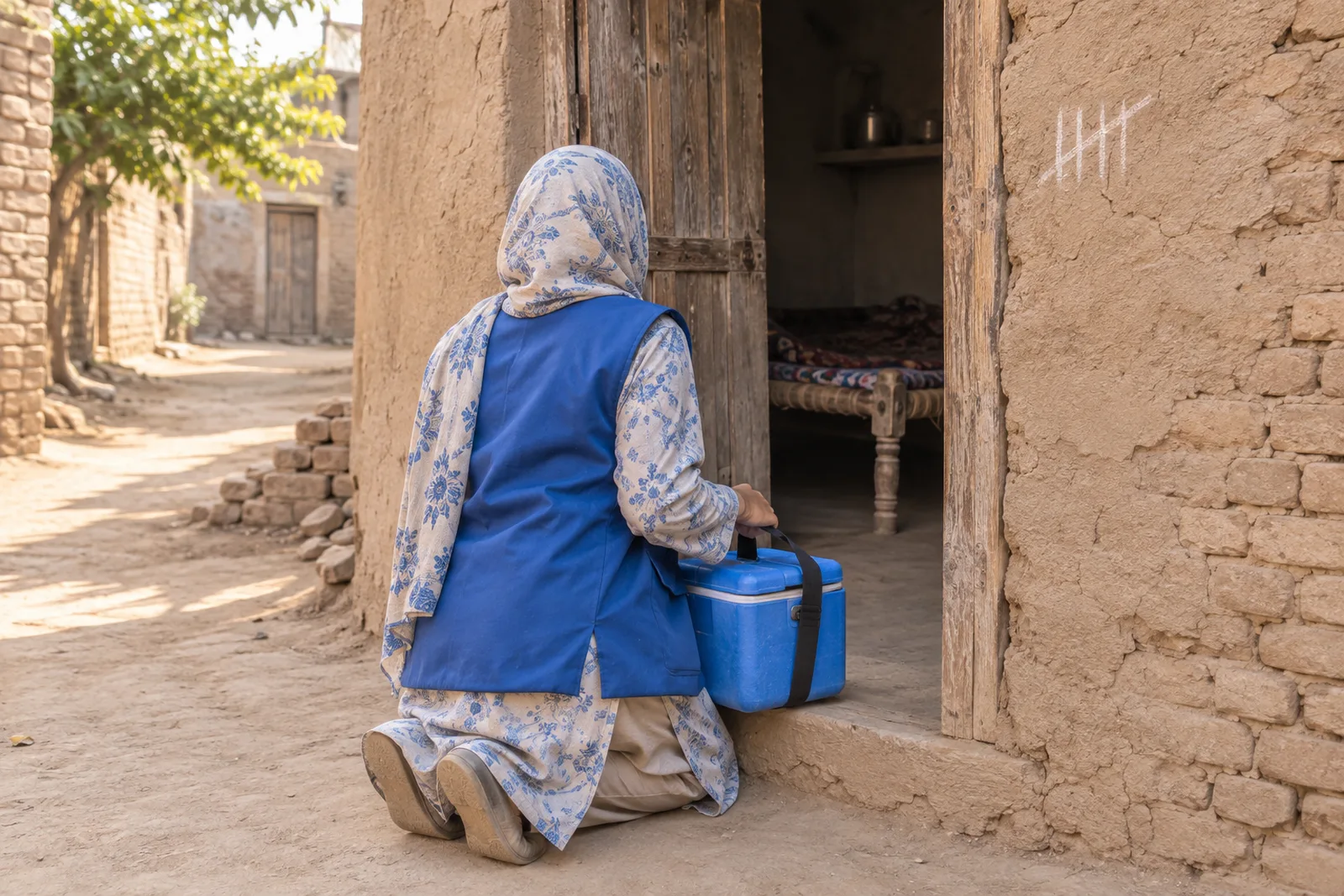
Pakistan has finished a week-long polio vaccination campaign that reached about 24 million children under five in 97 districts, the National Emergency Operations Centre (NEOC) said when it ended on 8 November, as reported by Radio Pakistan. More than 200,000 frontline workers went door to door and also vaccinated children at schools, fixed centres and transit points.
The drive comes as cases fall sharply. Pakistan has reported nine polio cases so far in 2026, seven in Khyber Pakhtunkhwa and two in Sindh, according to the NEOC, reported by Arab News. That compares with 31 cases in 2025. Aziz Memon, who chairs Rotary’s Pakistan National PolioPlus Committee, told The News that cases fell from 74 in 2024 to 31 in 2025 and to “just a handful” this year.
Why it matters
Pakistan and Afghanistan are the last two countries where wild poliovirus is still endemic. Polio can cause lifelong paralysis and has no cure, so vaccination is the only protection. Pakistan has cut paralytic polio by 99.8 per cent since the early 1990s, when it had an estimated 20,000 cases a year, according to the Pakistan Polio Eradication Initiative, reported by Daily Times.
Testing of sewage, which picks up the virus even when no child is paralysed, points the same way. The World Health Organization’s polio Emergency Committee, in a statement published on 13 November, said Pakistan had reported 128 positive environmental samples so far in 2026, compared with 651 in the whole of 2025. It said “the overall trajectory of WPV1 cases and environmental sample positivity is declining”, noted a significant fall in positive samples in Karachi, and praised “strong leadership and high-level commitment” in Pakistan, including from the Prime Minister’s Office. The committee’s figures, gathered for its meeting on 30 September, counted four Pakistani cases at that point; the NEOC has since reported more.
We have the knowledge and tools to deliver on our promise.
Aziz Memon, chair of Rotary’s Pakistan National PolioPlus Committee
The wider picture
The campaign’s reach was broad. Daily Times, citing the Polio Eradication Initiative, reported about 9.2 million children vaccinated in 13 districts of Punjab, 7.1 million in 20 districts of Sindh, 4.7 million in 27 districts of Khyber Pakhtunkhwa and 2.2 million in 31 districts of Balochistan, with smaller numbers in Islamabad, Gilgit-Baltistan and Azad Jammu and Kashmir. In Sindh, health officials said the campaign met more than 98 per cent of its household vaccination targets, Dawn reported. Memon credited stronger local leadership and Pakistan’s investment in female frontline health workers for helping to curb transmission.
The WHO committee was clear that the job is not done. It said transmission remains intense in southern Khyber Pakhtunkhwa, where “significant operational and security challenges” make good campaigns hard, and that local transmission persists in parts of Karachi, which “do not yet reflect eradication-level programme quality”. It warned that district-level quality is still uneven because of vaccine hesitancy in some communities and insecurity in Khyber Pakhtunkhwa and Balochistan. Across the border, Afghanistan has reported 25 cases this year, more than in all of 2025, and has not run house-to-house campaigns since October 2024.
Memon put it simply: “the road to ending polio is not linear”. He listed conflict, reduced funding, misinformation, waning vaccine confidence and climate-related disasters among the hurdles.
Could it work elsewhere?
In GGND’s view, the most transferable lessons are two: sewage testing, which shows where the virus is hiding before children fall ill, and a workforce of local women who can enter homes that outsiders cannot. Both are being used against other diseases. The harder lesson is that eradication needs neighbouring countries to move together, because the virus does not stop at the border.
What remains unresolved
- Southern Khyber Pakhtunkhwa. The most intense transmission is in areas where insecurity limits access to children.
- Afghanistan. Rising cases there, and the lack of house-to-house campaigns, put the shared border region at risk.
- Coverage claims. The 24 million figure is reported by the programme itself. The WHO says national figures look strong but quality varies by district.
- The 2026 target. The global goal is to interrupt wild polio transmission in 2026. In GGND’s view, with cases still being reported in both countries, that deadline now looks out of reach.
What happens next
The NEOC says every child under five must get drops in each campaign, even if vaccinated before, and has urged parents to complete routine immunisation. In Karachi, a follow-up routine vaccination drive ran in 121 union councils from 10 to 14 November. The real measure will be whether 2027 brings the first year without a case.
Sources
- World Health Organization Statement of the Forty-sixth Meeting of the Polio IHR Emergency Committee (13 November 2026)
- Radio Pakistan Week-long polio campaign ends with 24 million children vaccinated (8 November 2026)
- Arab News Pakistan Pakistan reports ninth polio case of 2026 as vaccination drive continues (5 November 2026)
- The News Pakistan saw 75pc drop in polio cases this year, but hurdles remain (13 November 2026)
- Daily Times Pakistan reaches over 24 million children in nationwide polio drive (13 November 2026)
- Dawn 7.1m children vaccinated across Sindh in anti-polio drive (12 November 2026)
Analysis and context are by The GGND Team. Where we draw our own conclusions, we say so. To report an error, contact us.