What happened
More than half a million new battery storage systems, with a combined capacity of about 8.2 gigawatt-hours, were put into operation in Germany in the first nine months of 2026, the German Solar Association (BSW-Solar) said on 22 October, based on its analysis of Federal Network Agency data. That is 91 per cent more new capacity than in the same period of 2025.
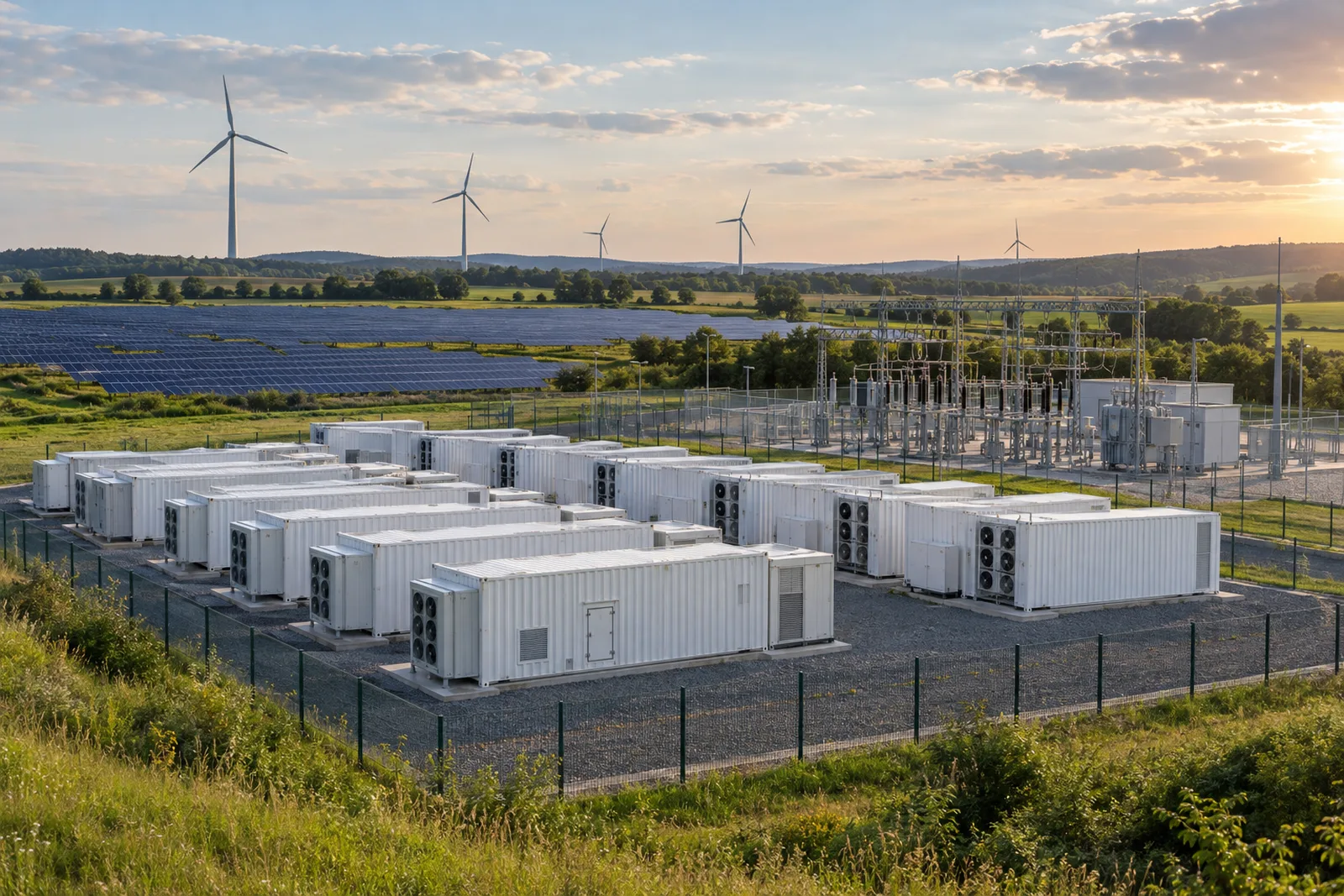
Large grid-scale batteries drove the growth. Their additions more than quadrupled, up about 350 per cent to around 3.8 GWh, and made up roughly half of all new capacity. Home storage grew 20 per cent to 3.2 GWh, commercial storage 67 per cent to about 0.7 GWh, and small units, often paired with plug-in balcony solar panels, 33 per cent to about 0.5 GWh, ESS News reported. The figures reflect registrations up to 12 October, and late entries usually push them higher. The association expects well over 10 GWh for the full year.
Why it matters
Germany produces so much solar power on sunny days that supply often outstrips demand. By 27 September, solar output in 2026 had already passed the whole of 2025, at 90.2 terawatt-hours, Clean Energy Wire reported via RenewEconomy. The same report noted rising hours of negative wholesale prices and more curtailment, when wind or solar plants are switched off because the grid cannot take the power.
Batteries store that surplus and release it in the evening or when the wind drops. According to calculations by the Fraunhofer Institute for Energy Economics and Energy System Technology (IEE), cited by BSW-Solar, an extra 80 GWh of battery storage could have saved consumers and the federal budget nearly 4 billion euros in 2025 alone. A second Fraunhofer IEE study found that batteries at substations could unlock unused grid capacity, under the conditions studied allowing up to twice as much solar to connect to existing distribution networks, the association said.
Battery storage systems are becoming a growth driver and a key lever for efficiency in the energy transition.
Carsten Körnig, Managing Director, German Solar Association (BSW-Solar)
The wider picture
The industry says the boom is not yet big enough. Fraunhofer scientists estimate that four to five times as much additional flexibility would be needed every year until 2030 to integrate planned renewables at the lowest cost. BSW-Solar has published 15 reform proposals, Clean Energy Wire reported, centred on three: a right to fair and flexible grid connection agreements so batteries can share connections with solar and wind farms; tenders by distribution grid operators for batteries at substations; and changes to congestion management so surplus solar can be stored instead of switched off.
Policy is contested. Germany’s coalition is debating rules that would cut support for small rooftop solar and reduce incentives for new projects in congested grid areas, which researchers and industry have criticised as a risk to investment, RenewEconomy reported. The market is not without casualties either: German battery storage manufacturer Sonnen filed for insolvency on the same day as the figures were released, while saying it would keep serving its more than 150,000 customers, ESS News reported.
Could it work elsewhere?
Any grid with a lot of solar faces the same midday glut. In GGND’s view, Germany’s experience shows two things: households will buy batteries alongside rooftop panels, but the biggest gains come from large batteries placed where the grid is congested, and that depends on connection rules more than on technology. Countries planning solar growth can write storage and flexible connections into grid rules from the start.
What remains unresolved
- Enough, fast enough. Annual additions would need to rise several times over to meet the flexibility Fraunhofer says is required by 2030.
- Grid connections. Whether parliament adopts fair, flexible connection rules in the upcoming grid package and Renewable Energy Sources Act reform is still open.
- No national target. BSW-Solar says the government has no clear lead ministry, binding storage targets or overall storage strategy.
- Counting. The figures come from an industry association’s reading of registry data and will change as late registrations arrive.
What happens next
Lawmakers are working on the grid package and changes to the Renewable Energy Sources Act, where BSW-Solar wants its proposals included. GGND will check the full-year figures in early 2027 to see whether storage additions top 10 GWh.
Sources
- Bundesverband Solarwirtschaft (BSW-Solar) Batteriespeicher-Zubau in Deutschland steigt um 91 Prozent (22 October 2026)
- Clean Energy Wire Battery storage deployment in Germany up 91%, reforms needed to maintain momentum – solar industry (22 October 2026)
- ESS News Germany’s battery storage additions surge to 8.2 GWh in first nine months of 2026 (22 October 2026)
- RenewEconomy (Clean Energy Wire) Germany smashes PV record, produces three times more solar power than Australia so far this year (29 September 2026)
Analysis and context are by The GGND Team. Where we draw our own conclusions, we say so. To report an error, contact us.