What happened
At its 46th meeting in Songdo, South Korea, from 26 to 29 October 2026, the Green Climate Fund approved the Fiji Coral Reef Resilience Project, with WWF as the accredited entity, the fund’s board records show. The fund is providing US$35.2 million, and a further US$7.4 million comes from the Government of Fiji, the Government of Australia and WWF, bringing the total to US$42.6 million, Fiji’s Ministry of Environment and Climate Change and WWF-Pacific said in a joint statement. They called it the country’s largest investment to date in nature-based approaches to coastal resilience.
Over 10 years the project plans to restore 835 hectares of mangroves and 2,524 hectares of riparian forest, build living shorelines, set up a management plan across 20 customary fishing grounds, or qoliqoli, and create a US$1.5 million fund for at least 12 community-designed adaptation projects. It will also support 50 reef-positive enterprises, including women-led businesses.
The approval was part of a record board meeting. The fund approved 21 projects worth US$1.97 billion, the largest total at a single meeting, taking 2026 approvals to US$3.3 billion, PINA reported from the fund’s release. Reuters put the year’s total at US$3.2 billion, citing the fund’s executive director, Mafalda Duarte.
Why it matters
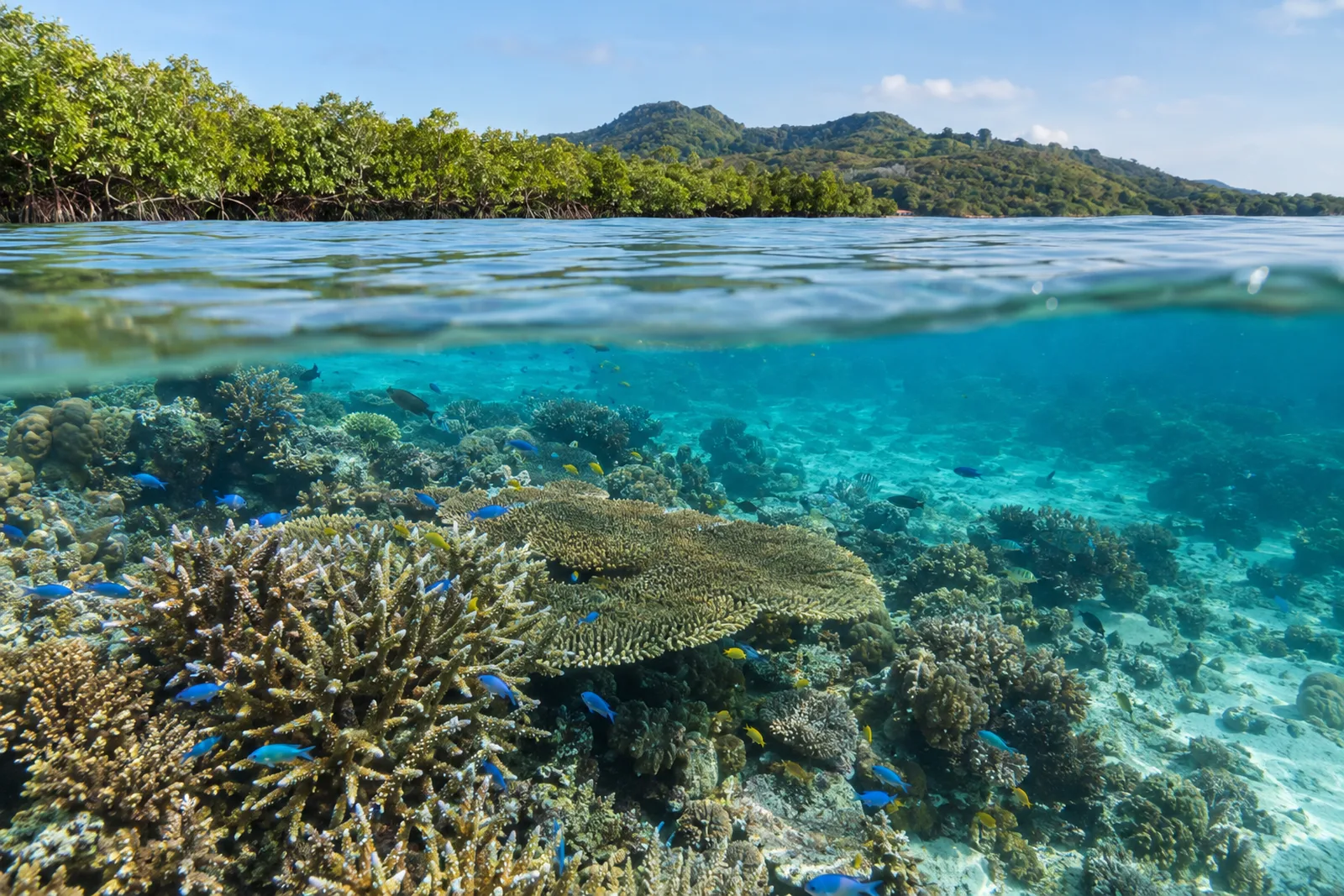
The Great Sea Reef stretches more than 275 miles along the western coasts of Vanua Levu and Viti Levu. It is home to 55 per cent of Fiji’s fish species and 74 per cent of its coral species, and can reduce wave energy by up to 97 per cent, according to the ministry and WWF. More than 75 per cent of Fijians live along the coast, and cyclones and floods cost the country more than US$500 million a year. The reef underpins an estimated 65 per cent of Fiji’s export earnings and 20 per cent of national GDP, while coral bleaching, overfishing, coastal development and sediment runoff are putting it under mounting pressure.
For many villages the link is direct. Emosi Rotokala, head of the environment committee in the district of Sasa in Macuata, said most households depend on fishing in their qoliqoli ‘to meet their daily needs, support family welfare, fund education, and contribute to community development’.
The project aims to raise fish biomass by 20 per cent, lower flood exposure for more than 74,000 people and avoid US$9 million in flood losses. It expects to benefit 121,358 people directly, about 13 per cent of the population. The fund’s regional director for Asia and the Pacific, Hemant Mandal, said the project would benefit 40 per cent of the population, PINA reported, a figure that appears to include indirect beneficiaries.
Community leaders welcomed the approach. Mere Colavatu, the Mali District Women’s Representative from Nakawaga Village in Macuata, said climate change was already affecting their shores, but ‘our communities also hold knowledge and solutions’.
The approval of this programme follows seven years of effort to get to this point.
Dr Sivendra Michael, Permanent Secretary, Fiji Ministry of Environment and Climate Change
The wider picture
Fiji is set to benefit from two other approvals at the same meeting: a regional Pacific programme to strengthen climate-resilient infrastructure across 14 island countries, and the women-led Matanataki Pacific Fund 1 for businesses in Fiji, Tonga and Vanuatu, FBC News reported.
The reef project builds on almost two decades of WWF work with communities along the Great Sea Reef. Ratu Semi Ramatai, chief of Nabouwalu Village in Bua, called the reef ‘our food source, our protection and part of who we are’, the statement said.
Could it work elsewhere?
The ridge-to-reef idea is simple: stop mud and pollution at the source on land, restore the coastal forests that buffer storms, and let communities manage their own fishing grounds. In GGND’s view, the locally led adaptation fund is the part most worth copying, because it gives money directly to the people who know the coast best.
What remains unresolved
- Warming seas. Coral bleaching is driven by global ocean heating. Local restoration can make a reef more resilient, but it cannot stop marine heatwaves.
- Different numbers. Official statements give 13 per cent and 40 per cent of the population as beneficiaries, and the preparation period as both seven and nine years. Results reporting will need to be clear about what is counted.
- Delivery. The money is spread over a decade and runs through government, WWF and many local partners. Large climate projects often start slowly.
- Funding pressure. Reuters reported that richer countries are reluctant to commit more money as the fund prepares to raise new resources, which could affect future Pacific projects.
What happens next
WWF-Pacific will lead implementation with the ministry, divisional forest offices, provincial authorities and iTaukei institutions, and a dedicated Great Sea Reef Management Unit will be set up within the ministry. GGND will follow the first mangrove plantings and community grants.
Sources
- Green Climate Fund Forty-sixth meeting of the GCF Board (B.46), 26–29 October 2026
- The Fiji Times (Ministry of Environment and Climate Change and WWF-Pacific) $95m project to protect Great Sea Reef (October 2026)
- PINA Fiji secures US$35.2m GCF grant to protect Great Sea Reef (29 October 2026)
- PINA GCF financing tops USD$3 billion for consecutive record year as reforms continue to deliver (30 October 2026)
- FBC News Fiji to benefit from major climate investments (29 October 2026)
- Reuters (via Yahoo Finance) Green Climate Fund approves record near $2 billion funding (29 October 2026)
Analysis and context are by The GGND Team. Where we draw our own conclusions, we say so. To report an error, contact us.