What happened
Malawi’s nationwide measles-rubella campaign reached more than 5.8 million children and achieved its national target, the World Health Organization said on 30 October 2026. The campaign was launched in Blantyre by the Minister of Health, Madalitso C. Baloyi, with the WHO Representative, Dr Charles Kuria Njuguna, and the Mayor of Blantyre, Isaac Jomo Osman.
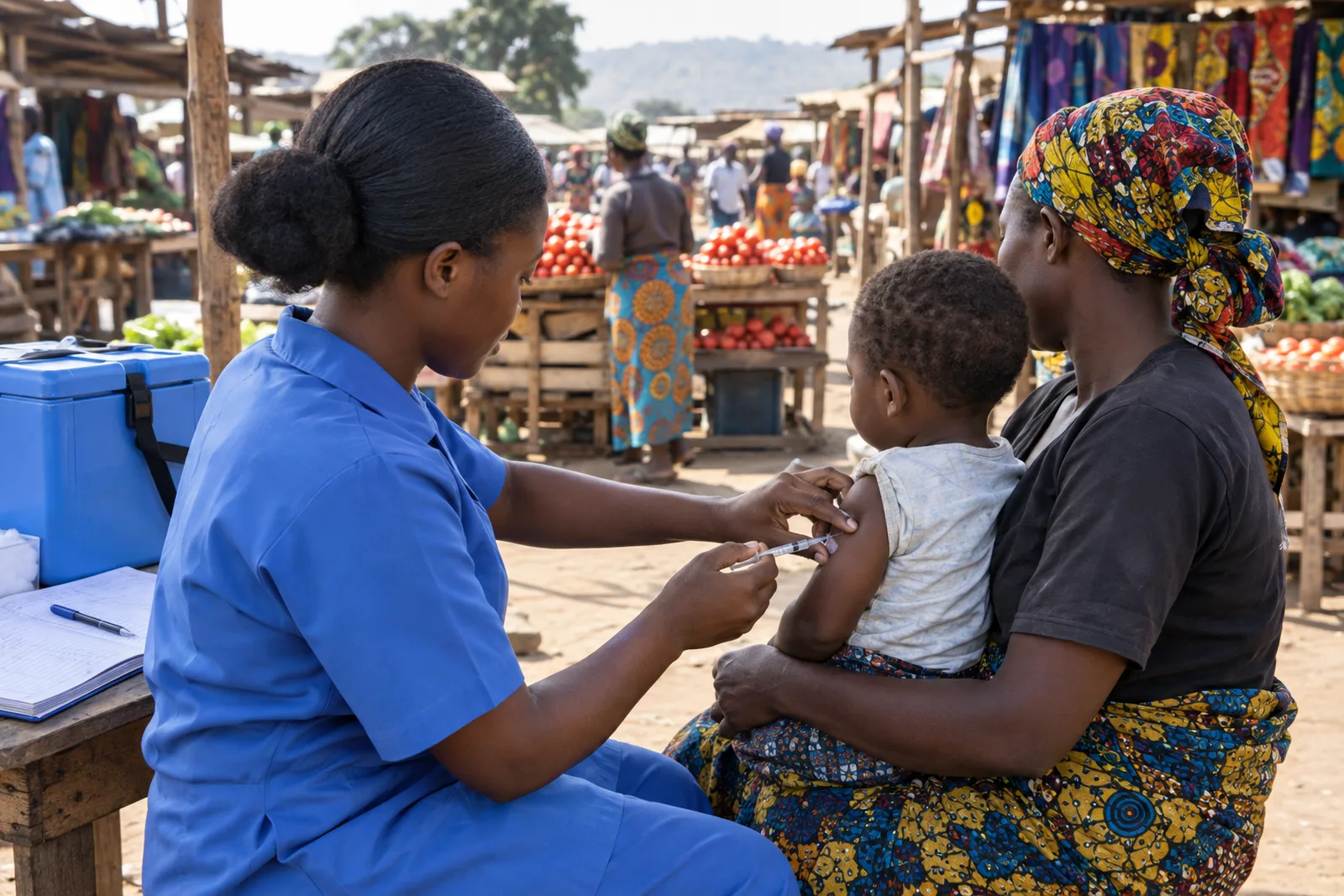
The five-day drive ran from 21 to 25 September and offered measles-rubella vaccine to every child aged nine months to nine years, whatever their previous vaccination status, The Times reported, plus vitamin A for children aged 12 to 59 months, according to Nyasa Times. WHO said teams reached remote communities on Likoma Island and in the hard-to-reach riverine areas of Traditional Authority Nyachikadza in Nsanje District, using schools, markets, lorry stations and places of worship as vaccination sites.
The measles results came in the same week as two other WHO reports from Malawi. A fourth national polio round, run from 11 to 14 August with the novel oral polio vaccine type 2, vaccinated 7,368,425 children, WHO said on 29 October. And a second-dose oral cholera vaccine campaign in five high-risk areas of Blantyre reached 186,108 people in August, before the Ministry of Health declared the 2025–2026 cholera outbreak over on 31 August, according to WHO.
Why it matters
Measles is one of the most contagious diseases in the world, and Malawi has had outbreaks since 2024. As of June 2026 the country had recorded more than 200 confirmed cases, with Nsanje, Chikwawa, Balaka, Lilongwe and Kasungu worst hit, Nyasa Times reported. Dr Jane Dzoole, deputy manager of the national immunisation programme, said routine coverage needs to exceed 95 per cent to close the gap, but has hovered between 80 and 85 per cent in recent years.
In Nsanje alone, the district had recorded 378 measles cases and two deaths shortly before the campaign, and about 118,000 children were targeted there, The Times reported. Vaccination posts were set up in places such as Bangula Old Market, so that mothers did not have to leave the market to find healthcare, while trained Red Cross volunteers went house to house.
The money behind the drives was modest by global standards. WHO deployed USD 1.5 million through a polio outbreak grant to support planning, logistics, monitoring and supervision across all districts, it said, and mobilised USD 120,933 for the Blantyre cholera campaign, which targeted the high-risk areas of Chemusa, Chirimba, Chilobwe, Suya and Mpemba. For the measles campaign, WHO said it supported emergency operations, real-time data systems and supervision, working alongside UNICEF, Gavi, Nutrition International, the Malawi Red Cross Society and JSI.
Rubella is usually mild in children, but infection in pregnancy can cause congenital rubella syndrome and serious birth defects. Vaccinating young children also protects the mothers and babies around them.
Parents in Nsanje described why they came forward. ‘I thought it wise to vaccinate my child to protect her from getting the disease and contain it from further spread,’ Fania Peterson from Nyanthana Village told The Times.
We want to ensure that no child or community member is left behind because of disability, gender, location, social status, distance or other barriers.
Chisomo Kamwendo, Malawi Red Cross Society District Manager for Nsanje, speaking to The Times
The wider picture
The last catch-up campaign, in 2023, is a useful warning. It reported administrative coverage of 82.4 per cent, with only five districts reaching the 95 per cent target, and a later survey put real coverage at 75.7 per cent, Nyasa Times reported. This year’s campaign was designed to do better, with real-time monitoring and supervision supported by WHO and a K600 million contribution from the Malawi Red Cross Society.
The polio and cholera results point the same way. Twenty-two of Malawi’s 29 districts passed the quality checks known as Lot Quality Assurance Assessment after the polio round, WHO said, and the cholera epidemic curve declined steadily after vaccination, Channel Africa reported.
Could it work elsewhere?
The methods are not new, but they are often skipped: detailed local planning, vaccination where people already gather, and trusted local volunteers. In GGND’s view, Malawi’s lesson is that reaching the last island or marsh village is mostly a question of planning and boats, not new technology.
What remains unresolved
- Administrative numbers. The polio round reported 104 per cent coverage, which usually means the official population estimates are too low. Independent post-campaign surveys will give the true picture.
- Measles survey results. WHO has not yet published a coverage survey for the measles-rubella campaign, and the 2023 campaign showed that reported and real coverage can differ by several points.
- Routine vaccination. Catch-up campaigns buy time. Unless routine coverage rises from 80–85 per cent towards 95 per cent, immunity gaps will open again.
- Outbreaks still under way. The Ministry of Health has said some districts are still recording unusually high numbers of measles cases, The Times reported.
What happens next
Health officials will be watching measles case numbers over the coming months to see whether transmission falls, and post-campaign surveys should show how many children were truly reached. GGND will follow the survey results and Malawi’s progress towards its goal of eliminating measles and rubella.
Sources
- WHO Regional Office for Africa No Child Too Far: How Malawi Reached Communities Beyond Roads, Rivers and Distance (30 October 2026)
- WHO Regional Office for Africa Malawi delivers strong fourth round polio campaign, reaching more than 7.3 million children (29 October 2026)
- WHO Regional Office for Africa From Outbreak Response to Long-Term Protection: Blantyre Achieves Full Coverage in Preventive Cholera Vaccination Campaign (30 October 2026)
- Nyasa Times Malawi launches drive to close measles immunity gap ahead of nationwide campaign (17 September 2026)
- The Times (Malawi) Vaccines beyond the hospital (25 September 2026)
- Channel Africa Malawi declares end to cholera outbreak after vaccination drive (30 October 2026)
Analysis and context are by The GGND Team. Where we draw our own conclusions, we say so. To report an error, contact us.