What happened
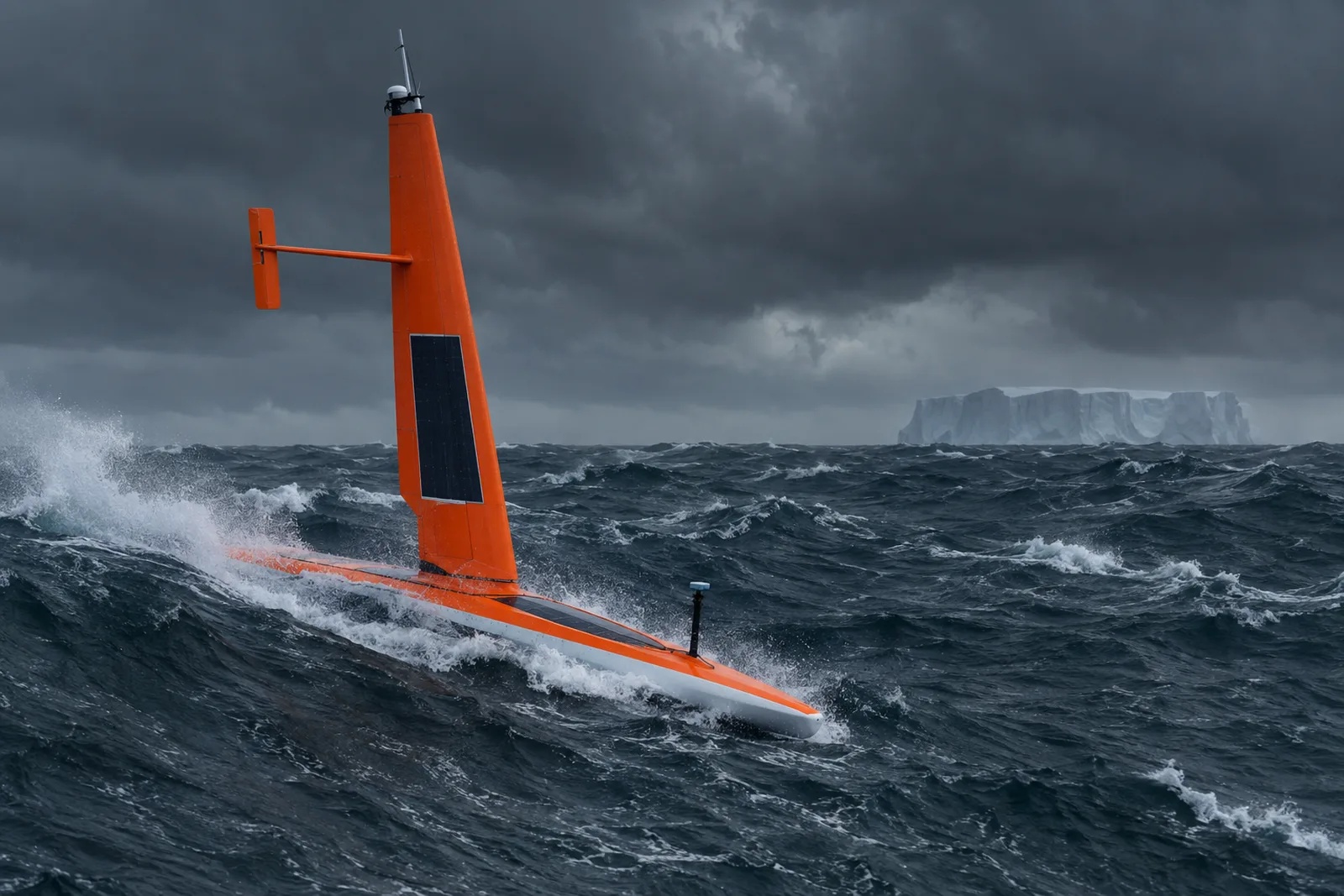
In September, the first of four uncrewed, wind-powered Saildrone Explorers left Hobart, Tasmania, to begin a five-year mission circling Antarctica. The project, Constraining Ocean Carbon with Optimized Observing (COCO2), is led by researchers at the US National Oceanic and Atmospheric Administration (NOAA), Columbia University and Australia’s national science agency CSIRO, NOAA’s Pacific Marine Environmental Laboratory (PMEL) says. Partners include the University of Washington, South Africa’s Council for Scientific and Industrial Research (CSIR), the Australian Antarctic Program Partnership, Schmidt Sciences and Saildrone, which builds the vehicles.
The drones sail on wind power and run their instruments on solar power, sending data back in near real time. Each will measure the carbon dioxide passing between air and sea, along with wind, air pressure, sunlight, humidity, air and sea temperature, salinity, chlorophyll and dissolved oxygen. After each lap of Antarctica, a drone returns to Hobart for repairs and new sensors and then sets off again, CSIRO says.
Why it matters
The ocean absorbs about a third of the carbon dioxide that goes into the atmosphere each year, and scientists estimate that the Southern Ocean accounts for about 40% of that, according to NOAA. Yet it is one of the least measured places on Earth, especially in winter, when storms and ice keep research ships and cargo vessels away. “Saildrones will give us unprecedented coverage of regions that we can’t get to with research vessels or commercial ships in winter,” said CSIRO scientist Elizabeth Shadwick, as quoted by Astrobiology Web.
Winter is exactly when surprises happen. A 2019 Saildrone mission, the first uncrewed circumnavigation of Antarctica, confirmed that in winter, deep water rich in carbon dioxide can churn to the surface and release the gas instead of absorbing it, NOAA says. Getting this right changes how much carbon the world believes the ocean can soak up.
With COCO2 we are filling a critical knowledge gap by adding observations during winter — something we have not been able to do with traditional oceanographic tools.
Adrienne Sutton, NOAA Pacific Marine Environmental Laboratory
The wider picture
The data will feed directly into the Global Carbon Budget, the annual assessment of how much carbon dioxide humans emit and how much land and oceans take up, Columbia Climate School says. Data also go to the World Meteorological Organization’s Global Telecommunication System for use in weather models.
The routes are not fixed. AI-driven ocean and atmosphere models will steer the fleet towards high-value areas. “We will be able to make adjustments over the course of the five-year mission to target data collection in the regions that are most needed to better understand the ocean carbon sink,” said Professor Galen McKinley of Columbia University, as quoted by CSIRO. In South Africa, scientists at CSIR’s Southern Ocean Carbon-Climate Observatory will use the data to track how individual storms drive carbon in and out of the ocean, CSIR says.
Could it work elsewhere?
Because the drones need no crew or chartered ship, the approach can continue through the southern winter and be scaled to cover far more ocean than ship campaigns, Columbia says. In GGND’s view, that matters well beyond Antarctica: many remote waters, from the high Arctic to the open Indian Ocean, are just as poorly measured.
What remains unresolved
- A fleet still being built. Only one drone is at sea so far. The others are due to follow at roughly three-month intervals, and partners describe the timing slightly differently.
- Surviving the Southern Ocean. The 2019 drone completed its voyage despite hitting an iceberg that wrecked some of its sensors, NOAA recalls. Losses or damage could leave gaps.
- Small numbers, huge ocean. Four drones will help, but they will still sample only a sliver of the Southern Ocean at any one time.
- Details that differ. Partners give slightly different launch dates (19 or 20 September) and distances per voyage (about 22,000 to 24,000 kilometres).
What happens next
The first drone is expected back in Hobart after roughly 200 days at sea, Saildrone says, and the 2026 Global Carbon Budget is due in November. “Getting the ocean’s carbon balance right is urgently important,” Sutton said. GGND will follow the fleet as it grows, and what its winter readings reveal.
Sources
- NOAA Pacific Marine Environmental Laboratory Saildrone research fleet to circle Antarctica for 5 years (October 2026)
- CSIRO Ocean drones set to brave the Southern Ocean for science (September 2026)
- Columbia Climate School Robot sailboats will spend five years measuring carbon in the Southern Ocean (24 September 2026)
- CSIR (South Africa) Saildrone ahoy: ocean scientists prepare to crunch data for global carbon budget (October 2026)
- Saildrone Saildrone embarks on a multiyear expedition to monitor carbon exchange in the Southern Ocean (2026)
- Astrobiology Web Icy ocean planet recon: Saildrone research fleet to circle Antarctica for 5 years (21 October 2026)
- NOAA PMEL Saildrone is first to circumnavigate Antarctica, in search for carbon dioxide (2019)
Analysis and context are by The GGND Team. Where we draw our own conclusions, we say so. To report an error, contact us.