What happened
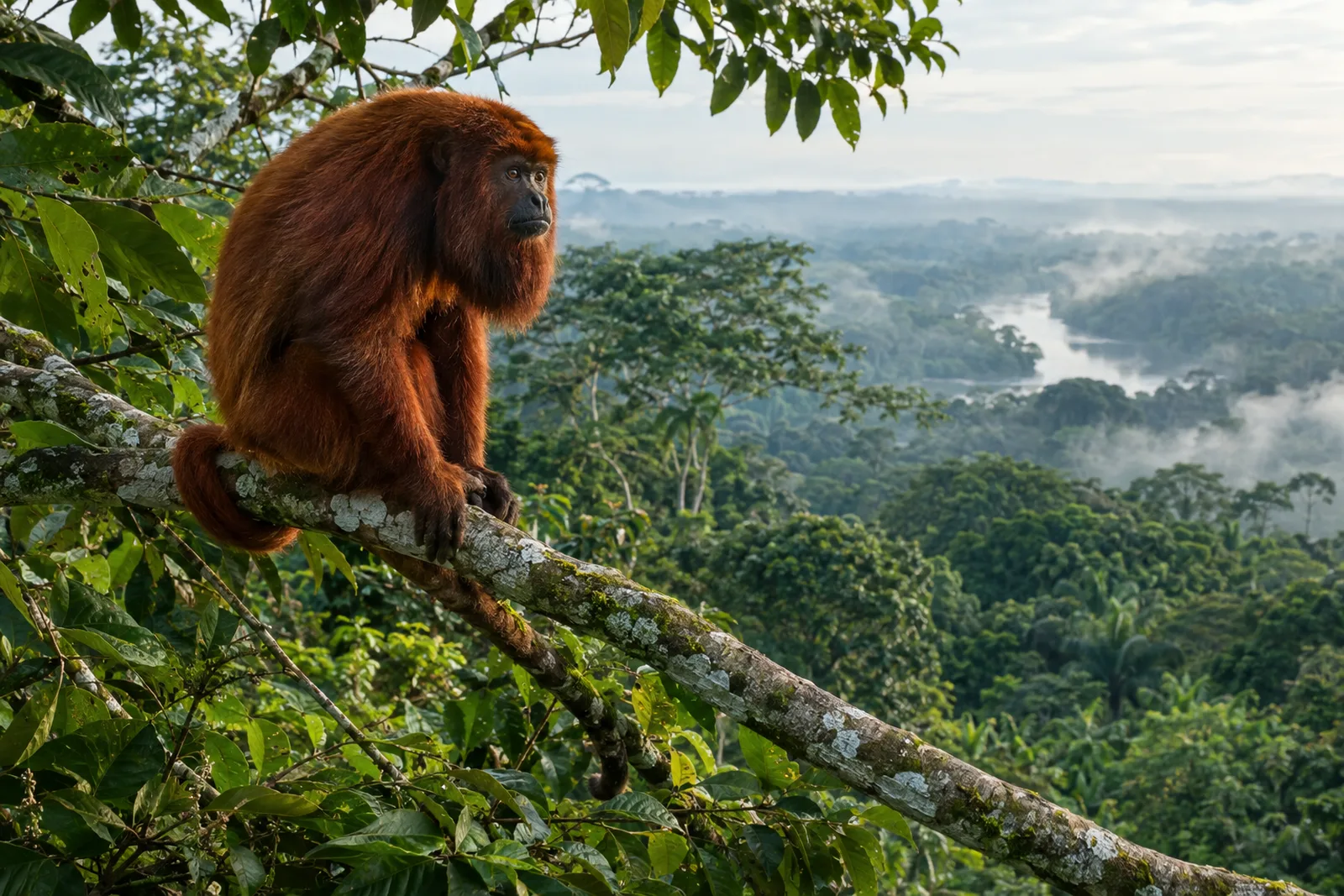
Howler monkeys are among the loudest and best-known animals of the American tropics, and yet scientists have just found two species nobody knew existed. An international team published a genome-wide study of the genus Alouatta in the journal Communications Biology on 30 October. It formally describes the Pantepui red howler (Alouatta iroi) and the Mato Grosso red howler (Alouatta matogrossensis).
The work was led by researchers at the University of Salford in England, who analysed the genomes of 11 howler monkey species from South and Central America and combined them with measurements of museum specimens, the university said on 4 November. The team sequenced more than 80 individual animals, from Central America to Argentina, G1’s Terra da Gente reported. The paper has 41 authors from several countries, according to the Brazilian environmental news site ((o))eco.
The Pantepui red howler lives in northern Amazonia, in Brazil, Guyana and Venezuela, according to the Bavarian State Natural History Collections (SNSB), whose Munich zoology collection supplied specimens. Its range is bounded by the Negro, Branco and Cauaburi rivers, and the reference specimen came from near the Serra do Aracá in Amazonas state. It has a bright yellow to golden back. The Mato Grosso red howler, with vibrant reddish-brown fur, lives in southern Amazonia between the Madeira and Teles Pires rivers, reaching the edge of the Cerrado savanna, G1 reported.
Why it matters
It is the first time a new howler species has been described since Alouatta puruensis in 1941, according to the University of Salford. You cannot protect a species that science does not know exists. The researchers say the work helps close two long-standing gaps: how many species there are, and where they live.
The timing is pressing. The Mato Grosso red howler’s range overlaps the so-called Arc of Deforestation, where farming is pushing into the forest. Salford describes it as one of the world’s fastest-deforesting regions. The authors write that its conservation status should be assessed urgently, because it is likely to be classified as Critically Endangered, ((o))eco reported. Fabiano Melo, a primatologist at the Federal University of Viçosa and a co-author, told ((o))eco that because the species lives in the Arc of Deforestation, an assessment and conservation strategies are needed immediately.
The study’s abstract notes that 11 of the 16 howler taxa recognised until now are already listed as threatened by the IUCN. In GGND’s view, naming these two species is good news because it gives conservation groups something precise to protect, before more of their forest is lost.
This discovery comes at a critical time, as increasing deforestation, climate change and habitat loss threaten many Amazonian species before they are fully understood or even discovered by science.
Professor Jean Boubli, University of Salford
The wider picture
The genomes also tell a story about how the Amazon became so rich in life. Big rivers such as the Amazon, the Rio Branco and the Xingu have acted as barriers for long periods, keeping populations apart until they became separate species, Salford said. Most of the Amazonian howler diversity arose within the last million years, according to the paper. Transitions between forest and open savanna also seem to have played a part, a researcher at Brazil’s National Institute of Amazonian Research (INPA) told G1.
The study also tidies up the family tree. A. puruensis is now treated as the same species as A. juara, A. discolor takes the name A. tapajozensis, and the authors recommend recognising the howlers of Trinidad as a separate species, A. insulanus, G1 reported. Museum collections were essential. “Our study shows once again how important large scientific collections are for assessing the current state of life on our planet,” said co-author Anneke van Heteren of SNSB.
“Our study shows that the Amazon still holds remarkable biological secrets, even among well-known animals such as howler monkeys,” said Dr Romina Batista of the University of Salford, the paper’s first author.
Could it work elsewhere?
The approach can travel. Cheaper genome sequencing, combined with old specimens in museum drawers, is revealing hidden species in many groups of animals. In GGND’s view, the howler study shows the value of pairing new DNA data with long-term collections, and of funding the taxonomists who do this slow work. Researchers at Portugal’s CIBIO-BIOPOLIS, part of the team, stressed the need for more taxonomists, Observador reported.
What remains unresolved
- No Red List status yet. Neither new species has been assessed by the IUCN. Until it is, the Mato Grosso red howler has no formal threat category, even though the authors expect it to be Critically Endangered.
- Forest loss. Much of the Mato Grosso red howler’s range is farmland frontier. Without protection on the ground, the name alone will not save it.
- A planned dam. The Pantepui red howler lives in a well-preserved part of the Amazon, but the researchers point to the planned Bem-Querer hydroelectric plant on the Rio Branco, and to future climate change, as threats, ((o))eco reported.
- Population size. The study maps where the species live, not how many animals there are. Field surveys will be needed.
What happens next
The researchers hope the findings will help conservation organisations identify the most vulnerable populations and prioritise protection across the Amazon Basin, Professor Boubli said. Some help is already in place. The Reconecta Project, led by conservationist Fernanda Abra, works to reduce road deaths of tree-dwelling animals by reconnecting forest fragments, which can help the Mato Grosso red howler, Salford said. And at Fazenda Anacã in Alta Floresta, Mato Grosso, the farm whose records provided the species’ type locality, the new howler already lives in protected forest and is followed by a local wildlife monitoring project, G1 reported.
Sources
- Communications Biology Genome-wide analyses reveal recent diversification and hidden diversity in Amazonian howler monkeys, including two new species (30 October 2026)
- University of Salford Scientists discover two new species of howler monkey (4 November 2026)
- SNSB – Bavarian State Natural History Collections Scientists Discover New Species of Howler Monkeys (5 November 2026)
- ((o))eco Estudo genético revela duas novas espécies de bugios no Brasil (3 November 2026)
- G1 – Terra da Gente Estudo revela duas novas espécies de bugios na Amazônia; uma delas nasce sob ameaça (4 November 2026)
- Observador / Lusa Equipa com investigadores do Porto descobriu duas novas espécies de macacos-bugio na Amazónia (2 November 2026)
Analysis and context are by The GGND Team. Where we draw our own conclusions, we say so. To report an error, contact us.