What happened
Rwanda is hosting the first trial in Africa of a long-acting injectable drug to prevent malaria. Medicines for Malaria Venture (MMV), a Swiss non-profit, and the Rwandan health research organisation Rinda Ubuzima announced the launch on 2 November of a Phase 1b study of a compound called MMV371. It is the first Phase 1 trial of a malaria long-acting injectable to be carried out on the continent.
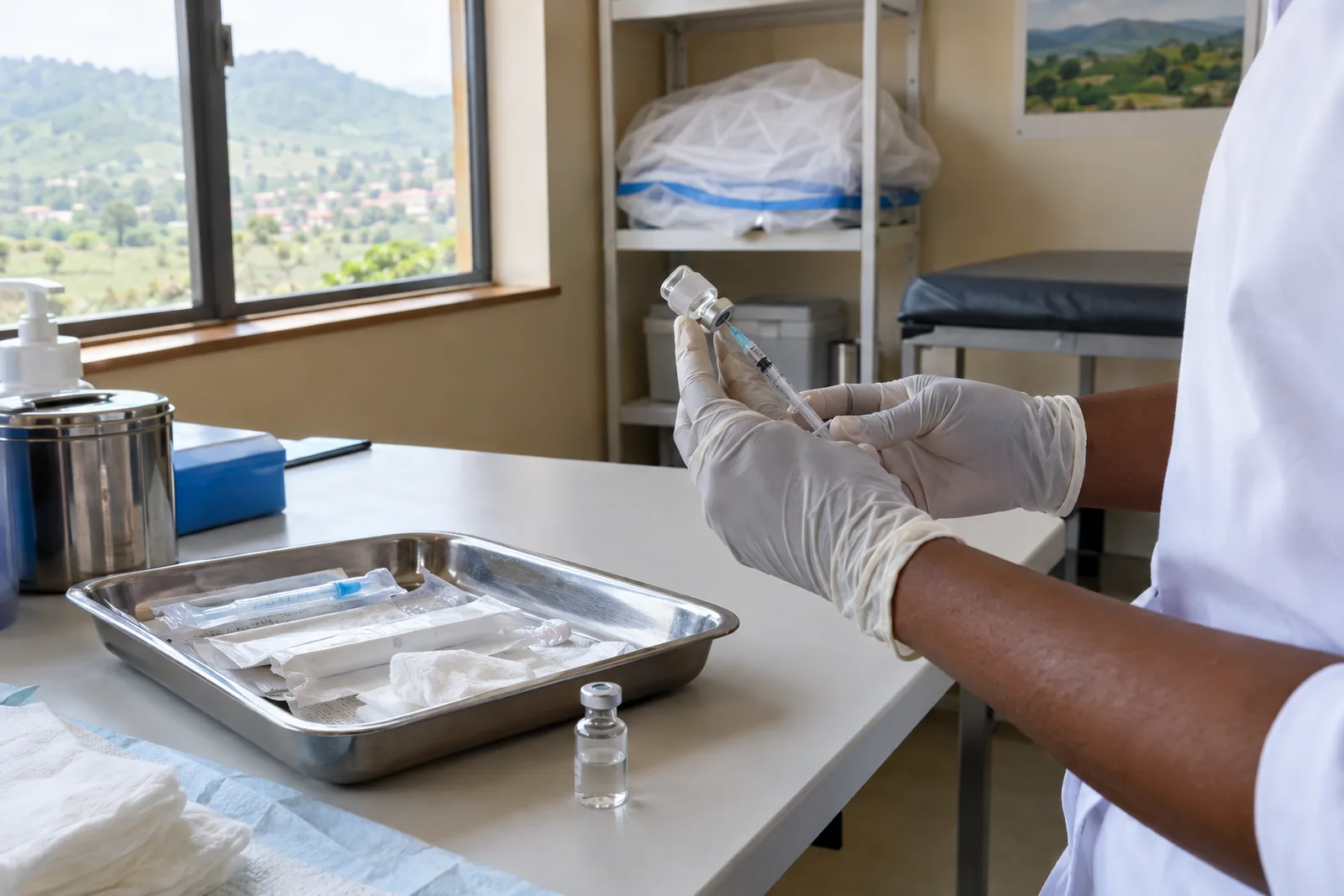
According to the trial’s registration on ClinicalTrials.gov, about 80 healthy volunteers aged 12 to 50 will take part. Each first receives a standard course of the malaria treatment artemether-lumefantrine to clear any existing infection. They then get a single injection into the muscle of the upper arm, the thigh or the hip. Three in four receive MMV371 and one in four a placebo, and neither the volunteers nor the researchers will know who got which. Each person is followed for up to seven months.
The main aim is to check safety and tolerability, and to measure how the body absorbs and processes the drug. The trial will also make an early estimate of how well it protects against malaria, CIDRAP reported.
Why it matters
Malaria caused 282 million cases and 610,000 deaths in 2024, most of them in sub-Saharan Africa, The Telegraph reported, citing World Health Organization figures. Today’s main prevention tools all need repeated doses. Seasonal malaria chemoprevention is given monthly, and the RTS,S and R21 vaccines are given to young children in four doses.
Missed doses leave gaps. Dr Cristina Donini of MMV told NewsGhana that the main advantage of MMV371 is how long it lasts. MMV371 is a derivative of atovaquone, one of the two drugs in the travellers’ pill Malarone, injected into muscle so that it is released slowly. An earlier study in Nottingham, England, found it was well tolerated in healthy adults and suggested one dose could protect for about three months.
The vaccines are for very young children. Researchers hope an injection like this could also protect older children, adolescents, adults and, eventually, pregnant women, who are especially vulnerable, The Telegraph reported. Women who could become pregnant are included in the Rwandan trial, which Donini said would provide data for later testing in pregnancy.
Long-acting injectables have the potential to redefine how malaria prevention is delivered, providing sustained protection from a single administration and expanding the options available to communities at risk.
Dr Martin Fitchet, Chief Executive Officer, Medicines for Malaria Venture
The wider picture
In GGND’s view, where the trial takes place matters as much as the drug, because early-stage medicine trials have often been run outside Africa. “Conducting this study in Rwanda demonstrates that partnerships such as this are essential to ensuring that African researchers and institutions are active contributors to the development of solutions for the communities and countries that need them most,” said Marie Michele Umulisa, Executive Director of Rinda Ubuzima, Capital FM reported.
Long-acting injections are gaining ground across global health. Lenacapavir, given twice a year, is now being rolled out to prevent HIV, and there are long-acting candidates for tuberculosis, The Telegraph noted. MMV and Africa CDC also aim to raise the number of African antimalarial manufacturers that meet WHO prequalification standards from three to seven by 2030, NewsGhana reported. In GGND’s view, a home-grown pipeline for both research and manufacturing would make any future injection easier to deliver on the continent.
Could it work elsewhere?
The idea is designed for places where malaria comes in seasons, usually after the rains. Donini told NewsGhana it could be particularly useful there, and that fewer clinic visits would help people in remote areas who sometimes miss appointments. If a season lasts longer than three or four months, people would probably need two injections, she told The Telegraph. MMV’s long-term goal is an injection that protects for up to six months, NewsGhana reported, and the team is working on a second-generation version it hopes could last a year.
What remains unresolved
- Early days. “The key word is ‘potential’,” Donini told NewsGhana. “MMV371 is still in early clinical development.” A Phase 1b study is mainly about safety, not proof that the drug works.
- A second drug is needed. MMV plans to combine MMV371 with a partner compound, also still in early development, to slow the emergence of drug resistance. No date has been given for when a combination could reach patients.
- Children must wait. The combination would only be tested in younger children after enough safety data in adults, Donini said. “It would be premature at this stage to give a timeline for studies in younger children.”
- Cost. Full costs have not been worked out. “Affordability will be critical, particularly at a time when aid budgets are shrinking,” Donini told NewsGhana. MMV hopes it could cost about the same as an insecticide-treated bed net.
What happens next
The trial is designed to test two dose levels already given to healthy adults in the UK, and three injection sites, according to the registry. An optional further group could test a higher dose. The results will help choose the dose for later, larger studies. The registry gives March 2028 as the expected completion date. MMV plans to extend its early-stage trial partnerships to more African countries, NewsGhana reported.
Sources
- ClinicalTrials.gov (Medicines for Malaria Venture) Safety and PK of MMV371 LAI in Healthy Adults and Adolescents in Rwanda, NCT07548021 (registry record)
- BusinessDay (MMV and Rinda Ubuzima announcement) Africa’s first-ever Phase 1 trial of a long-acting injectable for malaria prevention launches in Rwanda (2 November 2026)
- The Telegraph First ever trial of long-acting injection against malaria to launch in Africa (2 November 2026)
- Capital FM via allAfrica Rwanda Launches Africa’s First Trial of Long-Acting Malaria Prevention Injection (6 November 2026)
- NewsGhana Single Malaria Jab Could Protect for Three Months, MMV Says (November 2026)
- CIDRAP Quick takes: Salmonella-typhoid vaccine, long-acting malaria drug, rapid viral vs bacterial test (November 2026)
Analysis and context are by The GGND Team. Where we draw our own conclusions, we say so. To report an error, contact us.