What happened
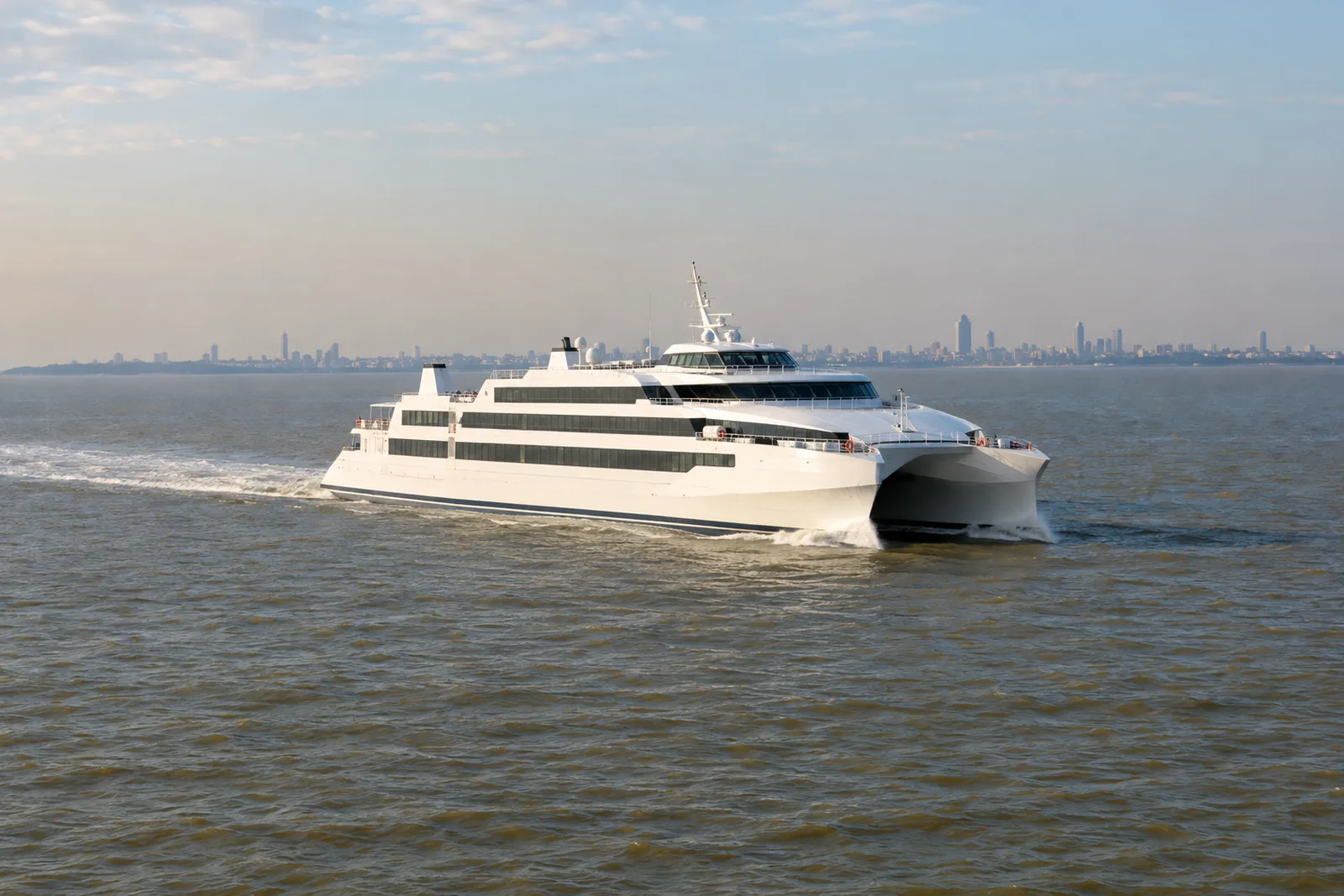
On 21 October 2026 the ferry company Buquebus unveiled the China Zorrilla at its terminal in Puerto Madero, Buenos Aires, and the next day the ship began commercial crossings to Colonia del Sacramento in Uruguay, the Presidency of Uruguay said. Named after the Uruguayan actor China Zorrilla, the ship can carry 2,100 passengers and 225 vehicles and has no fossil-fuel engines.
The 130-metre catamaran was built by Incat Tasmania in Hobart. Its energy storage system exceeds 40 megawatt-hours and includes more than 250 tonnes of batteries that drive eight electric waterjets, gCaptain reported. The battery supplier, Corvus Energy, says the system is more than 41 megawatt-hours and about four times larger than any previous battery system in commercial maritime service, according to a statement from its owner, BW Group.
Why it matters
Until now, battery ferries have mostly worked short commuter routes with light loads, such as the Ellen in Denmark. The China Zorrilla’s crossing is about 55 km, with more than two thousand people on board, New Atlas reported. The ship was originally designed for diesel and liquefied natural gas and was redesigned for full electric power during construction.
Where the electricity comes from matters as much as the ship. In 2025, 98 per cent of Uruguay’s electricity came from renewable sources, mainly hydropower, wind and biomass, Econosur reported, citing Uruguay’s energy ministry. The International Finance Corporation has estimated that replacing diesel on the route could avoid the equivalent of 37,545 tonnes of carbon dioxide a year.
‘Tendremos un barco que es totalmente amigable con el ambiente, 100% eléctrico,’ said Alejandro Sánchez, Secretary of the Presidency of Uruguay, at the launch (‘We will have a ship that is totally environmentally friendly, 100% electric’).
This project proves that battery-electric propulsion is no longer limited to smaller ferries or short routes.
Ole Jacob Irgens, Executive Vice President, Corvus Energy
The wider picture
‘This ship proves that large, high-capacity commercial vessels can operate on electric power,’ said Incat chairman Robert Clifford, gCaptain reported. Without diesel engines, the ship runs with much less noise and vibration. Its four battery rooms hold 5,016 battery modules, and it can sail for about an hour and a half on battery power, Corvus Energy said.
The ship needed new infrastructure on land. Uruguay’s state utility UTE built an underground network of roughly nine kilometres to the Port of Colonia, which now has 15 megawatts of power available for charging, and the project’s overall cost has been put at about US$170 million, financed partly by a US$107 million loan from Banco Santander Uruguay backed by an International Finance Corporation guarantee of up to US$67 million, according to Econosur’s review of public documents. Uruguayan officials said UTE was preparing its grid for this kind of demand.
There are trade-offs. The electric design caps service speed at about 25 knots, adding around ten minutes to each crossing compared with the original plan, New Atlas reported. And the first commercial arrival in Colonia did not go smoothly: neither of the port’s passenger gangways worked, about 700 passengers had to leave by the vehicle ramp, and the National Ports Administration opened an investigation, El Observador reported.
Could it work elsewhere?
Incat is already building three 129-metre battery-electric ferries for the Danish operator Molslinjen, gCaptain reported. In GGND’s view, the model suits busy, fixed routes of up to an hour or two where ports can be connected to a strong, clean grid. On grids that still burn a lot of coal or gas, the climate benefit would be much smaller.
What remains unresolved
- Real emissions savings. The 37,545-tonne figure is a projection. Measured energy use and emissions after months of service have not yet been published.
- Charging and timetable. Reports give different figures for charging, from 40 minutes for a partial top-up to around 80 minutes for a full recharge, and the crossing time is reported as 75 to 90 minutes.
- Battery capacity. Sources give slightly different sizes, from more than 40 MWh to 43 MWh, and long-term battery wear on a high-speed vessel is not yet known.
- Port readiness. The gangway failure in Colonia shows that the shore side has to work as reliably as the ship.
What happens next
The China Zorrilla is scheduled to cross up to four times a day, New Atlas reported. Its first months of service will show whether charging, reliability and costs match the promises. GGND will follow the results and the first of Incat’s Danish ferries.
Sources
- Presidencia de la República Oriental del Uruguay Comienza a operar ferry 100% eléctrico de gran porte que unirá Uruguay y Argentina (22 October 2026)
- BW Group / Corvus Energy The world’s largest marine battery system entered into operation (28 October 2026)
- gCaptain World’s Largest Battery-Electric Ship Begins Commercial Service in South America (26 October 2026)
- New Atlas World’s largest electric ferry enters service in South America (29 October 2026)
- El Observador Primer viaje del China Zorrilla a Colonia: no funcionaron las mangas de la ANP (22 October 2026)
- Econosur Buquebus Electric Ferry Infrastructure in Uruguay (25 October 2026)
Analysis and context are by The GGND Team. Where we draw our own conclusions, we say so. To report an error, contact us.