What happened
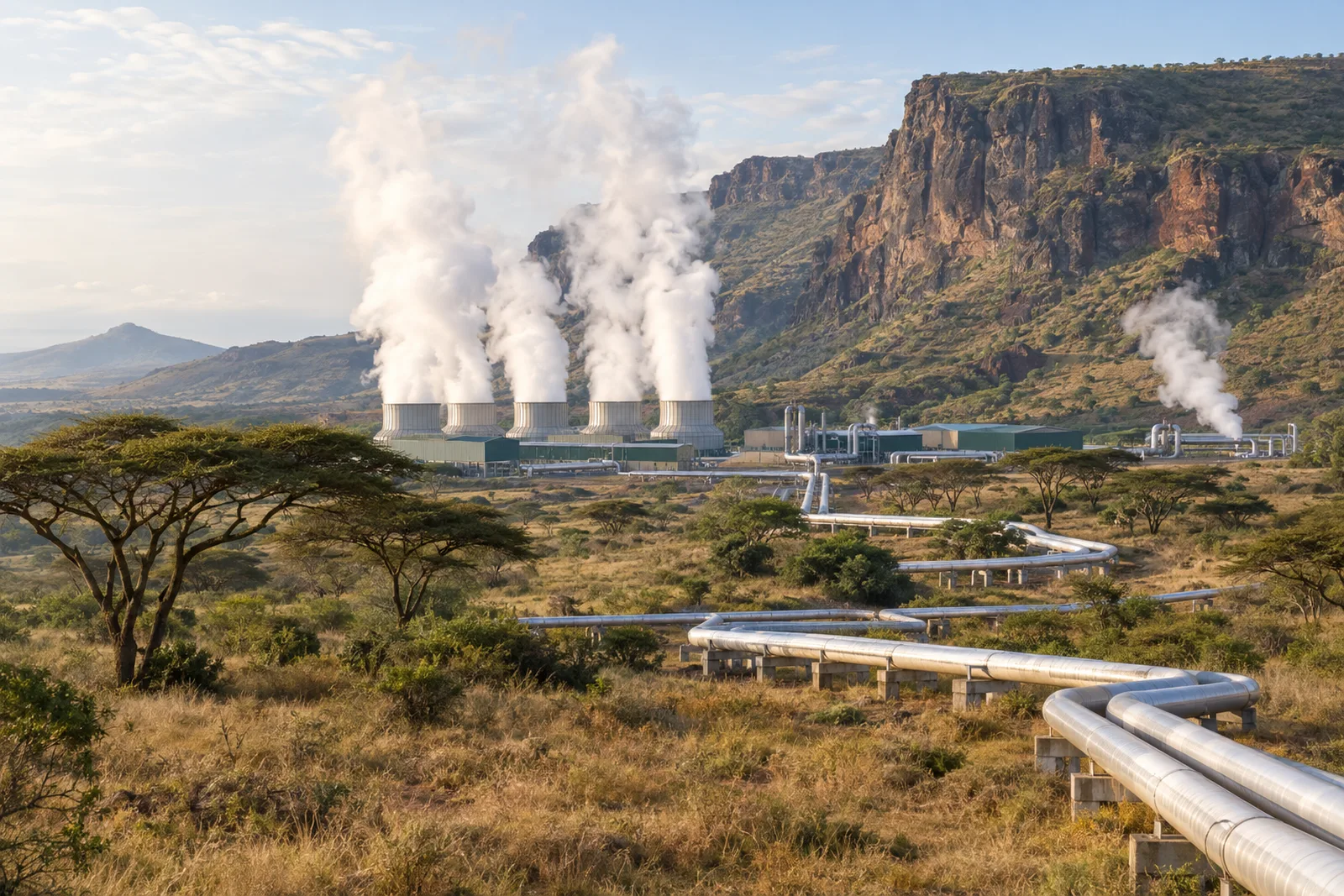
Kenya’s main state-backed power producer, KenGen, says it has finished rebuilding Olkaria I, the oldest geothermal power station in the country and the first in Africa. Managing director Peter Njenga told shareholders at the company’s annual general meeting in Nairobi on 29 October that the work was complete, Business Daily reported. The plant, first commissioned in 1981 with a maximum output of 45 megawatts (MW), was shut down three years ago for the overhaul.
After the rebuild, the station’s installed capacity is 63 MW, ThinkGeoEnergy reported, citing KenGen. Crucially, engineers achieved that increase without drawing more steam from the ground. According to a Xinhua feature, the amount of steam available for generation stayed the same; the gain came from new turbines and generators, a redesigned steam-field pipeline layout and improved separators, valves and cooling systems.
Kenya’s Energy and Petroleum Regulatory Authority (EPRA) has already approved a 25-year power purchase agreement for the refurbished plant. ‘They are doing reliability tests for the plant and they will go online next month,’ EPRA’s director general, Edward Kinyua, told Business Daily.
Why it matters
Geothermal power is the backbone of Kenya’s electricity system. In the year to June 2026, geothermal plants generated 6,420.51 gigawatt hours, or 40.91% of the country’s electricity, and installed geothermal capacity rose to 1,013.7 MW, according to EPRA’s Energy and Petroleum Statistics Report 2026. Unlike solar and wind, geothermal plants run day and night, which makes them valuable for keeping the grid stable.
The timing matters too. While Olkaria I was offline, Kenya’s peak demand rose by about 400 MW, from 2,149 MW in 2023 to 2,549 MW now, Business Daily noted. Electricity imports from Ethiopia and Uganda rose to 1.91 billion kilowatt hours in the year to June 2026, up 60.5% on two years earlier. Every megawatt of reliable home-grown supply eases that pressure.
Maurice Awuor, KenGen’s electrical engineering manager, said the rebuilt plant represents about 2% of Kenya’s installed generating capacity. ‘Geothermal resources are an important domestic energy source for Kenya,’ he told Xinhua, adding that their relatively low costs can reduce the power sector’s exposure to swings in oil and gas prices.
We have completed rehabilitation of the 63MW Olkaria 1 geothermal power station, which now awaits official commissioning hopefully by the end of the year.
Peter Njenga, managing director of KenGen, at the company’s annual general meeting, as reported by Business Daily
The wider picture
The project was part of KSh15.5 billion that KenGen invested in power infrastructure in the year to June 2026, The Star reported. Shareholders accepted a 16.7% cut in the dividend so more cash could go into plants. KenGen supplied 8,975 gigawatt hours to the grid in the year, 57.2% of national demand, and more than 90% of what it dispatched came from renewable sources. Its pipeline includes a proposed 42.5 MW solar plant at Seven Forks, the redevelopment of the Gogo hydropower station and battery storage.
Work on Olkaria I began in August 2023, with China’s SEPCOIII as the main contractor. Unit 3 came online in May 2026 and Unit 2 by July, according to ThinkGeoEnergy. Japan’s Toshiba Energy Systems and Solutions supplied steam turbines and generators alongside SEPCOIII, Business Daily reported. Under its national energy compact, Kenya aims to raise installed geothermal capacity to 1,681 MW by 2030, Xinhua reported.
Could it work elsewhere?
In GGND’s view, the most transferable lesson is that old renewable plants can be a quick source of new capacity. Rebuilding on an existing, well-understood steam field avoids the cost and risk of drilling new wells, and Olkaria I shows how much more electricity modern equipment can extract from the same resource. Countries along the East African Rift, such as Ethiopia, are developing their own geothermal fields, and ageing hydro and geothermal plants worldwide could follow a similar path. The engineers involved were candid that it is not easy: ‘Building a new plant is like painting on a blank canvas,’ SEPCOIII’s deputy project manager Zhang Yang told ThinkGeoEnergy, while a rehabilitation has to fit inside the space and layout that already exist.
What remains unresolved
- Commissioning date. KenGen says the plant awaits official commissioning, hopefully by the end of the year, while EPRA expects it online next month. Until then, the extra power is not yet reaching homes and businesses.
- How much power will be sold. KenGen describes a 63 MW plant, but EPRA’s report lists a power purchase agreement variation for 60.51 MW. The difference probably reflects the plant’s own use of power, but the published figures have not been reconciled.
- Imports and prices. Demand is still rising quickly, so it is not yet clear how far Olkaria I will reduce Kenya’s reliance on imports, or whether customers will see any change in their bills.
- Cost. Business Daily put the upgrade at KSh15.6 billion, a figure close to KenGen’s total annual investment of KSh15.5 billion; a separate project cost has not been published by KenGen.
What happens next
The plant is completing reliability tests before formal commissioning. KenGen will also go through a leadership change, with Ronoh Kibet due to succeed Peter Njenga as managing director on 1 February 2027, The Star reported. EPRA’s next annual statistics report should show how much Olkaria I adds to Kenya’s geothermal output once it is running at full strength.
Sources
- Business Daily KenGen upgrades Olkaria geothermal plant in bid to ease electricity imports (29 October 2026)
- ThinkGeoEnergy KenGen increases capacity of Olkaria I geothermal power station following rehabilitation (30 October 2026)
- The Star (Kenya) KenGen shareholders approve dividend payout cut as it invests in projects (30 October 2026)
- Xinhua via Big News Network Feature: Chinese firm helps upgrade Africa’s first geothermal power plant in Kenya (28 October 2026)
- Energy and Petroleum Regulatory Authority (EPRA) Energy & Petroleum Statistics Report 2026 (30 September 2026)
Analysis and context are by The GGND Team. Where we draw our own conclusions, we say so. To report an error, contact us.