What happened
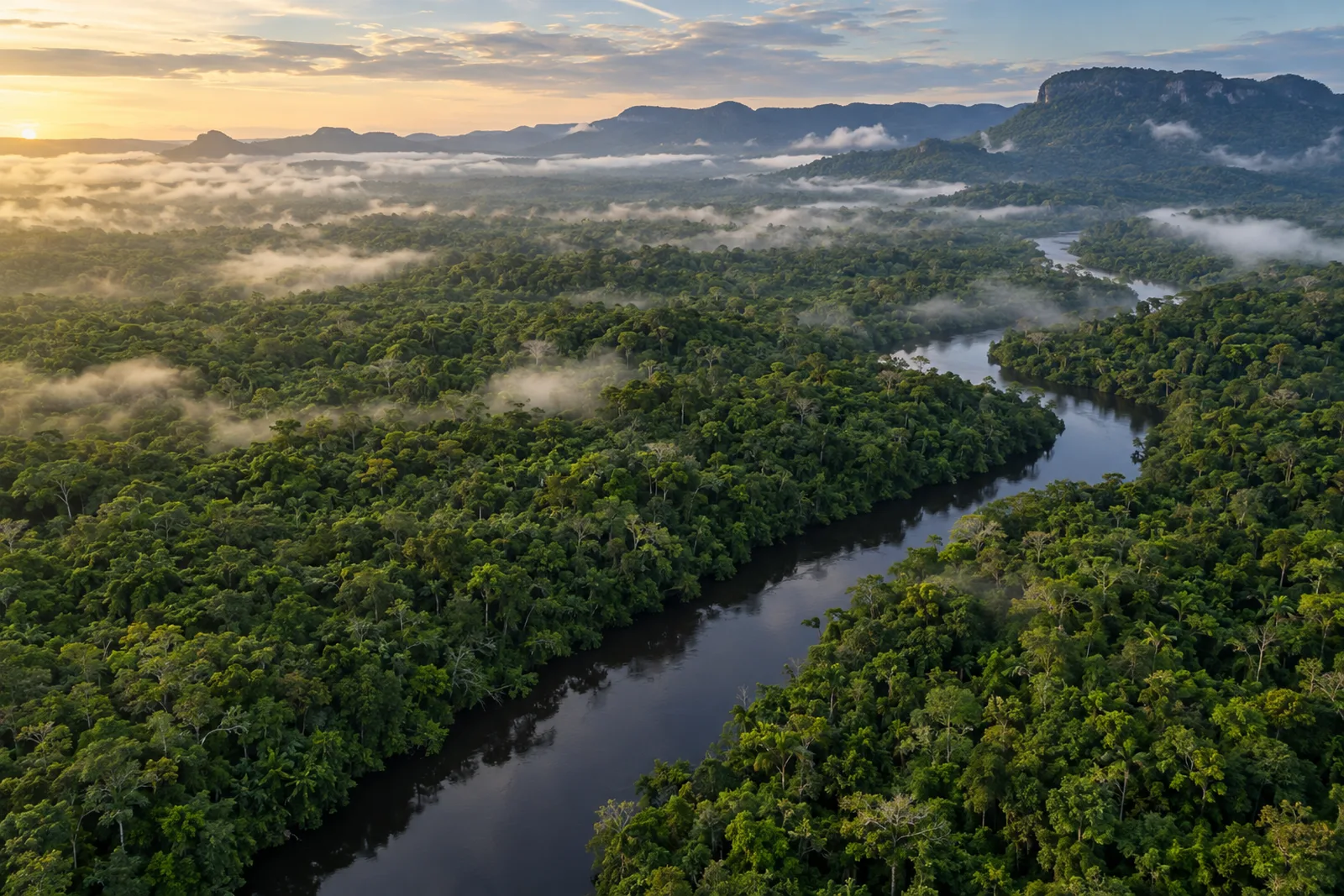
Four conservation funders have pledged an initial US$12.5 million to help Guyana give permanent protection to the Acarai–Rupununi Corridor, a vast stretch of forest in the south of the country. The Bezos Earth Fund, Andes Amazon Fund, Nia Tero and Rainforest Trust announced the joint pledge on 30 October in Georgetown, according to Rainforest Trust. It supports President Irfaan Ali’s announcement that Guyana will advance the process of permanently protecting the corridor, which the funders put at more than 1 million hectares (2.4 million acres) and describe as one of the largest intact forest landscapes left in the Americas.
The pledge was announced at the opening of the second Global Biodiversity Alliance conference, an initiative led by President Ali, at the Arthur Chung Conference Centre, Guyana’s Department of Public Information reported. Rainforest Trust’s chief executive, James Deutsch, called the money ‘a very small down payment’, and said the commitment is conditional on legally enforceable, permanent protection of the corridor against mining and other incompatible activities.
Why it matters
About 85% of Guyana is forested, but only around 8.4% of its land is in the national protected area system, Rainforest Trust said. Protecting the corridor would roughly double that protected footprint and take the country about halfway to its goal of protecting 30% of its lands and waters by 2030.
The area is rich in wildlife and still little studied. The corridor sits in the Guiana Shield region of the Amazon biome and ‘harbors extraordinary and largely unstudied biodiversity’, said Megan MacDowell, executive director of the Andes Amazon Fund, in the funders’ statement. Guyana’s News Room illustrated its coverage with a dyeing poison frog photographed during a Field Museum rapid inventory in the corridor in November 2024, on its Fueled site.
The donors say the funding is designed to make protection permanent, with clearly defined boundaries and lasting safeguards against mining, industrial logging and other activities that are incompatible with conservation, according to Rainforest Trust.
For Guyana, forest stewardship is not a sacrifice we make for development; it is the foundation of the development model we are building.
Dr Mohamed Irfaan Ali, President of Guyana, in a Rainforest Trust statement
The wider picture
Guyana is best known today for its fast-growing oil and gas industry, but it has also been earning money for keeping its forests standing through carbon credit sales, President Ali noted at the conference, the News Room reported. He argued that the country can also be paid to protect biodiversity. The two-day conference on 30 and 31 October focused on how to scale up finance for nature.
Supporters framed the pledge as a vote of confidence. ‘Guyana is showing what 30×30 leadership looks like,’ said Brian O’Donnell, director of Campaign for Nature, while the Bezos Earth Fund’s Padu Franco said Guyana ‘has an opportunity to secure permanent protection while its forests are still largely intact’, according to Rainforest Trust.
The funders say Indigenous Peoples and local communities are central to the plan. Supported projects must uphold their rights, including free, prior and informed consent, and give them a meaningful role in planning, governance and management, the statement said. On 31 October, Deutsch told a panel that the partners aim to channel the money into specific projects within about a year, including the corridor, protected areas and Indigenous territories, Guyana’s Department of Public Information reported. ‘Much more money is going to come in the future, but we got here fast,’ he said.
Could it work elsewhere?
Both Deutsch and the Bezos Earth Fund’s Padu Franco pointed to Project Finance for Permanence as a model Guyana could consider, according to the Department of Public Information. Under that approach, governments, communities and funders agree conservation targets and costs, then combine public, philanthropic and market money to sustain protected areas for 20 years or more. In GGND’s view, Guyana’s advantage is that it is acting before large-scale clearing, which is far cheaper than restoring damaged land later. The harder test, which other forest nations will watch closely, is whether permanent protection can hold alongside a booming extractive economy.
What remains unresolved
- Size and name. The funders describe a corridor of more than 1 million hectares, while government reporting quoted Deutsch welcoming the president’s ambition to protect 1.5 million hectares. Some local reports also called it the Acarai–Corentyne Corridor. The final boundaries have not been published.
- Legal protection. The corridor is still proposed. The pledge is conditional on permanent, legally enforceable protection, which Guyana has yet to put in place.
- Consent. The funders require free, prior and informed consent from Indigenous communities, but how and when that process will happen has not been set out.
- Long-term money. The funders say meeting the 30% goal will need substantially greater and sustained investment, and the pledge combines new and existing funding.
What happens next
Guyana’s 30×30 plan is led by the Ministry of Natural Resources, the Guyana Forestry Commission and the Protected Areas Commission, working with Indigenous Peoples and local communities, Rainforest Trust said. The funders have invited other public and private donors to join them, and partners are preparing to help identify Guyana’s key biodiversity areas to guide where money goes, the Department of Public Information reported.
Sources
- Rainforest Trust Conservation Funders Pledge Initial $12.5 Million Toward Permanent Protection of Guyana’s Forests and Biodiversity (30 October 2026)
- Department of Public Information, Guyana Charitable organisations pledge US$12.5M for Guyana’s biodiversity efforts (30 October 2026)
- Department of Public Information, Guyana Partners aim to get US$12.5M conservation pledge to communities within a year (1 November 2026)
- News Room Guyana (Fueled) Guyana pushes to protect world’s biodiversity (31 October 2026)
Analysis and context are by The GGND Team. Where we draw our own conclusions, we say so. To report an error, contact us.