What happened
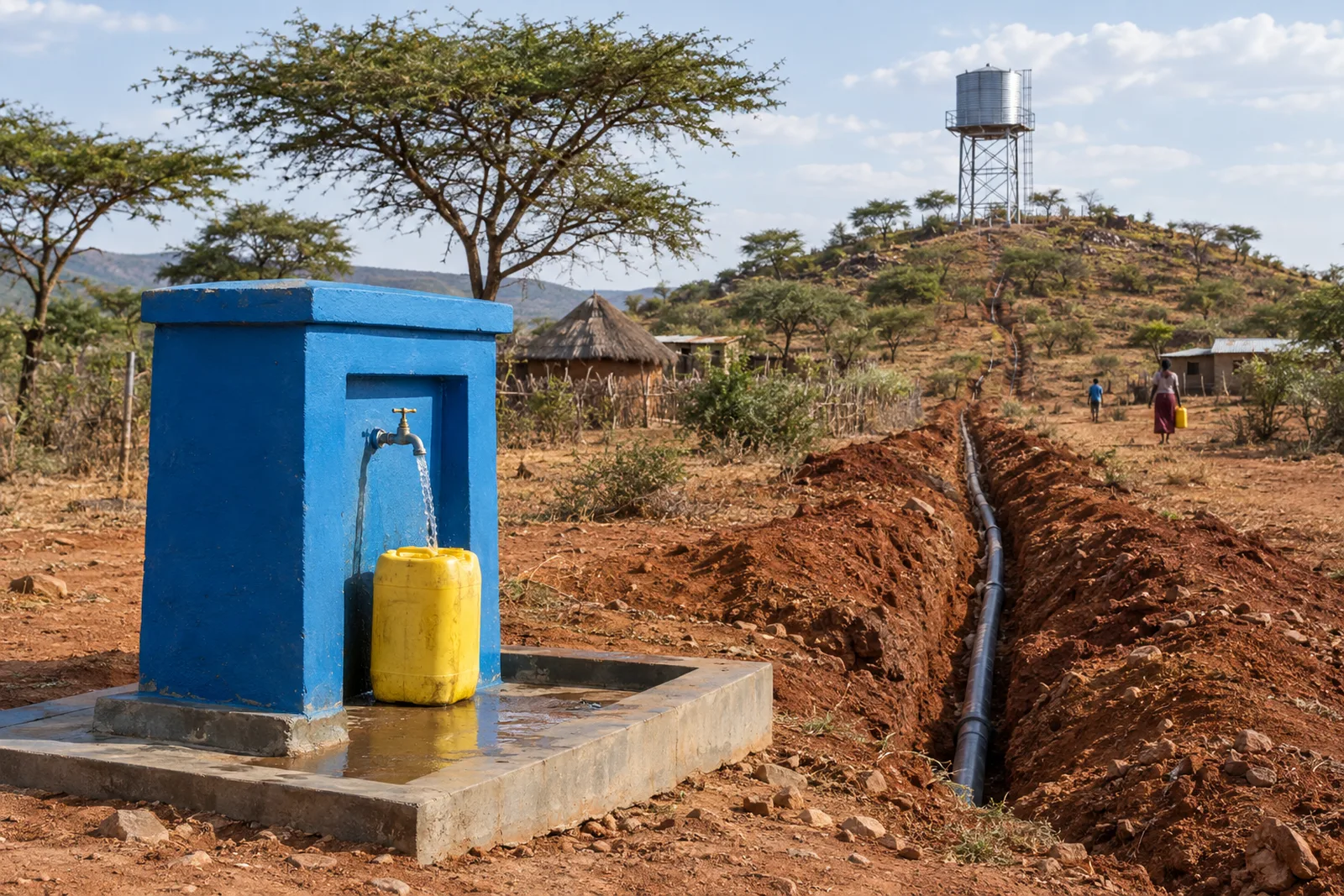
On Saturday 24 October 2026, President William Ruto commissioned Phase Two of the Mwala Cluster Last Mile Water Supply Project at Mbiuni in Mwala Constituency, Machakos County, at the start of a four-day tour of the Ukambani region, KBC reported. The state broadcaster said the project will supply about 120,000 residents across Mwala, Makutano, Masii, Kivandini, Wamunyu, Kathama, Oldonyo Sabuk, Mbiuni, Mbaani, Kilembwa and Kyawango.
The scheme has a supply capacity of 6.6 million litres a day and is expected to serve 137,400 people and 10 institutions across 10 towns, The Eastleigh Voice reported. Water Cabinet Secretary Eric Muuga was among those present.
Why it matters
Lower Eastern Kenya is semi-arid, and many households in Mwala have long depended on distant, seasonal or unsafe sources. The project is jointly funded by the Government of Kenya and the African Development Bank under the Kenya Towns Sustainable Water Supply and Sanitation Programme, according to Tanathi Water Works Development Agency, the public body that built it. Its main works are a 3.5-metre weir on the Ndarugu River at Munyu, 4.48 kilometres of raw-water mains, a treatment plant designed for 6,600 cubic metres a day with a 1,000-cubic-metre clear-water tank, and about 80 kilometres of transmission and distribution pipes.
Getting here was not easy. Tanathi’s project page records delays caused by the non-performance of a previous contractor, whose contract was terminated and re-tendered. By April 2026, the government said construction was 93 per cent complete, in a government statement in which the Water Cabinet Secretary called the project “a key step towards ending the persistent water shortages in Ukambani”.
We must be deliberate and intentional in addressing water shortages in Ukambani.
William Ruto, President of Kenya, at the commissioning in Mbiuni
The wider picture
Commissioning the main works is only half of the job. Ruto said the second phase would focus on last-mile connections to individual homes. “In the next budget next month we will allocate Sh200 million towards the distribution of Mwala Cluster water to your households,” he said, with a further Sh500 million earmarked for a last-mile programme to reach an extra 120,000 residents in Mwala Constituency, Sacco Review reported. He also said Sh300 billion had been set aside for 12 dams, including two in Ukambani, through the proposed National Infrastructure Fund.
The trade magazine Kenya Engineer offered a useful caution: the 120,000 figure is an announced service target, “not a count of connected households or a measure of water delivered”. It argued that the real proof will come from production logs, meter readings, hours of supply and water-quality tests in each service area.
The politics are also visible. The tour took Ruto into a region associated with opposition leader Kalonzo Musyoka ahead of the 2027 General Election, Capital FM noted, adding that the impact for residents will depend on whether investments translate into better access to water.
Could it work elsewhere?
Kenya has several similar schemes in progress. Tanathi lists water projects for Machakos town and for Kiambere and Mwingi, funded with partners including the African Development Bank and Italian Cooperation, and several have faced long delays too. In GGND’s view, the lesson from Mwala is that river-fed treatment plants can bring reliable water to dry areas, but only if the pipes to homes, the operator and the maintenance budget are planned and funded as carefully as the plant itself.
What remains unresolved
- Who is covered. Official and media figures range from 120,000 and 137,400 people to about 150,000 and, on full completion, about 270,000. They describe different phases and are not a count of people already receiving water.
- What it cost. News reports at the commissioning put the value at Sh1.47 billion; Tanathi and the April government statement say Sh1.7 billion. The difference has not been explained.
- Household connections. The Sh200 million for distribution to homes still needs parliamentary approval, and the last-mile phase has no published timetable.
- Running the system. Who operates the scheme, how tariffs are set and how maintenance is funded will decide whether taps keep flowing.
What happens next
The focus now moves to connecting households and to the budget allocations Ruto promised. GGND will look for the first public data on active connections and hours of supply in Mwala’s towns.
Sources
- Tanathi Water Works Development Agency Ongoing projects: Mwala Cluster Water Supply Project
- Government Advertising Agency (Presidential Communication Office) Mwala water project to end Ukambani water shortage (9 April 2026)
- KBC President Ruto kicks off four-day Ukambani development tour (24 October 2026)
- Capital FM Ruto begins four-day Ukambani tour, commissions Sh1.47bn Mwala water project (24 October 2026)
- The Eastleigh Voice Ruto kicks off four-day Ukambani tour with Sh1.47 billion Mwala water project (24 October 2026)
- Sacco Review Ruto commissions Sh1.47bn Mwala water project in Machakos (October 2026)
- Kenya Engineer Mwala’s water project: what will prove the last mile works? (27 October 2026)
Analysis and context are by The GGND Team. Where we draw our own conclusions, we say so. To report an error, contact us.