What happened
Kenya has secured a commitment of €22 million, about KSh3.3 billion, from Germany to expand its Smallholder Irrigation Programme into western Kenya, Kenyans.co.ke reported on 25 November. Irrigation Principal Secretary Ephantus Kimotho announced the deal on Tuesday 24 November after meeting National Assembly Speaker Moses Wetang’ula.
“During the recent G2G negotiations in Berlin, we secured a commitment of EUR 22 million for the programme. It targets 8,000 acres and 10,000 farmers across seven counties,” Kimotho said. The counties are Migori, Homa Bay, Kisumu, Siaya, Busia, Bungoma and Kakamega. A second round of consultations with governors is planned for 17 and 18 December, to agree how costs will be shared between national and county governments, drawing on the experience of Mount Kenya.
The government-to-government talks took place in Berlin on 25 June, with Treasury Principal Secretary Chris Kiptoo leading Kenya’s side and Joachim Schmitt of Germany’s development ministry, BMZ, leading Germany’s, The Standard reported at the time.
Why it matters
Around 80% of Kenya is arid or semi-arid, and the country suffered five failed rainy seasons between October 2020 and December 2022, according to a KfW factsheet on the programme. The same document notes that poverty is particularly widespread in the west. For a family on a small plot, reliable water can mean a second or third harvest a year instead of one.
The model has a track record. The German development bank KfW says earlier phases around Mount Kenya, between 2005 and 2014, reached 5,500 households on 2,184 hectares through 19 schemes. Kenya’s State Department for Irrigation puts the total across Phases I to IV at 6,773 acres.
During the recent G2G negotiations in Berlin, we secured a commitment of EUR 22 million for the programme. It targets 8,000 acres and 10,000 farmers across seven counties.
Ephantus Kimotho, Principal Secretary, State Department for Irrigation
The wider picture
KfW’s ex-post evaluation of Phase III, published in 2020, rated it “successful”. It found the schemes added 561 hectares of irrigated land and raised cropping intensity from 166% to about 201%, short of the 220% target. Costs were about €3,139 per hectare, compared with an average of €5,462 for the National Irrigation Board, the evaluation said.
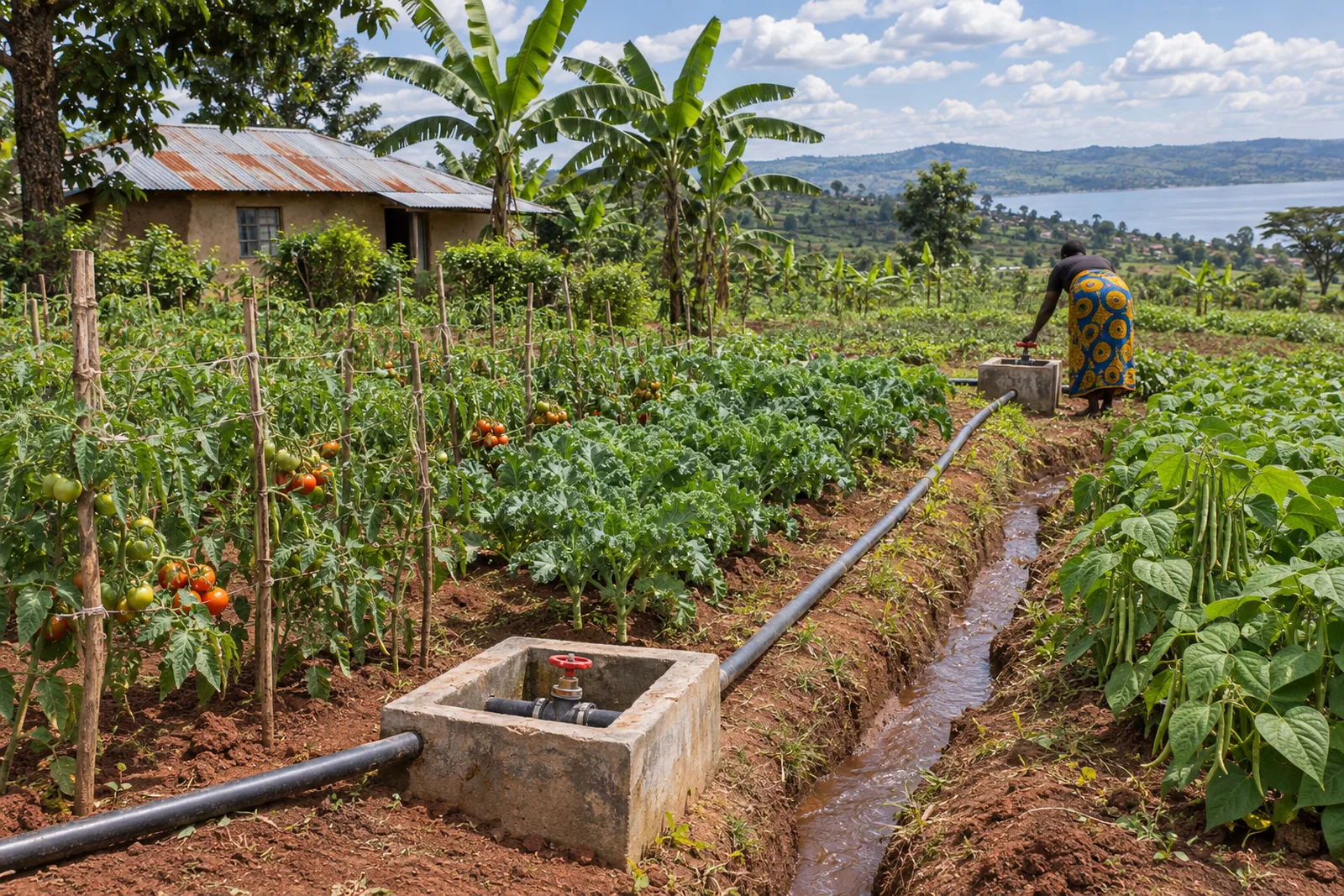
A key feature is that farmers pay part of the cost. KfW says smallholders cover about half of the investment through loans from commercial banks. In Phase III the loans carried interest of 12% a year over five years; three cooperatives repaid in full and one had its loan rescheduled. At the new Kiramanthi scheme in Tharaka Nithi, 270 farmers on 272 acres contributed half of the KSh175 million cost through a loan arranged with Equity Group Foundation, the Kenya News Agency reported in May.
The evaluation also flagged a weakness: illegal water abstraction upstream. Its authors warned that gains “seem to be only temporary, as new or repeated illegal abstraction occurs”. In GGND’s view, that is the lesson the western counties most need to learn before the first pipe is laid.
The ambition is large. Kimotho told The Standard in June that “annual farmer incomes are projected to increase from Sh12.4 million to Sh45.7 million”, a projection rather than a measured result.
Could it work elsewhere?
Small, farmer-run gravity schemes with shared costs are cheaper than big state projects and give farmers a stake in keeping them working. In GGND’s view, the approach could suit many hilly, well-watered parts of East Africa. It depends on fair water rules, honest cooperatives and loans that farmers can afford.
What remains unresolved
- Money on paper. The €22 million is a commitment. It has not been disbursed, and no land in the west is yet irrigated under the programme.
- Who pays what. Counties and the national government have not yet agreed how to share costs; talks with governors resume in December.
- Debt for farmers. If farmers must again borrow about half the cost, high interest rates could put poorer households off.
- Water rights. Upstream abstraction undermined earlier gains, and theft of valves was a worry at Kiramanthi.
What happens next
Governors and national officials meet on 17 and 18 December to work out cost-sharing, and the Irrigation, Agriculture, Trade and Cooperatives departments are to coordinate planning. GGND will follow whether a financing agreement is signed and when the first western schemes are chosen.
Sources
- Kenyans.co.ke Kenya secures Ksh3.3bn Germany deal for farmers in 7 counties (25 November 2026)
- The Standard Kenya, Germany strike deal on smallholder irrigation expansion (25 June 2026)
- KfW Development Bank Factsheet: Small-scale Irrigation Programme Mount Kenya, Phase IV
- KfW Development Bank Ex-post evaluation: Small-scale Irrigation Programme Mount Kenya III (2020)
- Kenya News Agency State Department for Irrigation to hand over Kiramanthi irrigation scheme to farmers (13 May 2026)
- State Department for Irrigation Meeting with KfW
Analysis and context are by The GGND Team. Where we draw our own conclusions, we say so. To report an error, contact us.