What happened
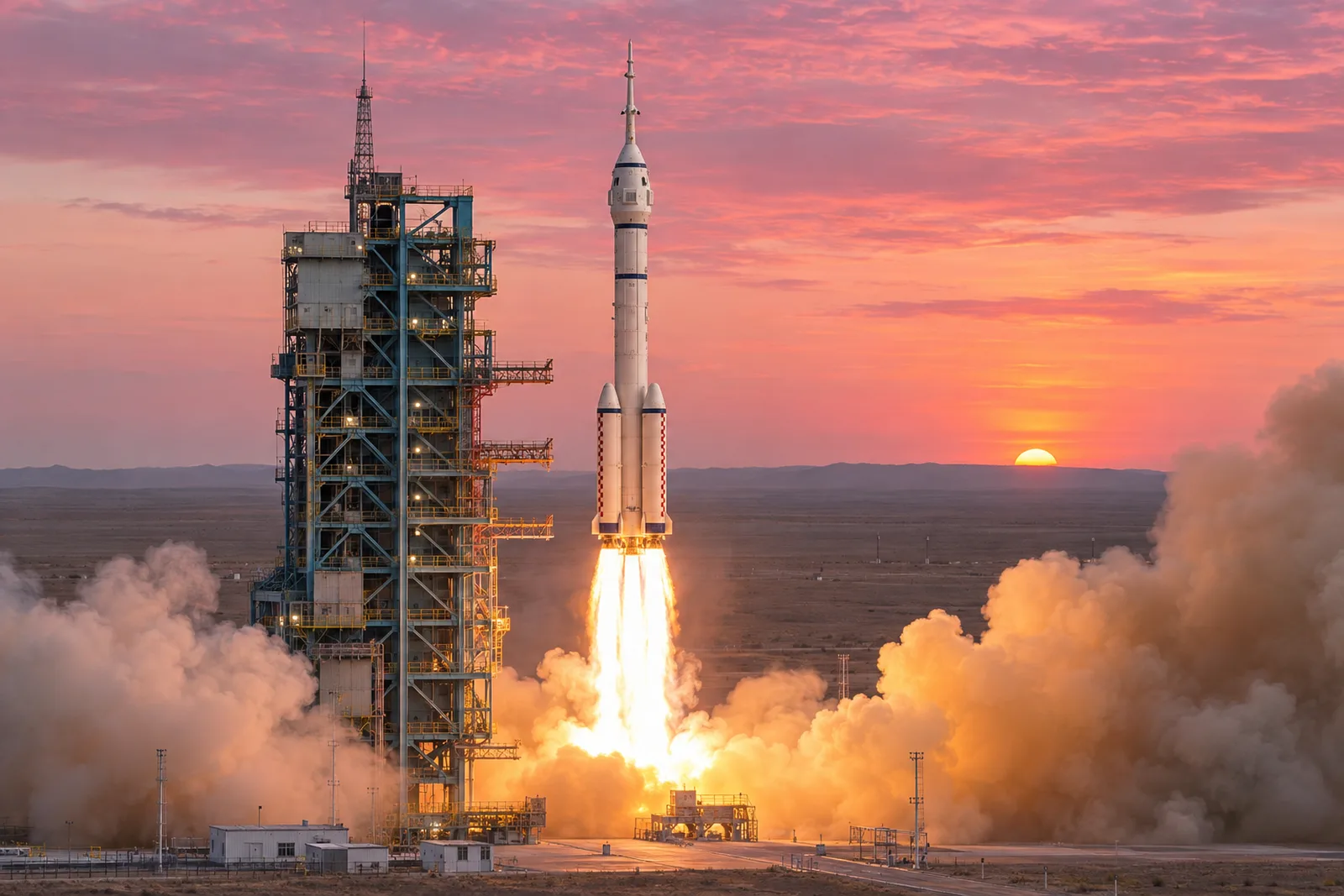
A Long March-2F rocket lifted off from the Jiuquan Satellite Launch Center in north-west China at 8:18 a.m. Beijing time on Wednesday 25 November, carrying Chinese astronauts Tang Hongbo and Wu Yi and Pakistani payload specialist Muhammad Zeeshan Ali, Xinhua reported, citing the China Manned Space Agency (CMSA). It was the first joint flight of Chinese and foreign astronauts in the history of China’s crewed space programme.
The spacecraft docked with Tiangong in about three and a half hours, and the crew already on board opened the hatch at 2:35 p.m. Ali, a 40-year-old pilot, became the first Pakistani in orbit and the first foreign astronaut to board the station, Reuters reported. Pakistan’s first person in space was Namira Salim, on a short suborbital Virgin Galactic flight in 2023, Space.com noted.
The flight follows an agreement signed in February 2025 between CMSA and Pakistan’s space agency, SUPARCO, under which two Pakistanis would train in China and one would fly, according to the Associated Press. Ali and Khurram Daud were chosen in April, and Ali trained for seven months in Beijing, including intensive Chinese lessons, Dawn reported.
Why it matters
More than 90 experiments and technology tests are planned for the mission, CMSA said. Four are China–Pakistan projects. Ali will run an experiment on photosynthetic cyanobacteria proposed by SUPARCO, which a Chinese Academy of Sciences official said could support oxygen regeneration and biomanufacturing at future stations. Another, led by the University of Agriculture, Faisalabad, will expose 32 quinoa seed samples outside the station for about a year to test their stress tolerance, Xinhua reported. The other two test graphene-based and self-healing carbon fibre composites.
For Pakistan, the symbolism is large. “I am not flying for myself. I carry the name of Pakistan on my shoulders,” Ali said before launch, according to Dawn. Prime Minister Shehbaz Sharif said the journey was “not just that of one astronaut but of 240 million Pakistanis”.
This mission is not a finish line; it is a launch pad.
Muhammad Zeeshan Ali, Pakistani astronaut
The wider picture
The mission is also diplomacy. China and Pakistan have worked together in space since 1990, when Pakistan’s first satellite, Badr-1, launched on a Chinese rocket, and China carried a Pakistani cubesat on its Chang’e-6 Moon probe in 2024, Xinhua noted. A UN spokesperson welcomed the international cooperation the mission represents. Blaine Curcio of Orbital Gateway Consulting told Reuters that it “brings prestige, important science and technology know-how, and a level of deeper collaboration and diplomatic goodwill with China.”
It comes as the International Space Station may be retired by around 2030, Reuters noted, which could leave Tiangong as one of the few places in orbit open to visiting astronauts. In GGND’s view, the good news here is that one more country now has a trained astronaut and its own experiments in orbit; how much that builds lasting skills at home is a separate question.
Could it work elsewhere?
Short visiting flights have long been a way for countries without their own rockets to train astronauts and fly science. In GGND’s view, the most useful part of the Pakistani model is that the experiments come from national universities and agencies, tied to problems at home, such as climate-resilient crops, rather than being purely symbolic.
What remains unresolved
- A short stay. Ali is due to spend about a week on the station and return on Shenzhou-23, so his own work time is limited.
- Science still to come. The quinoa samples stay outside for a year, and results from all four experiments will take time to publish.
- Dependence. Pakistan cannot yet launch people itself, so further flights depend on China’s plans and goodwill.
- Geopolitics. The flight is part of a wider contest over who leads in space, and the prestige may outweigh the science.
What happens next
Ali is to complete his experiments and return to Earth with two Shenzhou-23 crew members, while Tang and Wu stay for about six months. Pakistan has also been promised a rover on a Chinese lunar mission around 2028, according to Reuters. GGND will look for the first published results from the Pakistani experiments.
Sources
- Xinhua (via CCTV) China launches Shenzhou-24 spaceship, opening Tiangong space station to first foreign astronaut (25 November 2026)
- Reuters China’s Shenzhou-24 space flight takes off with Pakistani national, first foreign astronaut (25 November 2026)
- Associated Press Report on the Shenzhou-24 launch with Pakistan’s first astronaut (25 November 2026)
- Dawn ‘A new era begins’: Pakistan’s Zeeshan Ali becomes first foreigner to board China’s Tiangong space station (25 November 2026)
- Space.com Report on the Shenzhou-24 launch, China’s first international crew to Tiangong (November 2026)
Analysis and context are by The GGND Team. Where we draw our own conclusions, we say so. To report an error, contact us.