What happened
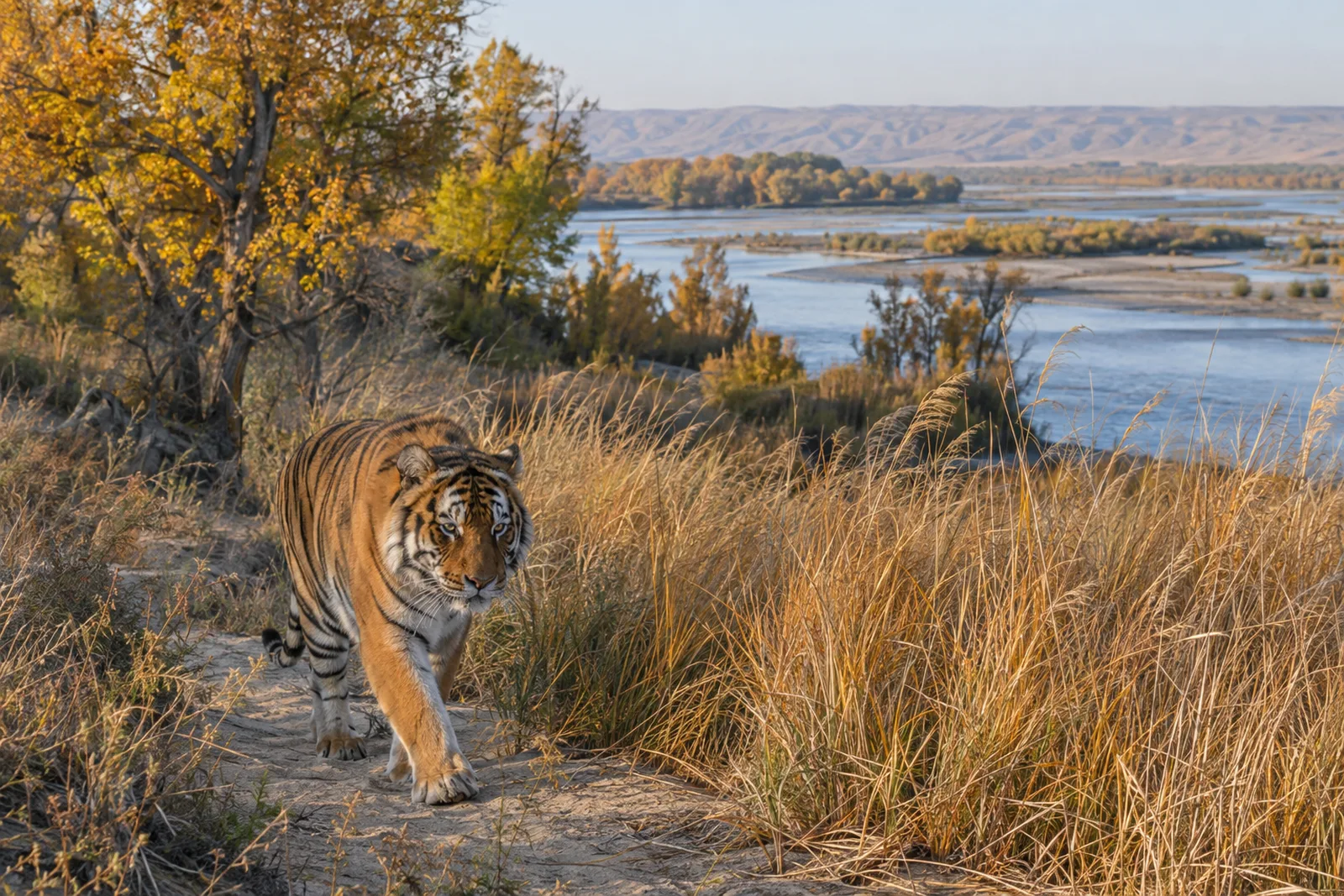
On 31 October, specialists released a male Amur tiger from his acclimatisation enclosure in the Ile-Balkhash State Nature Reserve into the wild. He is called Amur, and he is only the second tiger to live free in Kazakhstan for more than 70 years, according to the Ministry of Ecology and Natural Resources, which announced the release on 2 November.
Before he was freed, Amur underwent veterinary examinations and behavioural tests. Specialists assessed his health, his hunting skills, his ability to find food on his own and how he reacted to people, and he was fitted with a satellite collar, The Astana Times reported. ‘Every tiger release carries significant responsibility. We must be certain that the animal is ready to live independently in the wild,’ said Daniyar Turgambayev, who chairs the ministry’s Forestry and Wildlife Committee.
Amur shares the reserve with a tigress named Umit, released on 31 July. The ministry says she is exploring the territory and hunting independently, and that her adaptation is going well. Within ten days of her release she had killed and eaten a boar and a wolf, RFE/RL reported. Two cubs that arrived with the adult tigers remain under supervision until they are old enough to be assessed.
Why it matters
Tigers once lived in the reed beds and riverside forests of Central Asia. The Caspian, or Turan, tiger disappeared from Kazakhstan in the middle of the 20th century because of the loss of riverside tugai forests, falling numbers of wild hoofed animals and poaching, the ministry says. By the mid-1930s an estimated ten animals were left, and by 1948 tigers are believed to have vanished from the territory of today’s Kazakhstan, according to RFE/RL.
Genetic research has shown that the extinct Turan tiger was closely related to the Amur tiger of the Russian Far East, which is why Amur tigers were chosen for the programme, Tengrinews reported. In GGND’s view, the release matters because it moves the project from preparation to reality: for the first time, a male and a female are living free in the same landscape.
Our main goal is not simply to return these predators to their historical habitat, but to establish a sustainable population capable of living and reproducing independently in the wild.
Alibek Kuantyrov, Kazakhstan’s Minister of Ecology and Natural Resources, as reported by The Astana Times
The wider picture
The tigers are the visible end of years of quieter work. The Ile-Balkhash reserve was created in 2018 and covers more than 415,000 hectares, Tengrinews reported. Staff have been restoring tugai forests and rebuilding the prey that tigers need. Bukhara deer and kulans, a wild ass native to Central Asia, have been brought in, and in September 2026 another 30 kulans were moved from Altyn-Emel National Park, the ministry says. RFE/RL put the total at more than 200 deer and over 100 kulans, and described the project as a US$30 million effort funded by WWF, UNDP and Kazakhstan.
The animals themselves came from Russia. In November 2025 the two countries signed a plan for the transfer, and in May 2026 four tigers caught in the wild in Russia’s Khabarovsk region, two adults and two cubs, arrived at the reserve, the ministry said at the time. Two zoo-born tigers brought from the Netherlands in 2024 have also been living in enclosures at the reserve, Tengrinews reported.
Not everyone nearby is celebrating. Valery Bilyachenko, who runs a fishing base close to the release site, told RFE/RL: ‘The main livelihood in the local villages is livestock farming. There are pastures and cattle, and naturally, local people are worried that the tigers will kill their animals.’ The ministry has set up three safety zones around the tigers’ habitat and a response team that can warn residents, drive a tiger back to a safe area or, if necessary, sedate and move it, The Times of Central Asia reported. Public access to the reserve is restricted.
Could it work elsewhere?
The Turan tiger once ranged from Central Asia to the Caucasus and northern Iran, The Times of Central Asia noted, so other countries could in theory follow. In GGND’s view, Kazakhstan’s main lesson is the order of work: it spent years restoring forests and prey before any tiger arrived, and it planned for conflict with people from the start. A country without large, protected, prey-rich land and a willingness to fund patient monitoring would struggle to repeat it.
What remains unresolved
- Whether they will breed. The hope is that Amur and Umit will find each other, but experts say the chances of the pair mating are small, RFE/RL reported. The Times of Central Asia called the birth of the first wild cubs ‘a far more significant milestone than the relocation itself’.
- Living with people. Some villages are only tens of kilometres from the release site. How well the safety zones and response teams work will only become clear over time.
- Water. The Ili delta depends on water flowing down the Ili River, which rises in China, so the future of the tigers is tied to protecting a transboundary river, The Times of Central Asia noted.
- Numbers. The long-term aim is around 50 tigers, according to RFE/RL. That would require many more releases, and wild births, over many years.
What happens next
Specialists will keep tracking both tigers by satellite and decide on the cubs once they reach the right age and pass the necessary tests. Two more young tigers are set to be released in 2027, RFE/RL reported. In GGND’s view, the real measure of success will not be the number of releases but whether tigers born wild in the Ili delta grow up there.
Sources
- Ministry of Ecology and Natural Resources of Kazakhstan Historic return of tigers to Kazakhstan continues: second tiger, Amur, released into the wild (2 November 2026, in Russian)
- Ministry of Ecology and Natural Resources of Kazakhstan First tigers from the Russian Federation delivered to Kazakhstan (May 2026, in Russian)
- The Astana Times Kazakhstan Releases Second Tiger Into Wild as Reintroduction Program Advances (2 November 2026)
- RFE/RL ‘Anti-Conflict’ Teams Dispatched As Wild Tigers Return To Kazakhstan (3 November 2026)
- The Times of Central Asia Kazakhstan Tiger Reintroduction: Second Amur Tiger Released into the Wild (3 November 2026)
- Tengrinews Ümit is no longer alone: a second tiger released into the wild in Kazakhstan (2 November 2026)
Analysis and context are by The GGND Team. Where we draw our own conclusions, we say so. To report an error, contact us.