What happened
On 30 October, Enova, the Norwegian state enterprise that funds climate and energy projects, said it would award NOK 3.94 billion to two floating offshore wind projects, according to Enova’s announcement. Fortius Offshore Wind will receive NOK 2 billion and Fram Wind Solutions NOK 1.94 billion. That is about EUR 381 million in total, Offshore Wind reported.
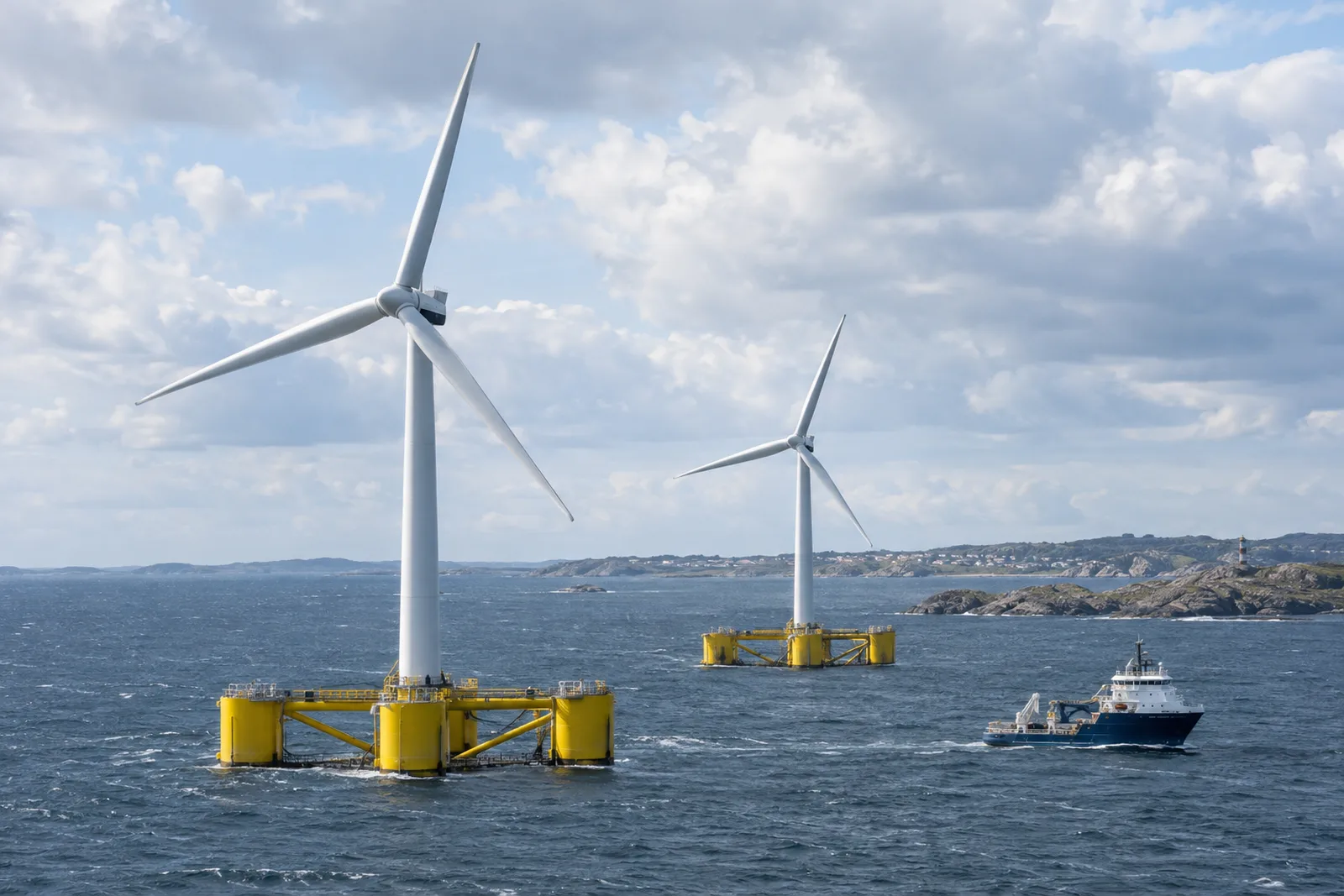
Each project plans to install two large turbines over the next five years at METCentre’s floating wind demonstration site off Karmøy in Rogaland. Every turbine will have a capacity of 18.5 megawatts, and together the four are expected to produce 300 million kilowatt-hours a year, enough to match the annual consumption of about 15,000 households, Enova says. The four turbines would match roughly 20 average onshore wind turbines.
Fram Wind Solutions is owned by BW Offshore (50 per cent), Grieg Kapital (35 per cent) and Fram Green Technology (15 per cent), and will use BW Ideol’s Damping Pool floating foundation, BW Offshore said. Fortius is being developed by Deep Wind Offshore, RenewEconomy reported.
Why it matters
Most offshore wind turbines stand on foundations fixed to the seabed, which only works in fairly shallow water. Floating turbines can be anchored in much deeper seas, where winds are often strong and steady, but they still cost far more. The two projects will test floating foundations for very large turbines, their mooring systems and ways of building and operating them, which Enova says are among the key areas where costs must fall.
‘Norway has particularly good prerequisites for developing floating offshore wind because we have a strong maritime industry and vast ocean areas with strong winds,’ said Oskar Gärdeman, Enova’s head of offshore wind. Market participants estimate that a successful global rollout could bring generation costs down to as little as NOK 1 per kilowatt-hour, according to a report Enova prepared for the Ministry of Energy.
The need is practical as well as climatic. ‘Norway is heading towards a power deficit, and this year’s dry season has shown what that means for Norwegian industry,’ Deep Wind Offshore wrote, RenewEconomy reported. Enova’s chief executive, Evy Glørstad, said both Norwegian industry and the transport sector need such power to cut their emissions.
If they succeed in making offshore wind technology profitable enough, it will be a major step toward faster, large-scale deployment of renewable power.
Evy Glørstad, chief executive of Enova
The wider picture
Norway already hosts the world’s largest floating offshore wind farm, Hywind Tampen, in the North Sea, Enova notes. France and the UK are also investing heavily; this summer France allocated EUR 63 billion to floating and fixed-bottom offshore wind over the next 25 years, Enova says. BW Ideol’s foundation is already in use at the 30 MW EolMed floating farm in France, which has generated electricity since May 2026, according to BW Offshore.
The projects were chosen through a competition that weighed the energy produced per krone of support, the potential for wider use of the technology, the carbon footprint, the impact on biodiversity and the prospects for low future costs. By GGND’s calculation, the support works out at roughly NOK 53 million per megawatt of capacity, a reminder that these are expensive experiments meant to make later projects cheaper.
Could it work elsewhere?
Many coastlines, from the Mediterranean to Japan and the US West Coast, have deep water close to shore, where fixed foundations are impractical. In GGND’s view, if these demonstrators show that the largest turbines can be floated, moored and maintained reliably, the lessons could travel well beyond Norway. Countries with shipyards and offshore oil and gas skills would be best placed to use them.
What remains unresolved
- Conditional money. The funding is only paid if the projects are carried out. Fram’s grant depends on reaching a final investment decision, securing financing and signing key supplier agreements within 24 months, BW Offshore said.
- A warning from the past. An earlier winner under the same programme, GoliatVind, lost its support after turbine supply problems, a missing concession and the deadline prevented it from keeping to its schedule, energynews.pro reported.
- Forecasts, not measurements. The 300 million kWh figure is a forecast for turbines that do not yet exist, energynews.pro noted, and real output will only be known once they run.
- The cost question. Norway’s parliament voted in June to review a separate NOK 35 billion subsidy for the 500 MW Utsira Nord floating wind project, Reuters reported, a sign of political doubts about how much public money floating wind should receive.
What happens next
Both companies now have to finalise designs, financing and supply contracts before building can start, with the turbines planned within five years. In GGND’s view, the first milestone to watch is whether both projects reach an investment decision within the two-year window; the second is whether the turbines deliver the promised cost lessons for Utsira Nord and beyond.
Sources
- Enova NOK 3.9 billion for two floating offshore wind projects (30 October 2026)
- BW Offshore 50% owned joint venture awarded NOK 1.94 billion Enova grant for floating offshore wind project (2 November 2026)
- Offshore Wind Norway Backs Two Floating Wind Demo Projects with EUR 381 Million (3 November 2026)
- RenewEconomy Norway to fund two floating offshore wind demonstrations in fresh push to drive down costs (2 November 2026)
- energynews.pro Enova backs two floating wind test projects at Norway’s METCentre site (30 October 2026)
- Reuters Norway parliament vote on subsidies review casts doubt on floating wind project (9 June 2026)
Analysis and context are by The GGND Team. Where we draw our own conclusions, we say so. To report an error, contact us.