What happened
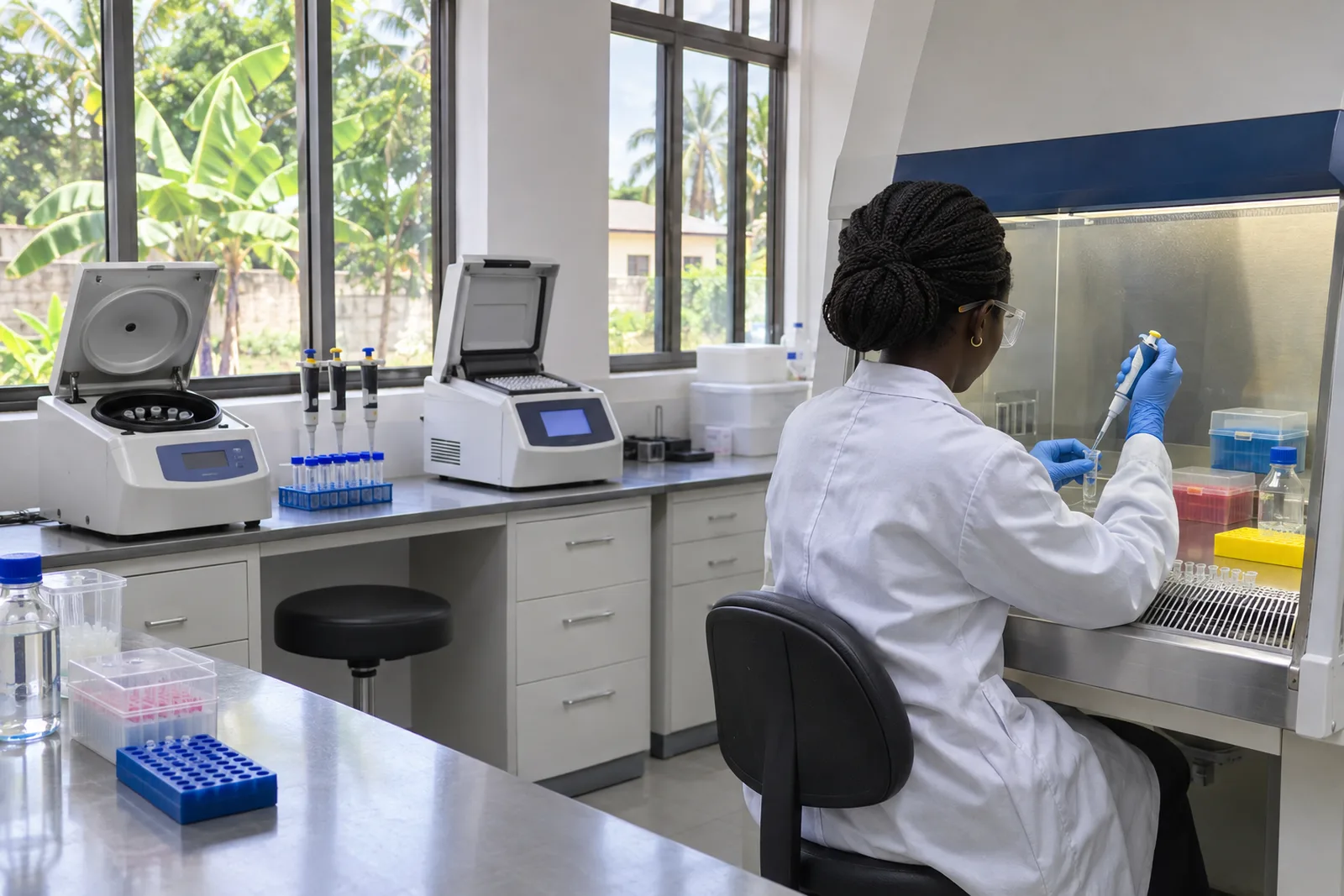
On 18 November, President John Dramani Mahama commissioned a human identification laboratory and new vaccine research and development laboratories, for mRNA and protein-based vaccines, at the Noguchi Memorial Institute for Medical Research (NMIMR) at the University of Ghana, GBC reported. The labs were supported under the WHO–EU Vax and Pharm Initiative, a 24-month project, the World Health Organization’s Africa office said.
The DNA laboratory answers a painful gap. After the helicopter crash at Adansi in the Ashanti Region on 6 August 2025, which killed eight people, samples had to be sent to South Africa for identification, Citi Newsroom reported. Ghana can now do that work at home.
Five Ghanaian scientists have been trained in mRNA technology: Prof Linda Eva Amoah, Prof Peter Kojo Quashie, Prof Augustina Angelina Sylverken, Dr Ruben Jani-Ayuvo and Dr Festus Kojo Acquah, GBC said. Mahama said Ghana is now “one of only five African countries using innovative mRNA technology to research and develop new vaccines”, Starr FM reported.
Why it matters
Ghana imports more than 70% of its medicines and 99% of its vaccines, according to Health Ministry figures from December 2025 cited by NewsGhana. In GGND’s view, that leaves the country exposed whenever global supplies run short.
The National Vaccine Institute’s chief executive, Dr Sodzi Sodzi-Tettey, said the first locally produced vaccine will be a tetanus-diphtheria (Td) vaccine. “We have set ourselves the timeline of 2027 to manufacture Ghana’s first vaccine, the Tetanus-Diphtheria vaccine, and we are really on track,” he said, MyJoyOnline reported. The first of three bulk substances has arrived from Indonesia and is at Atlantic Life Sciences, where the vaccine will be filled and finished, and the government fully funded the equipment and training, he said. Ghana needs at least US$50 million a year for vaccines, according to the NVI.
Mahama said his government had allocated $1 billion to support the pharmaceutical industry, the Ghana News Agency reported, and that $46 million had been provided this year for childhood vaccines.
These facilities represent an important investment in Ghana’s scientific capacity and its ability to take greater responsibility for its health security.
Dr Fiona Braka, WHO Representative to Ghana
The wider picture
The labs sit within a broader push. A national pharmaceutical manufacturing policy launched on 28 October 2026 aims for Ghana to produce 60% of its medicines locally within five years, NewsGhana reported. A Ghana Biomanufacturing Training Consortium is planned by the end of 2027 to train the workforce the industry will need, according to MyJoyOnline. NMIMR is led by its director, Prof Dorothy Yeboah-Manu.
Trust is part of the challenge. In 2015, an Ebola vaccine trial in Ghana was abandoned after misinformation spread, NewsGhana recalled. In GGND’s view, the scientific and public health gains from local vaccine research will depend as much on clear communication with communities as on laboratory equipment.
Could it work elsewhere?
Africa imports most of its vaccines, and the African Union wants far more to be made on the continent. Ghana’s approach is step by step: build research capacity, train scientists, start with fill-and-finish of a well-established vaccine, and work towards full production. In GGND’s view, that is a realistic model for other mid-sized countries, provided governments keep funding it after the donor-backed phase ends.
What remains unresolved
- Fill-and-finish, not yet full production. The 2027 Td vaccine will use bulk substance from Indonesia. Making the active ingredient in Ghana is a much bigger and later step.
- Money after the project. The WHO–EU initiative runs for 24 months. How the labs’ running costs and staff will be funded afterwards has not been set out in detail.
- From research to products. No specific mRNA vaccine candidate or trial timetable has been announced.
- Public trust. The abandoned 2015 Ebola trial shows how quickly misinformation can stop vaccine work.
What happens next
The National Vaccine Institute is preparing to fill and finish the Td vaccine in 2027, starting in the first quarter of the year, according to the Ghana News Agency. GGND will follow whether that date holds, how the DNA lab is used, and whether Ghana’s mRNA team announces its first research candidates.
Sources
- WHO Regional Office for Africa Ghana commissions human identification and vaccine research laboratories to advance health sovereignty (24 November 2026)
- GBC President Mahama commissions DNA, vaccine research laboratories at Noguchi (18 November 2026)
- MyJoyOnline / Ghana News Agency Ghana to produce first locally manufactured vaccine by 2027 – Mahama (20 November 2026)
- MyJoyOnline Ghana targets first locally manufactured vaccine by 2027 – NVI (19 November 2026)
- Citi Newsroom Mahama commissions vaccine and DNA laboratories at Noguchi Memorial Institute (18 November 2026)
- Starr FM Ghana mRNA vaccine development: Mahama commissions Noguchi labs (18 November 2026)
- NewsGhana Noguchi DNA laboratory opens as Ghana targets own vaccine (November 2026)
Analysis and context are by The GGND Team. Where we draw our own conclusions, we say so. To report an error, contact us.