What happened
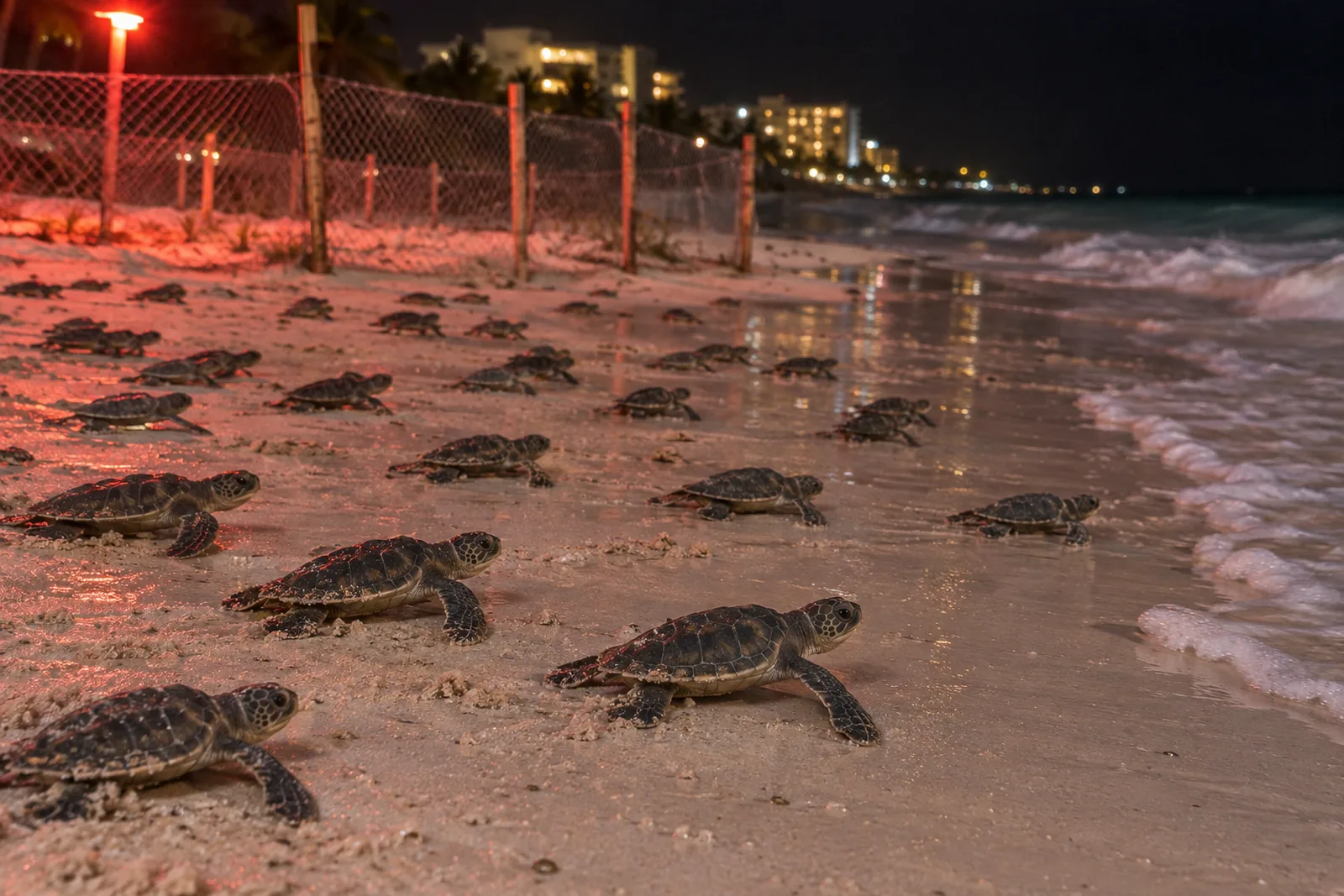
Cancún has closed the most successful sea turtle season in its records. Teams from the municipality of Benito Juárez protected 13,207 nests holding 1,512,591 eggs in 2026, and 1,362,537 hatchlings made it to the sea, Noticaribe reported on 22 November, citing the mayor, Ana Paty Peralta. Local outlets including Quinto Poder described it as a historic record.
Almost all of the nests belonged to green turtles (Chelonia mydas): 13,133 nests, 1,503,941 eggs and 1,354,613 hatchlings. Loggerheads (Caretta caretta) laid 64 nests, producing 6,775 hatchlings, and the critically scarce hawksbill (Eretmochelys imbricata) laid just 10, producing 1,149, SDP Noticias reported.
The work covers about 12 km of beach between Punta Cancún and Punta Nizuc, much of it in front of hotels. The city’s ecology department, led by Fernando Haro Salinas, ran 1,240 day and night patrols, kept 51 protection corrals where eggs are moved to incubate safely, and attended 38 strandings. It also gave 142 training courses to 3,078 people, including security guards, lifeguards and hotel staff, and bought off-road vehicles and quad bikes for the patrols, Lado.mx reported.
Why it matters
All three species nesting in Cancún are listed as endangered under Mexico’s NOM-059 standard, and the corrals operate under a permit from the environment ministry, Semarnat, Grupo Animal reported. The jump is large. In 2025 the city recorded 10,438 nests, more than 1.2 million eggs and more than 1.1 million hatchlings, according to the municipality. This year’s nest count is about a quarter higher.
The corrals seem to make a real difference. Nine in ten protected eggs became hatchlings that reached the sea this season, Lado.mx reported. Protected nests reach survival rates of about 90%, compared with between 30% and 70% for unprotected nests, Luces del Siglo reported in August. In GGND’s view, that is the core of the story: on one of the busiest tourist coasts in the Americas, nesting turtles are being given a better chance, not a worse one.
Temperature is a very important factor in determining sex.
Lorena Flores, biologist, Cancún ecology department (translated from Spanish)
The wider picture
Heat shaped this season. Hatching began about a week earlier than usual because of high temperatures, Grupo Animal reported in September. That matters because, in sea turtles, the temperature during incubation decides whether a hatchling is male or female. Lorena Flores, the biologist who directs natural resources management in the city’s ecology department, told Grupo Animal that eggs nearer the surface tend to become females and deeper ones males, and that eggs are arranged in each nest to aim for a balance of 50% females and 50% males.
The city has also tried to bring residents and visitors in. City teams held 55 talks and puppet shows reaching 651 people, and at the end of the season released 200 hatchlings at night on Playa Marlín, under strict measures including red light and gloves, Quinto Poder reported. Hotels play a direct part: some keep their own protection corrals, and in September the ecology department publicly praised one hotel for managing its corral well, a municipal notice shows. By then the city had already counted 10,407 nests, almost as many as in the whole of 2025.
Turtle nesting naturally rises and falls from year to year, because females do not nest every season. Cancún’s earlier peaks, in 2020 and 2023, each produced close to 1.2 million hatchlings, according to Luces del Siglo, and no leatherback nests had been recorded by August this year.
Could it work elsewhere?
Beach corrals and night patrols are used on nesting coasts around the world, and they do not need advanced technology. What stands out in Cancún is that a city government runs the work on hotel beaches and trains the people who are on those beaches every night, from lifeguards to security staff. In GGND’s view, that is the transferable lesson for other tourist coasts: the cheapest protection comes from the people who are already there, if they know what to look for and who to call.
What remains unresolved
- Hatchlings are not adults. Only a small share of hatchlings survive to breed, decades later. A record season says little yet about whether the populations themselves are growing.
- Natural swings. Nesting varies a lot between years, so one record does not prove a trend. Several more seasons are needed.
- Heat and sex ratios. Hotter sand is speeding up hatching and can tip nests towards females. How well the corrals can balance this as temperatures rise is unclear.
- Whose numbers. The figures come from the municipality, which runs the programme. We have not seen an independent count.
What happens next
Each year the municipality must ask Semarnat to approve a management plan for its turtle camp in the hotel zone, Grupo Animal reported, so the 2027 season will again run under federal oversight. GGND will look for the 2027 count, and for any published data on hatchling sex ratios, to see whether this year is the start of a trend or a good year in a naturally variable cycle.
Sources
- Noticaribe Récord de tortugas marinas en Cancún: nacen más de 1.3 millones de crías en 2026 (22 November 2026)
- SDP Noticias Cancún registra más de 13 mil nidos de tortugas marinas en 2026 (22 November 2026)
- Quinto Poder Cancún rompe récord histórico en conservación de tortugas marinas durante 2026 (22 November 2026)
- Lado.mx Cancún’s 2026 sea turtle season results (22 November 2026)
- Municipality of Benito Juárez Informa Dirección General de Ecología sobre manejo de corral de protección de tortugas marinas (8 September 2026)
- Municipality of Benito Juárez 2025 sea turtle season results (30 January 2026)
- Grupo Animal Calor adelanta eclosión de huevos de tortuga marina en Cancún (30 September 2026)
- Luces del Siglo La tortuga marina y el milagro de la vida nocturna en Cancún (3 August 2026)
Analysis and context are by The GGND Team. Where we draw our own conclusions, we say so. To report an error, contact us.