What happened
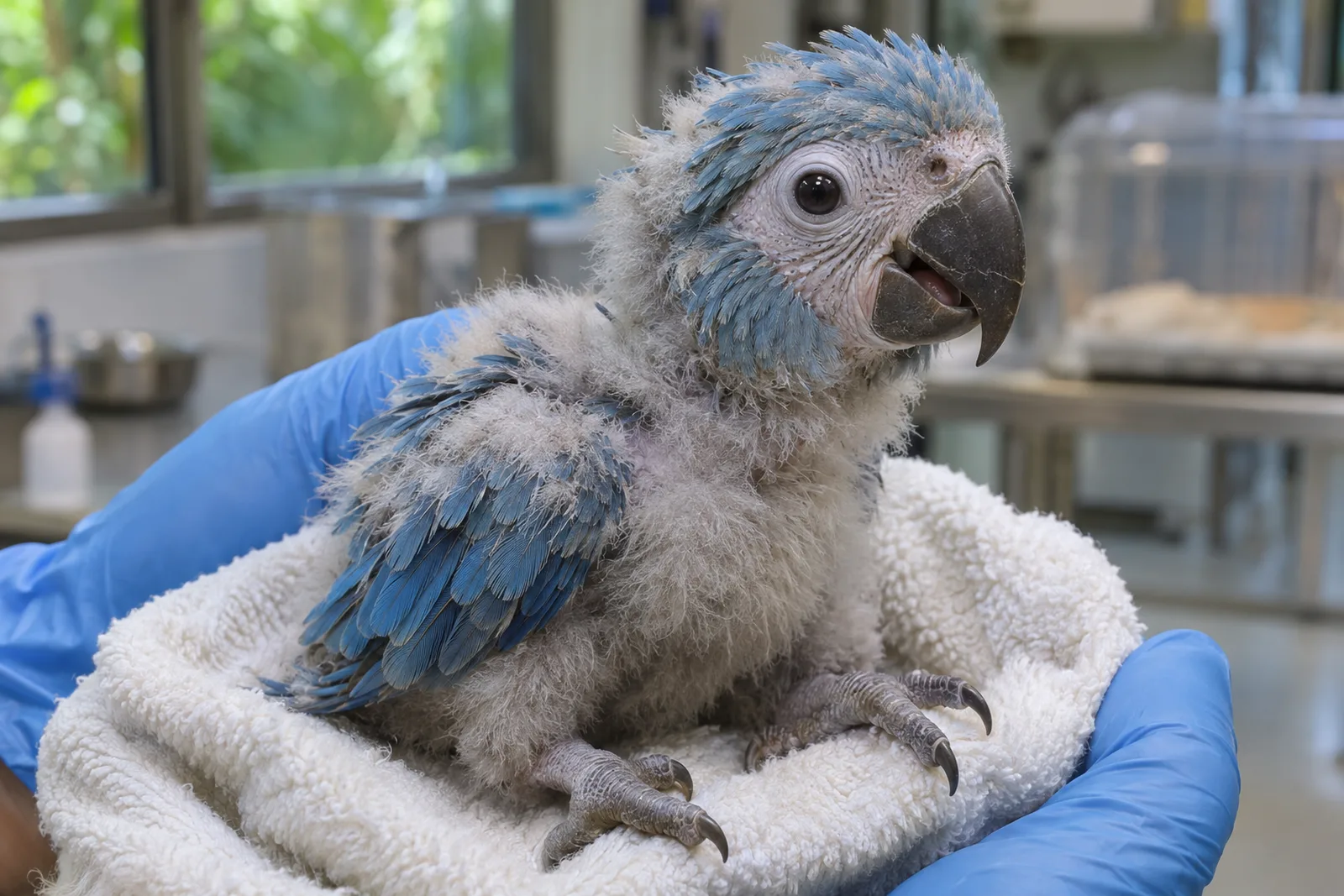
On Tuesday 24 November, São Paulo Zoo, Brazil’s environment ministry and the conservation agency ICMBio presented Hope, a female Spix’s macaw and the first of her species ever hatched in a Brazilian zoo, Agência Brasil reported. ICMBio and the environment ministry give her hatching date as 18 October; some other Brazilian reports say 25 October.
Hope weighed 12.4 grams. She was badly positioned in the egg and had reached the end of the incubation period, so keepers had to help her out. “It was 28 days of suffering until we saw her hatch. She needed help, we had to remove her from inside the egg because she was badly positioned,” Fernanda Guida, head biologist of the zoo’s bird division, told Reuters. “We chose ‘Hope’ because we hope we can give a better future to this species.”
Early days were hard. She refused the usual feeding syringe and had to be tube-fed, and the team practically slept beside her until the critical phase passed after about 15 days, Guida told El País. Now about a month old, she weighs around 350 grams and is growing blue feathers.
Why it matters
The Spix’s macaw, or ararinha-azul, comes from the Caatinga dry forest around Curaçá in Bahia. Deforestation and trapping for the pet trade wiped it out in the wild by 2000, and the IUCN lists it as Extinct in the Wild. About 330 birds survive, all in human care, according to ICMBio. Hope brings São Paulo Zoo’s flock to 28, about 8.5% of the world’s population.
The zoo’s role began in August 2023, when ICMBio’s bird centre asked it to take 27 macaws from a private breeder in Minas Gerais that had left the national conservation plan. The zoo then built a R$5 million, 900-square-metre conservation centre for up to 44 birds, opened in May 2024. The birds belong to the state and cannot be sold or sent abroad, El País reported. Success was not quick: last year the zoo had two pairs and 38 eggs, but no chicks, Guida said. Hope being female matters too, as most of the zoo’s birds are male.
Seeing this chick hatch after so much effort is a collective achievement and an incentive for us to keep moving forward.
Fernanda Guida, head of the bird department, São Paulo Zoo
The wider picture
Hope arrives during a crisis in efforts to return the species to the wild. Captive-bred Spix’s macaws were released near Curaçá in recent years under a partnership with the German-based Association for the Conservation of Threatened Parrots (ACTP), which held about half the world’s birds. ICMBio ended that agreement in 2024. In May 2025, seven birds tested positive for circovirus, which causes the incurable beak and feather disease, and a court later upheld ICMBio’s order to capture and test the free-flying birds, Mongabay reported. ACTP and its Brazilian partner disputed ICMBio’s account.
ICMBio has paused releases. “Because of circovirus among the reintroduced macaws, which led ICMBio to intervene in the programme and temporarily pause reintroduction, we are now focusing on strengthening breeding of the species in Brazil,” said Marcelo Marcelino, the agency’s director of biodiversity research, in a statement translated by GGND. In GGND’s view, that makes careful zoo breeding, with strict biosecurity, more important than ever.
Environment Minister João Paulo Capobianco said the chick raised hope of “seeing flocks of Spix’s macaws flying free in the Caatinga” again.
Could it work elsewhere?
Zoos have helped bring back species such as the California condor and the Przewalski’s horse. In GGND’s view, São Paulo shows that a national zoo can take on this role quickly when a government asks, but also that it can take years, many failed eggs and careful pairing by family tree before the first chick appears.
What remains unresolved
- Numbers. One chick barely moves a world population of about 330. Guida hopes for about ten breeding pairs; for now there are few.
- Genetics. The species is highly inbred and breeds slowly, El País reported, which raises the risk of poor health and low fertility.
- Disease. Circovirus has no cure. Releases cannot restart until the outbreak is understood and contained.
- Cooperation. The dispute between ICMBio and the former private partners over the wild birds and their care has not been settled.
What happens next
Hope will be hand-reared and closely monitored, with weekly health tests. The zoo hopes more pairs will breed in the coming seasons. GGND will follow whether more chicks hatch, and when ICMBio decides it is safe to return macaws to Curaçá.
Sources
- ICMBio Nascimento inédito de ararinha-azul no Zoo de São Paulo marca avanço na conservação da espécie (24 November 2026)
- Ministério do Meio Ambiente e Mudança do Clima Capobianco participa de celebração pelo nascimento de ararinha-azul no Zoológico de São Paulo (24 November 2026)
- Reuters Brazil zoo hails birth of Spix’s macaw chick as boost for species’ recovery (24 November 2026)
- Agência Brasil Extinct in the wild, Spix’s macaw chick hatches at São Paulo zoo (25 November 2026)
- El País ‘Hope,’ the macaw chick that could bring back a species that has been extinct in Brazil for over two decades (25 November 2026)
- Mongabay Virus outbreak deepens rift over return of Spix’s macaw to Brazil (28 October 2025)
Analysis and context are by The GGND Team. Where we draw our own conclusions, we say so. To report an error, contact us.