What happened
Bhutan has won the 2026 Earthshot Prize in the Protect and Restore Nature category. The five winners were announced on Tuesday 17 November at an Awards Night in Mumbai, India, hosted by the Prince and Princess of Wales, and each receives £1 million, the Earthshot Prize said. The other winners were PFAS-Free France, the Niue Ocean Wide Trust, the Indian electric rickshaw maker Mahindra Last Mile Mobility and the Danish energy company Ørsted.
Princess Chimi Yangzom Wangchuck received the award for Bhutan, the Bhutan Broadcasting Service reported. The prize recognises a country of about 800,000 people whose forests protect Himalayan water systems that help sustain 1.6 billion people downstream across South Asia, according to the organisers.
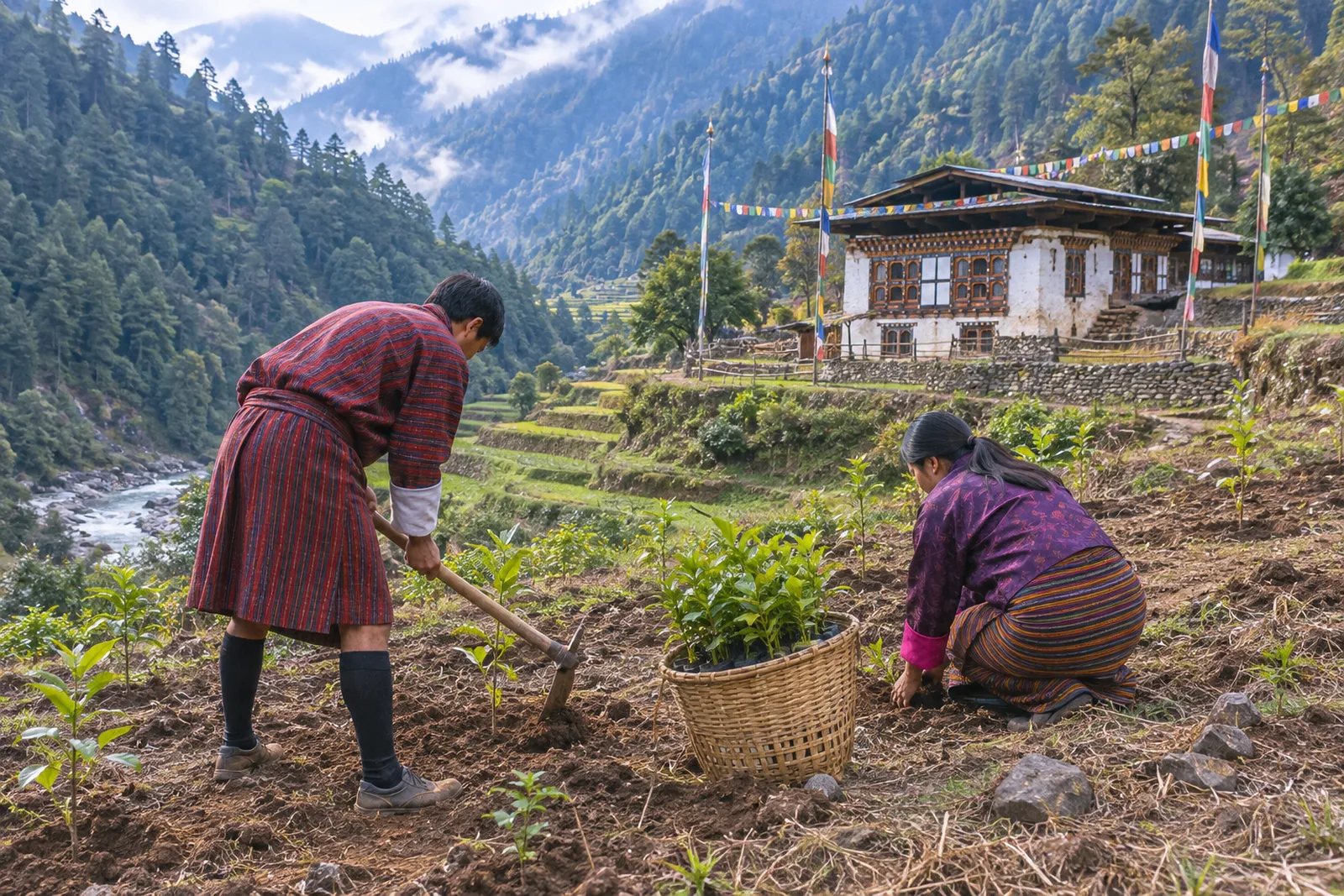
The money will go towards Restore Bhutan, a national programme launched in 2025. It aims to restore 50,000 hectares of degraded forests, farmland and urban land by 2030, store about 1.96 million tonnes of carbon dioxide and secure 133 billion litres of water, Mongabay reported.
Why it matters
Bhutan’s constitution requires at least 60% of the country to remain under forest for all time. It currently keeps nearly 70% under forest and protects more than half of its land through a national network of protected areas. The prize organisers say Bhutan absorbs more carbon than it emits, and that its forests and watersheds provide services, such as carbon storage and steady water supplies, worth an estimated US$14.5 billion a year, according to its Earthshot profile.
Holding on to forest is not the same as repairing damage, and Bhutan is under growing pressure. Nearly 2,000 of its water sources are drying, and forest fires affected almost 18,000 hectares between 2021 and 2024, the profile says. In GGND’s view, that is what makes this award interesting: it rewards a country for moving from protection to restoration, at a time when climate change is putting even well-protected land at risk.
In Bhutan, we believe that caring for nature is caring for ourselves.
Princess Chimi Yangzom Wangchuck, Royal Government of Bhutan
The wider picture
Restore Bhutan is run with the Department of Forests and Park Services, the Bhutan Trust Fund for Environmental Conservation, the Bhutan Ecological Society and Conservation International. Rather than rely on short-term grants, it plans to combine blended finance with Jurisdictional REDD+, a scheme that pays for verified, country-wide reductions in forest loss. It also says it will put community stewardship and Indigenous knowledge at its centre, alongside stronger fire management, according to the Earthshot Prize.
The princess linked the award to a long national tradition. “This vision began with His Majesty the Fourth Druk Gyalpo, Jigme Singye Wangchuck, who declared that 60 per cent of our land must remain under forest cover for all time,” she said, BBS reported. She added that Restore Bhutan was “more than an effort to restore degraded landscapes”.
The ceremony itself drew criticism. It was held at the Jio World Convention Centre in Mumbai, which is operated by Reliance Industries, and some conservation groups objected because of the company’s fossil fuel businesses and controversies around the Vantara animal facility, Mongabay reported. The prize told The Guardian the venue was chosen for practical reasons and that it paid the standard commercial rate. That criticism concerns the event, not Bhutan’s work.
Across all winners, the prize says its 2026 choices were informed for the first time by the science of “positive tipping points”, the moment when change starts to sustain itself, The Independent reported on the wider awards.
Could it work elsewhere?
Few countries can write a forest quota into their constitution and keep to it for decades. But parts of the model travel well: a single national restoration plan, long-term finance tied to verified results, and local communities doing much of the work. The Bhutanese government has said its experience “can offer lessons to other forest-rich, climate-vulnerable nations”, its Earthshot profile records. In GGND’s view, the most useful lesson is the order of things: protect what is left first, then restore, rather than planting new trees while old forest is still being lost.
What remains unresolved
- The scale of the money. £1 million is a welcome boost, but restoring 50,000 hectares in four years will need far more. How much of the blended and REDD+ finance has been secured has not been published.
- Whose numbers. The forest cover, carbon-negative status and US$14.5 billion value of ecosystem services come from Bhutan and the prize organisers. We have not seen an independent assessment of them.
- Climate pressure. Drying springs and forest fires show that even well-protected forests are at risk. Whether restoration can keep pace with these losses is an open question.
- Measuring success. It is not yet clear how progress towards the 50,000-hectare target will be tracked and reported publicly.
What happens next
The Awards Night will stream on Prime Video from 30 November, and all 15 finalists will get access to the prize’s network of businesses, investors and philanthropists, the organisers said. GGND will look for Restore Bhutan’s first progress figures, and for news of the finance it needs to reach 50,000 hectares by 2030.
Sources
- The Earthshot Prize 2026 Earthshot Prize Winners Crowned (17 November 2026)
- The Earthshot Prize Bhutan: 2026 Winner, Protect and Restore Nature (November 2026)
- Bhutan Broadcasting Service Bhutan wins 2026 Earthshot Prize in Protect and Restore Nature category (18 November 2026)
- Mongabay Bhutan wins $1.3m Earthshot Prize for maintaining 70% forest cover (18 November 2026)
- The Independent The five Earthshot Prize winners awarded £1million each to tackle climate crisis (18 November 2026)
Analysis and context are by The GGND Team. Where we draw our own conclusions, we say so. To report an error, contact us.