What happened
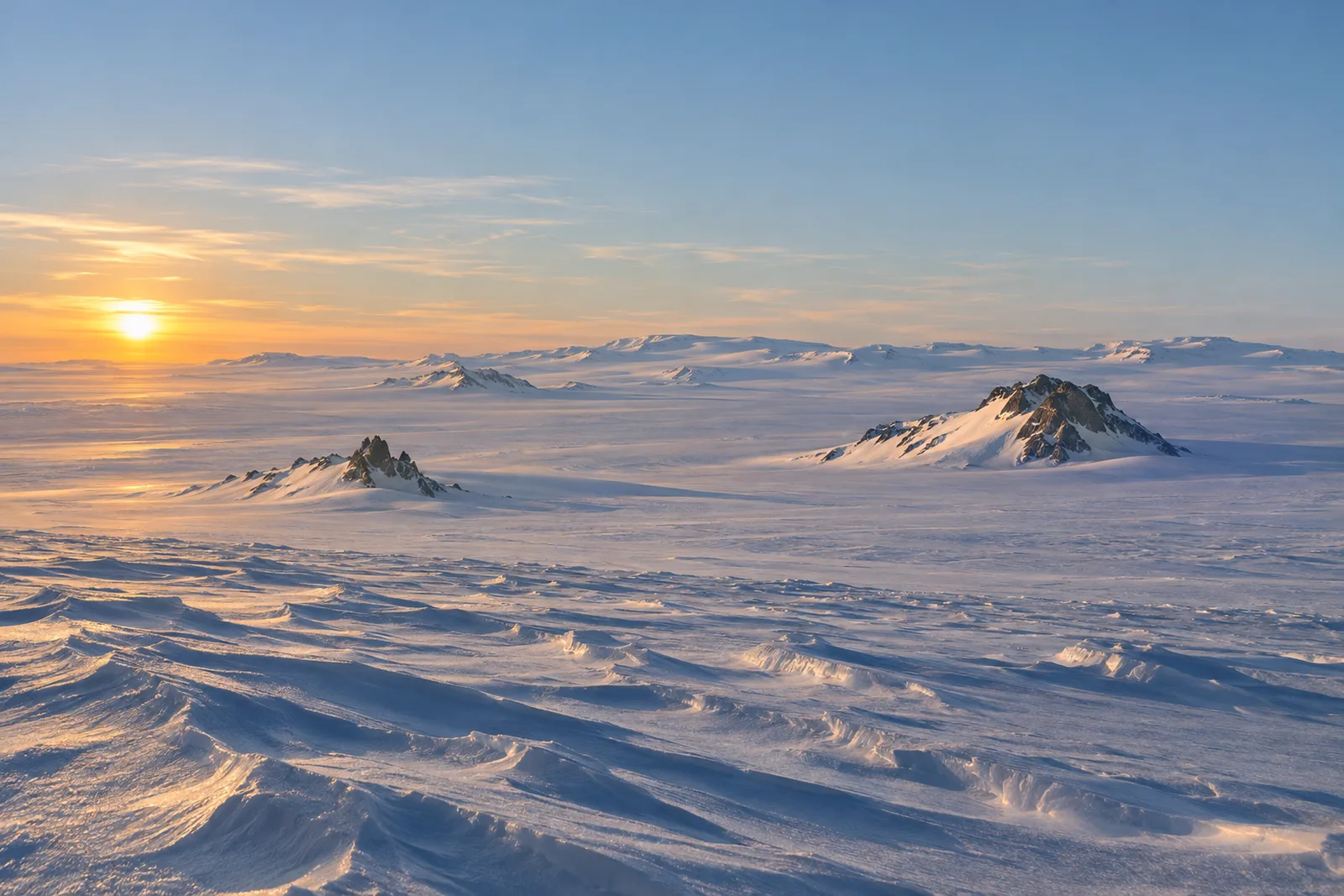
More than 99.5% of Antarctica is covered by ice, so its rocks are almost impossible to sample directly. Researchers at the Australian National University (ANU) and Germany’s GFZ Helmholtz Centre for Geosciences took a different route. They analysed 1,712 grains of zircon, a tough mineral that survives erosion, from sediments drilled from the seabed around the continent. Zircons record the age and conditions of the rocks they came from.
The grains point to previously unknown “supermountains” that formed between 650 and 450 million years ago, as the landmass that is now Antarctica collided with India and Africa during the assembly of the supercontinent Gondwana, ANU said on 18 November. “They are by far the largest mountain-building events to have affected Antarctica,” said Emeritus Professor Ian Campbell, who led the work with Dr Bei Chen of GFZ. The study appears in the journal Earth and Planetary Science Letters, and the samples came through the Australian office of the International Ocean Discovery Program.
Why it matters
The researchers compare the ranges in scale to the Himalayas, Euronews reported. Their age is what makes them interesting. The Cambrian period, from about 539 to 485 million years ago, saw the sudden spread of complex animal life, known as the Cambrian explosion.
The authors argue that as the mountains eroded, they released vast amounts of nutrients into the oceans and helped bury carbon, which lowered carbon dioxide and raised oxygen in the atmosphere, conditions that favoured larger, more complex animals. According to Live Science, the Gondwana mountain-building produced around one-fifth of the world’s zircons, compared with 14% for the later supercontinent Pangaea, which the authors read as a sign of how extraordinary these mountains were.
It is unlikely to be a coincidence that Earth’s dramatic period of evolution coincides with Earth’s most important period of mountain building: the formation and erosion of the Gondwana supermountains.
Ian Campbell, Emeritus Professor, Australian National University
The wider picture
Not everyone is convinced by the link to evolution. Nathan Daczko, a geologist at Macquarie University, told Live Science the connection is “an exciting hypothesis rather than an established causal relationship”. Elias Rugen of the University of Southampton said: “It is really difficult to infer a mountain’s height from data like this.” He added that “the methods used in this study cannot directly demonstrate that this particular mountain belt was directly responsible for the rise in oxygen or the Cambrian Explosion.” Alan Collins of the University of Adelaide was more supportive, saying the work fits the idea that Gondwana’s mountains were among the largest on Earth.
Even sceptics agree on the value of the data. “The study highlights just how much geological history remains hidden beneath Antarctica,” Daczko said. The work adds to other recent efforts to map the landscape under the ice, including new maps of the bed beneath the ice sheet, Geographical reported. Knowing the shape and roughness of the ground beneath the ice helps scientists model how the ice sheet flows, which feeds into forecasts of future sea-level rise.
In GGND’s view, this is good news of a quieter kind: international scientific drilling, shared samples and careful lab work are filling in a blank part of Earth’s history, and the open disagreement among experts is how science is meant to work.
Could it work elsewhere?
The method, reading the history of hidden land from mineral grains carried away by rivers and ice, can be used wherever rock is buried or out of reach. In GGND’s view, the more ocean-drilling cores that are shared and re-examined, the more of Earth’s deep past can be reconstructed without ever reaching the bedrock itself.
What remains unresolved
- Cause or coincidence. The timing fits the Cambrian explosion, but other geologists say the study cannot show the mountains caused it.
- Height. Zircons record how rocks formed, not how tall the mountains were, so comparisons with the Himalayas are an interpretation.
- Location. The grains came from seabed sediments, so exactly where the mountains stood under the ice is still uncertain.
What happens next
The findings will be tested by other researchers using new samples, ice-penetrating radar and models of ancient ocean chemistry. GGND will watch for studies that either strengthen or challenge the link between Gondwana’s mountains and the rise of complex life.
Sources
- ANU Reporter Discovery of previously unknown Gondwana supermountains found under Antarctic ice (18 November 2026)
- Earth and Planetary Science Letters Chen and Campbell, study of Antarctic detrital zircons (2026)
- Live Science Ancient supermountains under Antarctica supercharged complex life on Earth, study claims, but not everyone agrees (November 2026)
- Euronews Himalaya-sized ancient supermountains found beneath Antarctica’s ice sheet (20 November 2026)
- Geographical Evidence of Himalayan-scale supermountains found beneath Antarctica (24 November 2026)
Analysis and context are by The GGND Team. Where we draw our own conclusions, we say so. To report an error, contact us.