What happened
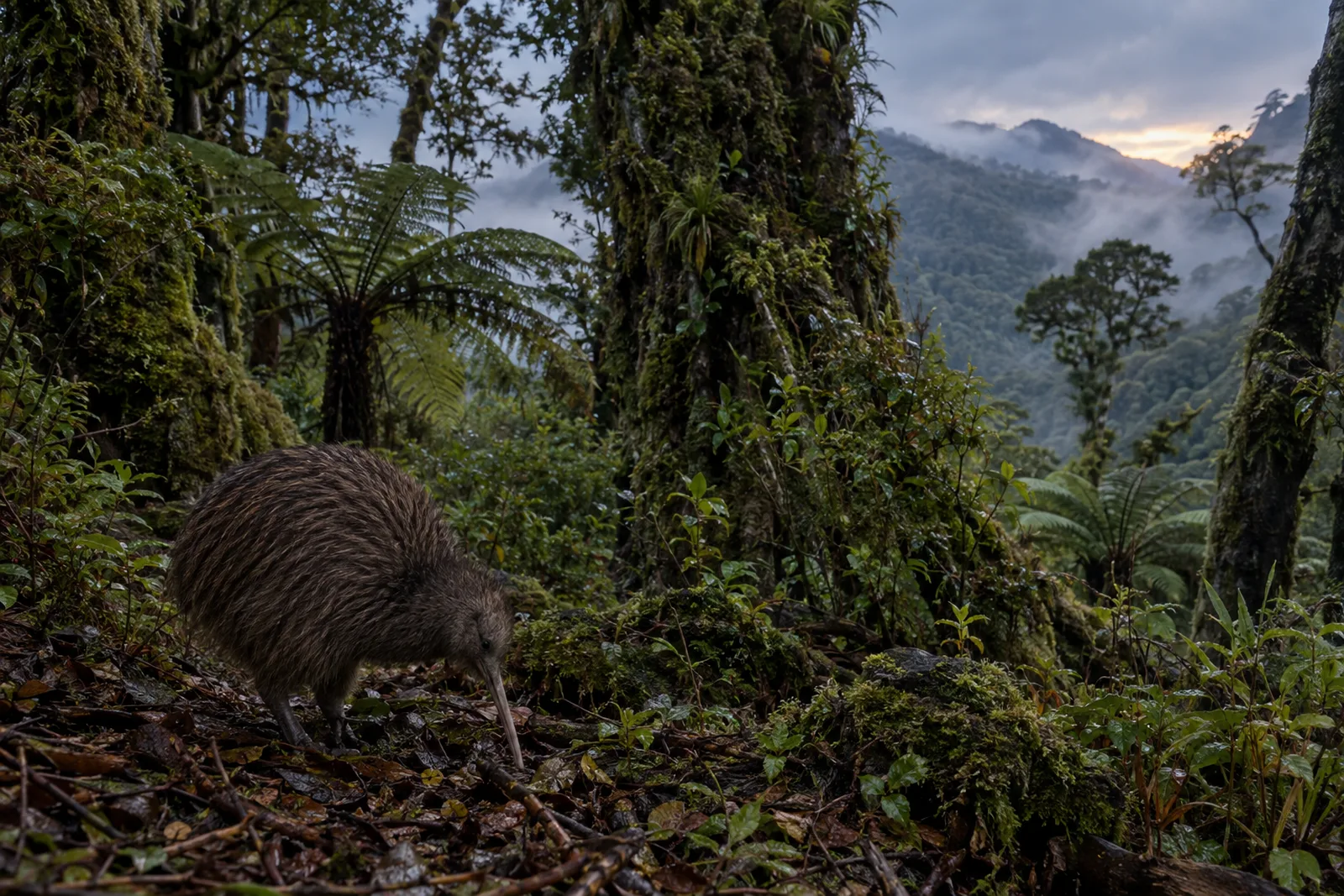
In August 2026, helicopters spread cereal bait containing the pesticide 1080 over nearly 50,000 hectares of the Raukūmara Range on New Zealand’s East Cape. Afterwards, the restoration team checked tracking tunnels, small boxes with ink pads that record the footprints of animals walking through. In one area, the share of tunnels showing rats fell from 80% before the operation to zero afterwards, RNZ reported on 22 October. Then a trail camera filmed a kiwi walking through the forest.
“It’s super exciting... a big booty kiwi! The first time we saw it on the trail cam the screams of joy coming from our team was just fantastic,” Ora Barlow, a trustee of Raukūmara Pae Maunga, told RNZ. The project’s own operation page records that the toxic bait drop for Block 1 ran from 8.18am on Monday 24 August to 9.30am on Tuesday 25 August, covering 48,150 hectares, after a non-toxic pre-feed over 50,391 hectares earlier in the month.
Why it matters
The Raukūmara covers 250,000 hectares and is the largest continuous native forest left in the North Island. But after generations of neglect, its trees are dying, its canopy is collapsing and birdsong is scarce, the project says. Deer, goats and pigs have stripped the understorey, while possums, rats and stoats eat leaves, eggs and chicks. Barlow described what local people saw when the team took them into the forest: “The loss of young forest growth, the silence of the forest, the 1000-year-old trees that had fallen down and been eaten from inside out.”
A forest with no rats, even for a while, gives ground-nesting birds like kiwi a chance to raise young. The kiwi on camera also answers a fear many people hold about 1080, that it wipes out everything.
These kiwi have been holding in there. They’ve been present pre and post 1080, so no - 1080 doesn’t kill everything.
Ora Barlow, Raukūmara Pae Maunga trustee, speaking to RNZ
The wider picture
Raukūmara Pae Maunga was set up in 2020 as a partnership between Ngāti Porou, Te Whānau-ā-Apanui and the Department of Conservation, with $34.4 million from the government’s Jobs for Nature scheme. Its five-year restoration report, published in January 2026, says it removed more than 10,300 feral deer and more than 2,000 feral goats across 110,000 hectares, Aotearoa’s largest indigenous-led deer management operation, and cut possum and rat numbers by 99%. It reports that no 1080 was detected in water. An earlier operation treated 117,215 hectares, including 40,000 hectares of private Māori land. The project has also planted 15,000 native trees and created jobs for descendants of the two iwi.
Winning local trust took time. “Our people have a deep relationship with the whenua, and the awa, and the ngahere... so when you’re talking about putting a toxin into that environment of course people are going to have concerns and questions,” Barlow told RNZ. She herself changed her mind: “I used to be anti-1080 but now I realise that wasn’t based on good information.” Wiremu Wharepapa, from Te Kaha, who has hunted in the range since he was a boy, said: “We’re in and out of the ngahere now, so it’s like our backyard - it was always our backyard - and it is our backyard.”
Could it work elsewhere?
The methods are well known in New Zealand. What is unusual is the leadership and scale. The project describes itself as the only integrated large-scale operation of its kind in the country, combining deer and goat control with aerial pest control, community water monitoring and training. In GGND’s view, the transferable lesson is about consent as much as technique: the team took sceptical neighbours into the forest to see the damage, held roadshows and water-monitoring days, and let people who live there lead.
What remains unresolved
- One area, one moment. The zero result comes from one area of the operation, measured shortly afterwards. Rats breed fast and can recover quickly, so repeated control will be needed.
- Toxin concerns. 1080 is poisonous to people, dogs and game animals, and the project warns that carcasses stay dangerous to dogs for four to eight months or longer. Some whānau still have questions.
- Funding gap. In October 2025 the government committed $6 million over three years, which the project says covers about a third of the annual investment it needs to keep working at scale.
- Proof of recovery. Fewer pests is a means, not the goal. The real test is whether seedlings, birdsong and kiwi numbers increase over the next decade.
What happens next
Raukūmara Pae Maunga became a charitable trust in December 2025 and is seeking long-term partners and donations to fill its funding gap. Its chair, Michelle Hippolite, put the mood plainly in January: “The ngahere is responding, our people are trained, we have momentum: the Raukūmara is forgotten no more.” GGND will follow the monitoring results, and whether the kiwi on the trail camera is joined by chicks.
Sources
- RNZ No traces of rats found in part of Raukūmara Forest where population of kiwi live (22 October 2026)
- Raukūmara Pae Maunga Aerial 1080 Operation Block 1: updates (August 2026)
- Raukūmara Pae Maunga Report shows outsized impact as Iwi-led conservation project turns charitable trust (21 January 2026)
- Department of Conservation Jobs for Nature case study: Raukūmara Pae Maunga
Analysis and context are by The GGND Team. Where we draw our own conclusions, we say so. To report an error, contact us.