What happened
Peru’s Ministry of the Environment (MINAM), working through the Research Institute of the Peruvian Amazon (IIAP), has sown 1,000 hectares of land damaged by forest fires and farming in the districts of Yarinacocha, Campo Verde and Callería, in Ucayali’s Coronel Portillo province, the IIAP announced. The work was carried out during 2026 and announced on 22 November, the state news agency Andina reported.
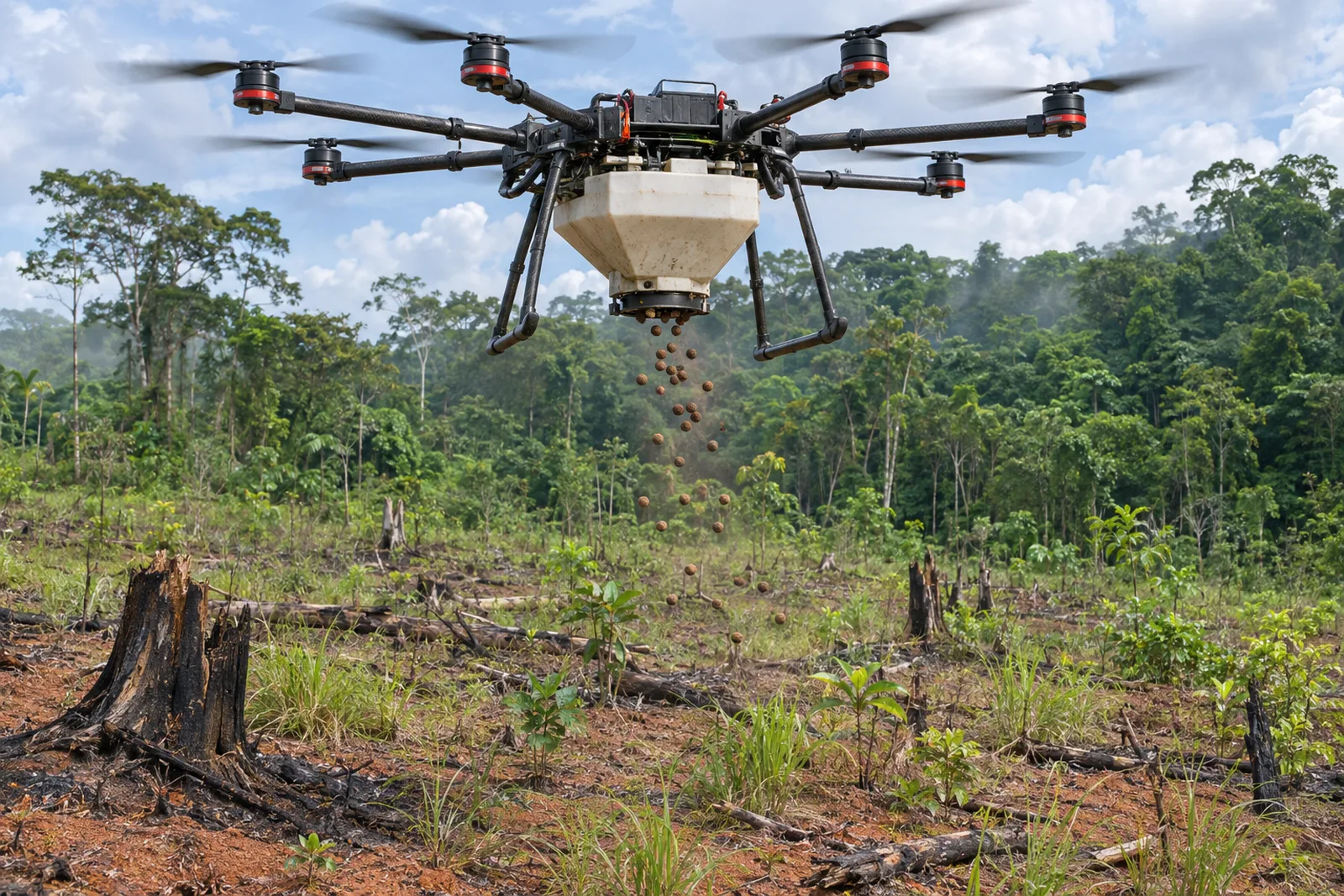
Heavy-lift agricultural drones dropped more than five million “restoration spheres” over secondary forest and degraded ground. IIAP researcher Edinson López explained that each sphere wraps native seeds in alluvial soil and organic fertiliser, protecting them from predators and the sun until the rains come. When the rain arrives, the sphere softens, releases its nutrients and lets the seed take root.
The mix uses seven fast-growing pioneer species: bolaina blanca, capirona, topa, cetico, sangre de grado, shaina and achiote. These plants colonise open ground quickly, shade out invasive weeds and add organic matter, creating conditions for the wider forest to return, López said.
Why it matters
Fire is a growing threat in Ucayali. By early September 2026, 46 forest fires had been reported in the region, 41 of them in Coronel Portillo, according to figures cited by Peru’s ombudsman’s office and reported by La República Sostenible. Land left bare after burning can stay degraded for years, especially where soil is poor and seed trees are far away.
The method is designed to be cheaper and faster than planting by hand. It avoids the stress of transplanting and the cost of carrying bagged seedlings into hard-to-reach areas, the IIAP said. In 2025 the institute said the technique could cover up to 50 hectares a day.
A tangible way of giving life back to the forests that are a source of water and climate regulation for our communities.
Carmen García Dávila, Executive President of the IIAP, October 2025 (translated from Spanish)
The wider picture
The Ucayali work builds on earlier campaigns. Between 2024 and 2025, the IIAP said it had treated more than 1,315 hectares in San Martín, Ucayali and Loreto, with germination above 40%, and it set a target of 2,000 more hectares when it launched its 2025 campaign. The institute linked the effort to Peru’s national strategy to restore 3.2 million hectares of degraded ecosystems by 2030.
The numbers so far are promising but early. Monitoring of earlier sites shows average germination of about 40%, and the IIAP estimates that this could establish 800 to 1,000 trees per hectare in Ucayali, enough to close the canopy. In a separate presentation in November, IIAP researcher Carlos Abanto reported preliminary germination of 48% to 62% and seedling survival of 41% to 45%, using 5,000 spheres per hectare, and described the technique as a complementary option rather than a complete answer.
La República Sostenible pointed out that the 800 to 1,000 trees figure, in GGND’s translation, “is an estimate that must be checked against the results of the scientific monitoring”. In GGND’s view, that is the right caution. The official release says the land was “restored”, but what has happened so far is sowing; restoration is what monitoring will, or will not, confirm.
Could it work elsewhere?
Drone seeding is being tried across the world, including in Argentina, where GGND reported on monkey puzzle seeding in October. In GGND’s view, Peru’s approach stands out for using a mix of local pioneer species and for publishing a monitoring plan with permanent plots. The IIAP stresses that timing matters: spheres must be dropped between the end of the dry season and the start of the rains, on exposed soil close to remaining forest.
What remains unresolved
- Seeds are not trees. Germination of about 40% is encouraging, but survival over several years is what turns seedlings into forest.
- Early days. First results from the Ucayali plots come six months after sowing, with checks at 12 and 24 months.
- The causes remain. Fires linked to farming and land clearing continue; newly sown areas could burn again without prevention.
- Cost and scale. The releases do not give the cost per hectare or compare it with natural regeneration or hand planting.
What happens next
The IIAP has set up permanent measurement plots near Pucallpa to track how many spheres land, how many seeds germinate, and how the seedlings grow and survive. GGND will look for the six-month results and for news of fire prevention in the sown areas.
Sources
- Research Institute of the Peruvian Amazon (IIAP) MINAM: IIAP restaura 1 000 hectáreas degradadas en Ucayali mediante dispersión aérea de semillas con drones (23 November 2026)
- Agencia Andina Incendios forestales en Ucayali: Minam recuperará 1 000 hectáreas de bosques afectados (22 November 2026)
- La República Sostenible Incendios forestales en Ucayali: Minam restaurará bosques (23 November 2026)
- Ministry of the Environment (MINAM) IIAP comparte técnicas de restauración de áreas por incendios forestales en eventos académicos (15 November 2026)
- Research Institute of the Peruvian Amazon (IIAP) Campaña 2025 de Restauración de Bosques Amazónicos afectados por incendios forestales (31 October 2025)
Analysis and context are by The GGND Team. Where we draw our own conclusions, we say so. To report an error, contact us.