What happened
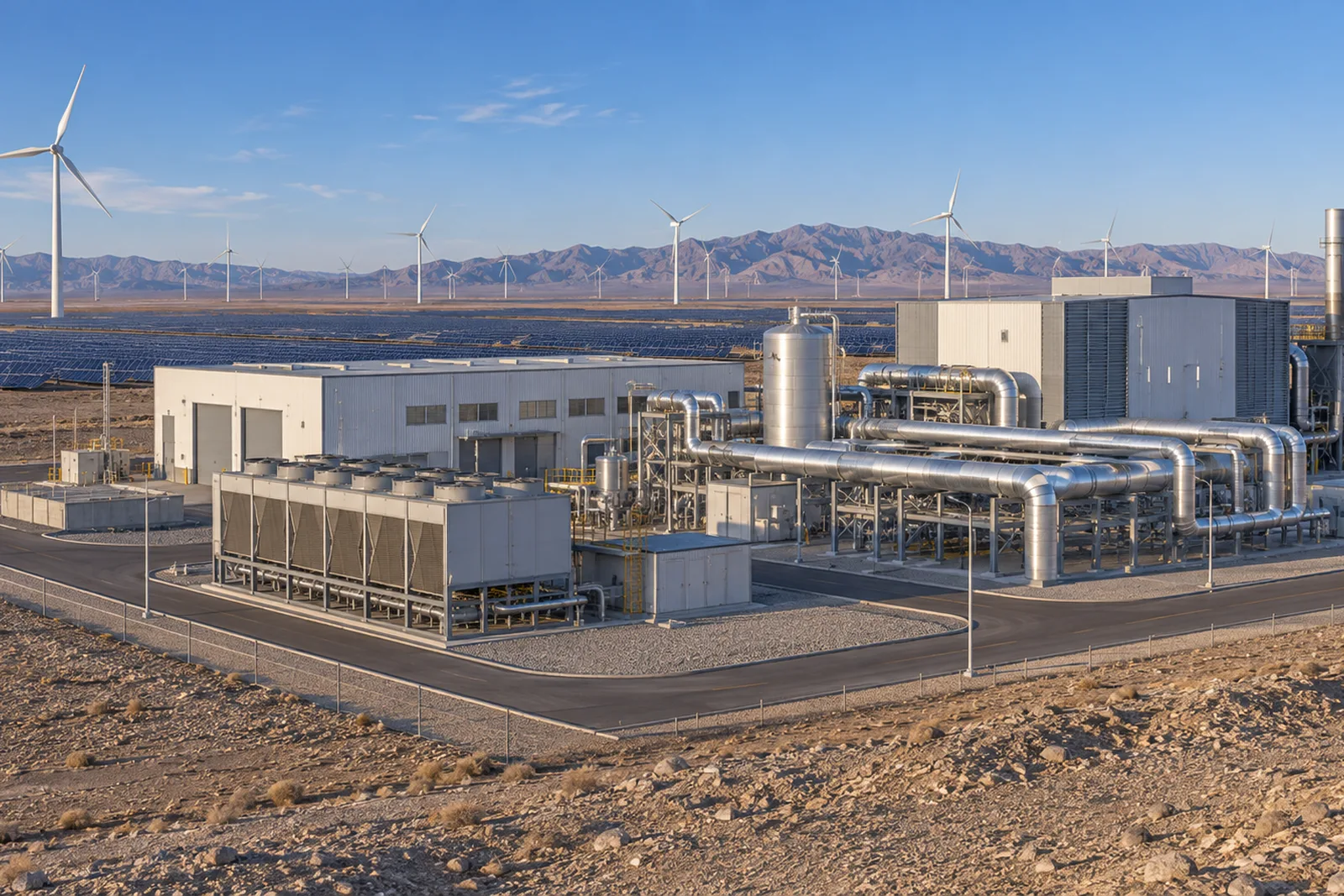
On 16 November 2026, a power station called Yuanchu No. 1 in Yumen, in Gansu province’s Jiuquan region, sent electricity to the grid for the first time. According to Science and Technology Daily, republished by China’s state assets regulator SASAC, it is the world’s first 300-megawatt compressed air energy storage plant built in artificially excavated caverns. It was developed, financed, built and is operated by CEEC Digital Technology Group, part of the state-owned China Energy Engineering Corporation, and is a national pilot project for new types of energy storage.
The idea is simple. When there is spare electricity, often from wind and solar farms, compressors force air into sealed underground spaces. When power is needed, the high-pressure air is released to drive turbines. At Yuanchu No. 1, four caverns with a total volume of about 200,000 cubic metres were dug into rock 110 metres underground, CGTN reported. The plant can store 1,800 megawatt-hours, takes eight hours to charge and six hours to discharge, has a design pressure of 18 megapascals and converts 72 per cent of the electricity it takes in back into electricity, according to SASAC. One full charge, it said, could charge 30,000 electric vehicles.
The company says the plant will produce about 600 million kilowatt-hours a year. A CEEC Digital release reproduced by China Nengyuan put the investment at about 2.5 billion yuan and said the station is designed to run about 330 days a year.
Why it matters
Solar and wind do not always produce power when people need it. Most of China’s new storage is short: only 27.6 per cent of installed capacity at the end of 2025 could run for four hours or longer, Global Times reported, citing the National Energy Administration. In GGND’s view, a plant that can discharge for six hours helps shift clean power from day to night, which is exactly the gap that matters as more wind and solar is built.
Until now, large compressed air plants in China mostly relied on natural salt caverns. Global Times, citing China Electric Power News, reported that suitable salt formations are concentrated in central, eastern and southern China, while the north, where many big wind and solar farms are, lacks them. Hard-rock caverns can be dug in many more places, including the Gobi desert. CEEC Digital earlier built a salt-cavern plant, Nengchu No. 1 in Yingcheng, Hubei, according to the company release.
Song Yuwen, a CEEC Digital official, said the project verified the reliability and practicality of the technology and filled gaps in standards for siting, design, construction, commissioning and operation of such plants (GGND’s translation from the Chinese).
China has become the only country in the world to master the full set of technical routes for artificial cavern compressed air energy storage.
Wan Mingzhong, chief expert, China Energy Engineering Corporation
The wider picture
China’s storage sector is growing very fast. Its installed new-type energy storage reached 136 million kilowatts at the end of 2025, up 84 per cent in a year, Global Times reported, citing the National Energy Administration. Lithium-ion batteries made up 96.1 per cent of that, with compressed air, flow batteries, flywheels and other technologies sharing the remaining 3.9 per cent. A plan for 2026 to 2030 sets a target of 300 million kilowatts of new-type storage by 2030.
Wan Mingzhong, chief expert at China Energy Engineering Corporation, told CGTN the plant could be paired with nearby wind and solar farms to create “a ‘generation-plus-storage green power station’ model”. In September, a pressure test in the plant’s No. 4 cavern reached 12.63 megapascals, which the company called a record for large artificial caverns, Global Times said. People’s Daily also reported the grid connection.
Could it work elsewhere?
In principle, yes. Many countries with large solar and wind resources have deserts and hard rock but no salt caverns. In GGND’s view, the bigger question is cost rather than geology. Digging and sealing high-pressure caverns is expensive, and a plant like this has to compete with batteries and with pumped hydro where hills and water allow. Independent data on Yuanchu No. 1’s real costs and performance will decide whether others copy it.
What remains unresolved
- Who checked the numbers. The efficiency, output and cost figures come from the state-owned developer and Chinese state media. GGND found no independent assessment yet.
- Only just connected. 16 November marked the first grid connection. How the plant performs over months and years of daily cycling is not yet known.
- Energy lost. At 72 per cent efficiency, more than a quarter of the electricity put in is lost on the round trip.
- Cost. Global Times noted that construction costs for hard-rock caverns are relatively high. Whether the 2.5 billion yuan investment pays back has not been shown.
What happens next
The plant now moves from first connection towards regular operation alongside the region’s wind and solar farms. GGND will look for operating data and for any new rock-cavern projects, inside or outside China.
Sources
- SASAC / Science and Technology Daily World’s first artificial-cavern compressed air energy storage station connected to the grid (in Chinese, 16 November 2026)
- CGTN First 300-MW artificial cavern compressed air energy storage station operational (16 November 2026)
- Global Times World’s first 300-MW artificial-cavern compressed air energy storage plant connected to grid in China (16 November 2026)
- China Nengyuan (CEEC Digital release) Yuanchu No. 1 grid connection (in Chinese, November 2026)
- People’s Daily Report on Yuanchu No. 1 (in Chinese, 17 November 2026)
Analysis and context are by The GGND Team. Where we draw our own conclusions, we say so. To report an error, contact us.