What happened
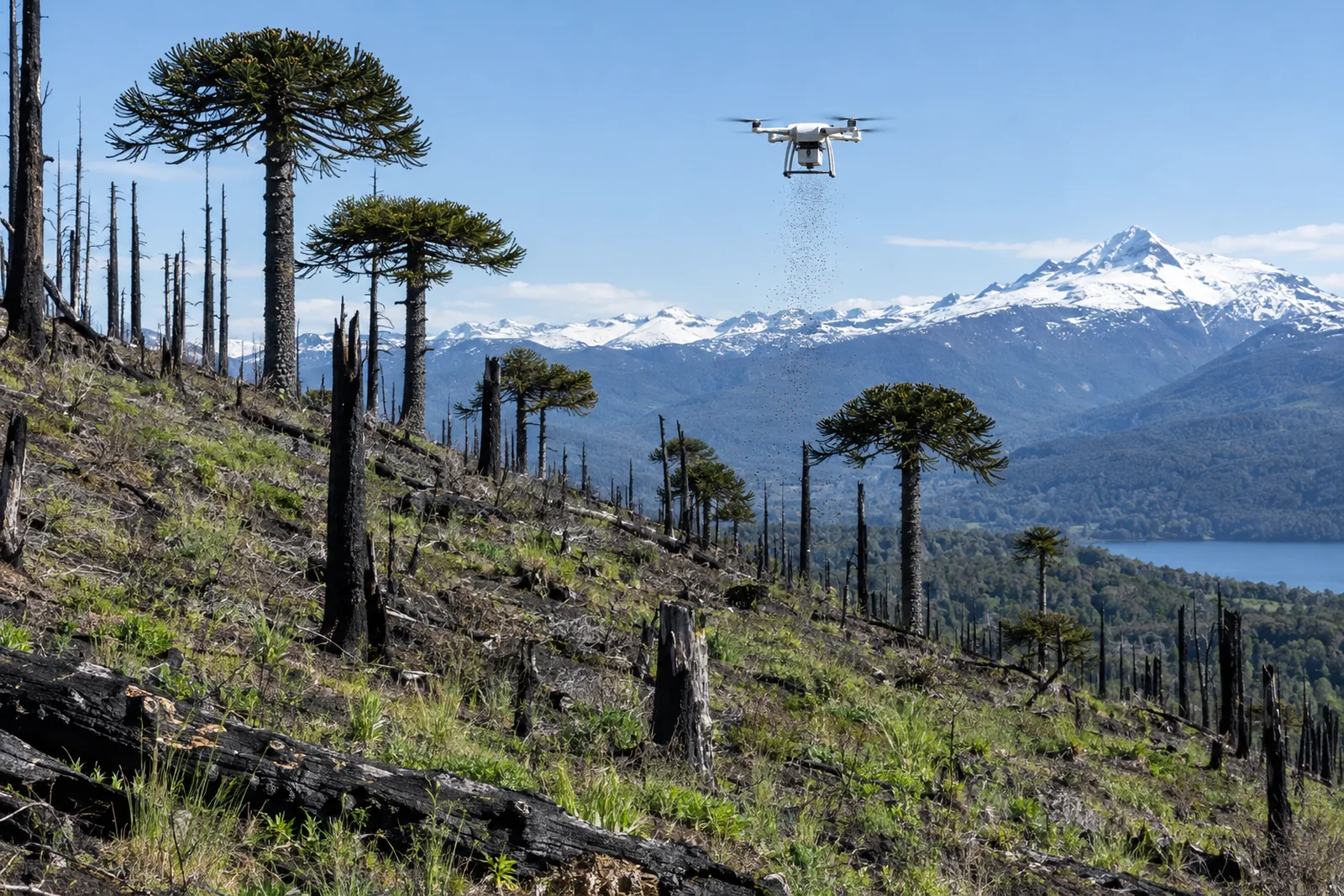
Between 15 and 19 October 2026, a team in Lanín National Park in Neuquén, northern Patagonia, tested a new way to bring back one of the world’s oldest kinds of tree. On a 40-hectare plot at Ñorquinco, mapped in detail beforehand, a single drone sowed seeds of the pewen, or monkey puzzle tree (Araucaria araucana), across the whole area in a day and a half, Argentina’s National Parks Administration (APN) reported.
Getting there was the hard part. On the first day the team set up a base camp on the mountain. Drones carried up equipment and supplies, while 300 kilograms of seeds went up on horseback with the help of park rangers and Mapuche residents known as the Protectors of the Pewen. Researchers then measured how densely the seeds had landed in permanent plots, to set a baseline and estimate how many plants per hectare might grow. The trial also tested a biotechnological seed treatment designed to stop wildlife eating so many of the seeds.
Why it matters
The pewen can live for more than 1,100 years and reach 50 metres in height. It is listed as Endangered on the IUCN Red List and appears in Appendix I of CITES, the strictest trade category. For the Mapuche communities who live in the area, it is at the centre of their worldview and their sense of belonging to the land, APN says.
It is also a tree that struggles to come back on its own. It grows slowly, and its large seed, the piñón, falls close to the parent tree. If a fire kills the seed-bearing trees, the forest can take centuries to recover, and the land may degrade before new trees appear, as La Nación explains. At Ñorquinco, a large fire in 2013 burned about 1,500 hectares of native forest. Drones could put seeds on steep, remote slopes where planting by hand is slow and dangerous.
The challenge, then, is to speed up the forest’s recovery before the degradation becomes irreversible.
Argentina’s National Parks Administration (APN), 20 October 2026, translated from Spanish
The wider picture
The drone trial is a new phase of an old effort, not a replacement for it. The Proyecto Pewen has brought together scientists, park staff, Mapuche communities, local groups and volunteers for more than two decades. A year after the 2013 fire, a diagnosis, severity analysis and restoration plan were drawn up. Since 2021, the project has fenced the area and planted 50,000 young pewen and coihue (Nothofagus dombeyi) trees, a first stage that APN describes as completed successfully.
The new work is led by the park with ReForest Latam, a company that combines biotechnology, drones and ecosystem analysis. It follows four phases, according to APN: mapping each area, collecting native seeds of local genetic stock and coating them with biostimulants, dropping them by drone into microsites that suit germination, and monitoring in the field. A scientific committee led by Dr Thomas Kitzberger of CONICET–INIBIOMA decides what to restore, where and how. Partners include the Consejo Zonal Pewenche, the Ñorquinco Mapuche Community, the Protectors of the Pewen of Ñorquinco and Aigo, researchers from INIBIOMA-CONICET and IANIGLA-CONICET, Amigos de la Patagonia, the Corporación Interestadual Pulmarí and Neuquén’s Under-Secretariat of Production, NoticiasNQN reports.
Could it work elsewhere?
That is exactly what the trial is meant to find out. If the method proves effective, it will be used across 200 hectares in 2027, and APN says the results could guide restoration of other degraded areas of Patagonia in the short and medium term, as Realidad SM also reports. Drone seeding is already being tried elsewhere in Argentina, including in the forests of the Gran Chaco with The Nature Conservancy. In GGND’s view, what stands out here is the mix: high technology carried up the mountain on horseback, guided by people whose families have lived with these trees for generations. That combination of local knowledge and science is likely to matter more than the drone itself.
What remains unresolved
- No results yet. The trial has only just ended. Whether the seeds germinate and the seedlings survive will be known only after monitoring in the permanent plots.
- Hungry wildlife. Pewen seeds are a food for animals. The trial tested a treatment to reduce how many are eaten, but its effect has not been reported.
- A conditional plan. The 200-hectare restoration in 2027 depends on the trial proving effective, La Nación notes. Plenty of seed alone does not guarantee germination.
- Scale of the damage. Even 200 hectares is a fraction of the roughly 1,500 hectares burned in 2013, and the sources do not say how the rest will be restored or funded.
What happens next
Researchers will track the sown plots to see how many seeds become seedlings, and use the findings to adjust the technical, biotechnological and logistical side of the work before the 2027 season. GGND will check back when the first counts of young pewen are published.
Sources
- Administración de Parques Nacionales (Argentina) Nueva etapa en la restauración del ecosistema biocultural del pewen en el Parque Nacional Lanín (20 October 2026)
- La Nación Siembra con drones en una zona quemada: el megaplan que promete recuperar 200 hectáreas de bosque (22 October 2026)
- NoticiasNQN Impulsan la restauración de 200 hectáreas de bosque de pehuenes afectadas por incendios en Ñorquinco (18 October 2026)
- Realidad SM Drones siembran semillas de pewen en bosque quemado de Ñorquinco (22 October 2026)
Analysis and context are by The GGND Team. Where we draw our own conclusions, we say so. To report an error, contact us.