What happened
Every southern spring, a hole opens in the ozone layer above Antarctica. This year it was unusually big. Fuelled by a powerful polar vortex, the 2026 ozone hole became the seventh largest in 48 years of monitoring, NOAA and NASA reported on 4 November. During the peak season, from 7 September to 13 October, it covered on average about 25 million square kilometres. It reached its greatest extent on 18 September, at 27.1 million square kilometres.
That sounds like bad news, and in one sense it is. But the scientists’ main message was different. The ozone layer is still on track to recover later this century, they said, and this year’s hole would have been larger still if ozone-destroying chemicals had not been cut through international cooperation.
Why it matters
Stratospheric ozone acts as Earth’s sunscreen, shielding people, animals and crops from harmful ultraviolet radiation. When it thins, more of that radiation reaches the ground. The damage was caused by chlorine and bromine from human-made compounds such as CFCs, once used in fridges, air conditioners and insulation.
Countries agreed to phase these out under the Montreal Protocol in 1987. Chlorine from ozone-depleting substances in the Antarctic stratosphere has since declined by about a third relative to 1980s levels, said Stephen Montzka of the NOAA Global Monitoring Laboratory, NASA reported. “The 2026 ozone hole is large but could have been 1 to 2 million square miles (3.5 million square kilometers) larger if ozone-depleting substances were as prevalent in the atmosphere today as they were at their peak in 2000,” said Paul Newman, a senior scientist at the University of Maryland, Baltimore County, and longtime leader of NASA’s ozone research team.
The annual ozone hole has been forming later in the season in recent years, which tells us the ozone layer is healing.
Paul Newman, longtime leader of NASA’s ozone research team
The wider picture
Why was this year so large? The polar vortex, a ring of winds that circles Antarctica each winter and spring, traps the frigid air in which ozone-destroying clouds form. “The polar vortex was unusually large this year in part because planetary-scale weather systems that typically propagate up from the lower atmosphere and break up the vortex were especially weak in August and September,” said Amy Butler of the NOAA Chemical Sciences Laboratory. The year before was very different. In 2025, the hole ranked as the fifth smallest since 1992, ABC News reported.
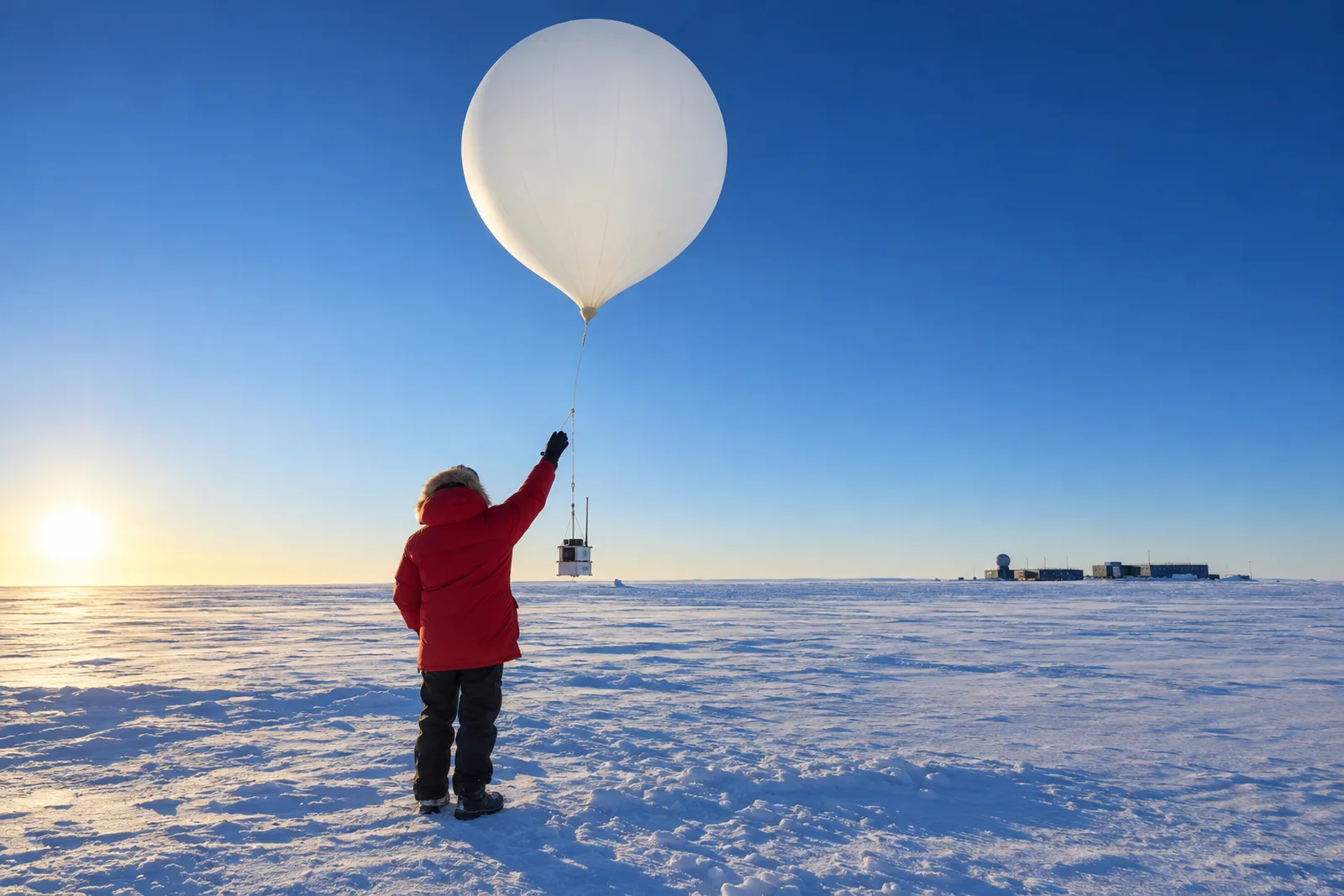
The depth of the hole tells a more hopeful story than its width. Balloon-borne instruments launched from the South Pole found that ozone directly overhead reached its lowest value for the year, 105 Dobson units, on 17 October. The lowest ever recorded there was 92 Dobson units in October 2006. The finding was confirmed by Dobson instruments, which have measured ozone at the South Pole since 1962, CIRES said. “Long-term ozone records from the South Pole provide the definitive baseline required to detect and quantify the recovery of the global ozone layer,” said Irina Petropavlovskikh, a CIRES senior research scientist.
Could it work elsewhere?
The Montreal Protocol is often held up as the clearest example of a global environmental treaty that works. Every country signed up, industry found substitutes, and the atmosphere is responding, even if slowly. In GGND’s view, the 2026 ozone hole is a useful reminder of what success looks like for other long problems such as climate change: progress shows up as a trend over decades, and a single bad year does not undo it. The same patience, and the same steady measurement, will be needed for cuts in greenhouse gases.
What remains unresolved
- Weather still rules single years. Strong polar vortices can produce large holes for years to come, even as chlorine falls. A big hole in one year does not mean recovery has stalled, but it can mean more UV for the Southern Hemisphere that season.
- Old chemicals linger. CFCs can stay in the atmosphere, or leak from old products and landfills, for many decades, NASA said. That is why full recovery is not expected until the 2070s.
- The treaty must hold. Recovery depends on countries continuing to keep ozone-destroying substances out of production and use.
What happens next
NOAA and NASA will keep watching. Monitoring relies on balloon launches and Dobson instruments at the South Pole, and on satellites including NASA’s Aura, the NOAA-20 and NOAA-21 satellites, and the Suomi National Polar-orbiting Partnership. A CIRES researcher, Anna McAuliffe, will lead this year’s measurements at the South Pole observatory, CIRES said. As the legacy compounds break down, scientists estimate that the ozone hole will recover by the 2070s.
Sources
- NOAA NOAA, NASA release measurements of 2026 ozone hole (4 November 2026)
- NASA Science NASA, NOAA Track 2026 Antarctic Ozone Hole (4 November 2026)
- CIRES, University of Colorado Boulder NOAA, NASA rank 2026 ozone hole among 10 largest on record (4 November 2026)
- ABC News Ozone hole in 2026 is largest in a decade, but long-term recovery remains on track: Report (4 November 2026)
Analysis and context are by The GGND Team. Where we draw our own conclusions, we say so. To report an error, contact us.