What happened
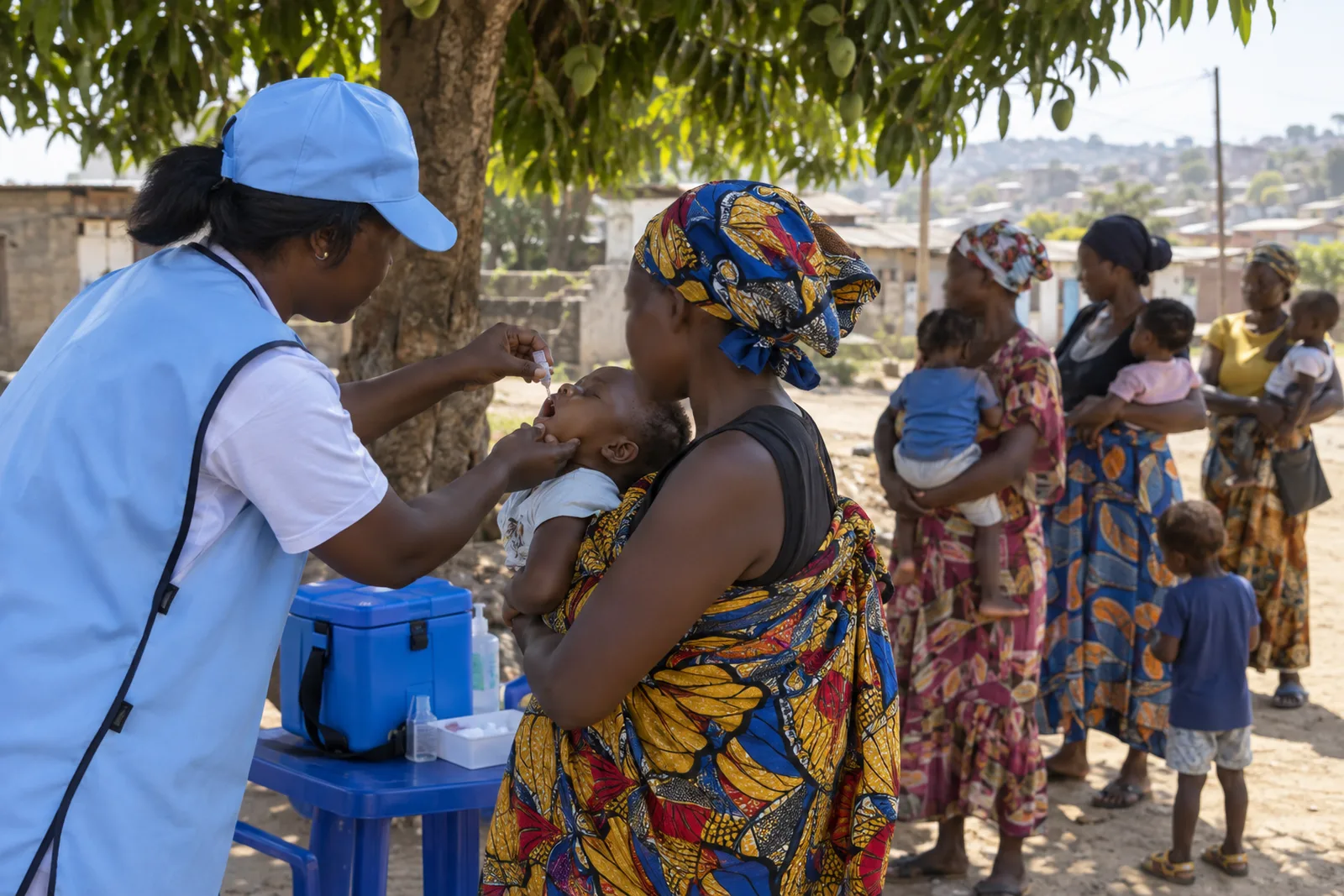
On Friday 23 October 2026, Angola’s Vice President, Esperança da Costa, launched a National Integrated Vaccination Campaign in Luanda. Over five days, to 27 October, children across the country are being offered vaccines against polio, measles, rubella and yellow fever, in what the World Health Organization’s Africa office calls “one of the largest public health operations ever carried out in Angola”.
Health Minister Sílvia Lutucuta said the campaign aims to immunise more than 10.9 million children aged between 9 months and 9 years, and will use more than 24 million vaccine doses, the Portuguese news agency Lusa reported via Saúde+. WHO says more than 77,000 health professionals, volunteers, social mobilisers and community leaders are taking part, organised into more than 11,000 teams working in towns, rural areas and hard-to-reach places. Teams use door-to-door visits as well as fixed and outreach posts, according to Novo Jornal.
In areas bordering the Democratic Republic of the Congo and Namibia, children are also receiving the injectable polio vaccine, coordinated with similar work in those countries. The campaign had first been planned for 8 to 12 October, but the Ministry of Health postponed it and set new dates.
Why it matters
All three threats are live in Angola. According to figures from the Ministry of Health reported by Novo Jornal, the country has recorded 20 cases of circulating vaccine-derived type 2 poliovirus in nine provinces since January 2025, 1,954 confirmed measles cases across 21 provinces, and 19 confirmed yellow fever cases in Luanda and Icolo e Bengo. Vaccine-derived polio spreads where too few children are immunised, and measles is one of the first diseases to return when coverage slips.
Angola is also one of nine countries that together account for more than half (52.4%) of the world’s “zero-dose” children, who have not received a single routine vaccine, Novo Jornal notes, citing a recent UNICEF and WHO report. A mass campaign is one of the fastest ways to reach those children at once.
This campaign reinforces our commitment to vaccination, but the protection of our children does not end with a single campaign. It is essential to maintain and strengthen routine vaccination.
Esperança da Costa, Vice President of Angola, at the launch in Luanda
The wider picture
“Ensuring that all children are vaccinated, regardless of where they live, is everyone’s responsibility and a matter of equity and social justice,” she told the launch, as quoted by WHO. The campaign is led by the Ministry of Health and supported by WHO, UNICEF, Gavi, the Global Polio Eradication Initiative and other partners.
The infrastructure behind it has grown. The number of health facilities offering vaccination has risen from 1,508 to 2,244, and more than 550 solar-powered cold-chain units have been installed so vaccines stay cold on the way to remote areas, Lutucuta said as reported by Lusa and Angola’s official government portal. Angola’s routine schedule has grown from five vaccines in 1979 to thirteen today. The campaign also builds on cross-border polio rounds earlier this year, when more than 10 million children were vaccinated across Angola, Namibia and the DRC, WHO reported in April.
Could it work elsewhere?
Integrated campaigns, which give several vaccines at one visit, are already used across Africa, and they save families repeated trips. In GGND’s view, the more transferable lesson from Angola is the plumbing: more vaccination points and solar-powered fridges in remote areas. Those are what keep children protected after the teams have gone home. As both the Vice President and the minister stressed, a five-day push only works if routine vaccination continues afterwards.
What remains unresolved
- No results yet. The campaign runs until 27 October. How many children were actually reached, and in which provinces coverage fell short, will only be known when the ministry and WHO publish their figures.
- Numbers that differ. WHO cites more than 11,000 vaccination teams, while the ministry said it had mobilised more than 18,000. WHO reported 39 confirmed type 2 polio cases since 2025 in April, while the ministry’s figure quoted in October is 20 cases. The government portal’s headline also says “24 thousand” doses where the minister spoke of 24 million.
- Routine vaccination. Angola still has many zero-dose children. Without stronger routine services, outbreaks of measles and vaccine-derived polio can return.
- Turnout. The campaign was postponed from its original 8 to 12 October dates. How well families heard about the new dates will shape turnout.
What happens next
Once the campaign ends on 27 October, coverage data will need to be compiled; independent coverage surveys often follow campaigns of this kind. The campaign was launched on the eve of World Polio Day, a reminder that the African Region was declared free of wild polio in 2020, while vaccine-derived strains still need to be stopped. GGND will report the results when they are published.
Sources
- WHO Regional Office for Africa Angola launches integrated vaccination campaign to protect more than 10 million children (23 October 2026)
- Lusa via Saúde+ Vacinação de crianças é investimento fundamental no futuro de Angola – ministra (23 October 2026)
- Novo Jornal Campanha para vacinar 11 milhões de crianças com início marcado para esta sexta-feira, 23 (22 October 2026)
- Governo de Angola Ministério da Saúde disponibiliza doses de vacinas para campanha nacional (23 October 2026)
- Ministério da Saúde de Angola MINSA adia arranque da campanha nacional de vacinação (October 2026)
- WHO Regional Office for Africa Over 10 million children protected against polio in coordinated cross-border campaigns across Angola, DRC and Namibia (24 April 2026)
Analysis and context are by The GGND Team. Where we draw our own conclusions, we say so. To report an error, contact us.