What happened
Namibia has its own air ambulance for the first time. On Wednesday 4 November, Vice-President Lucia Witbooi launched the state-owned service in Windhoek, the Namibian Broadcasting Corporation reported. Until now, patients in remote areas without private medical aid often faced long road journeys to specialist care.
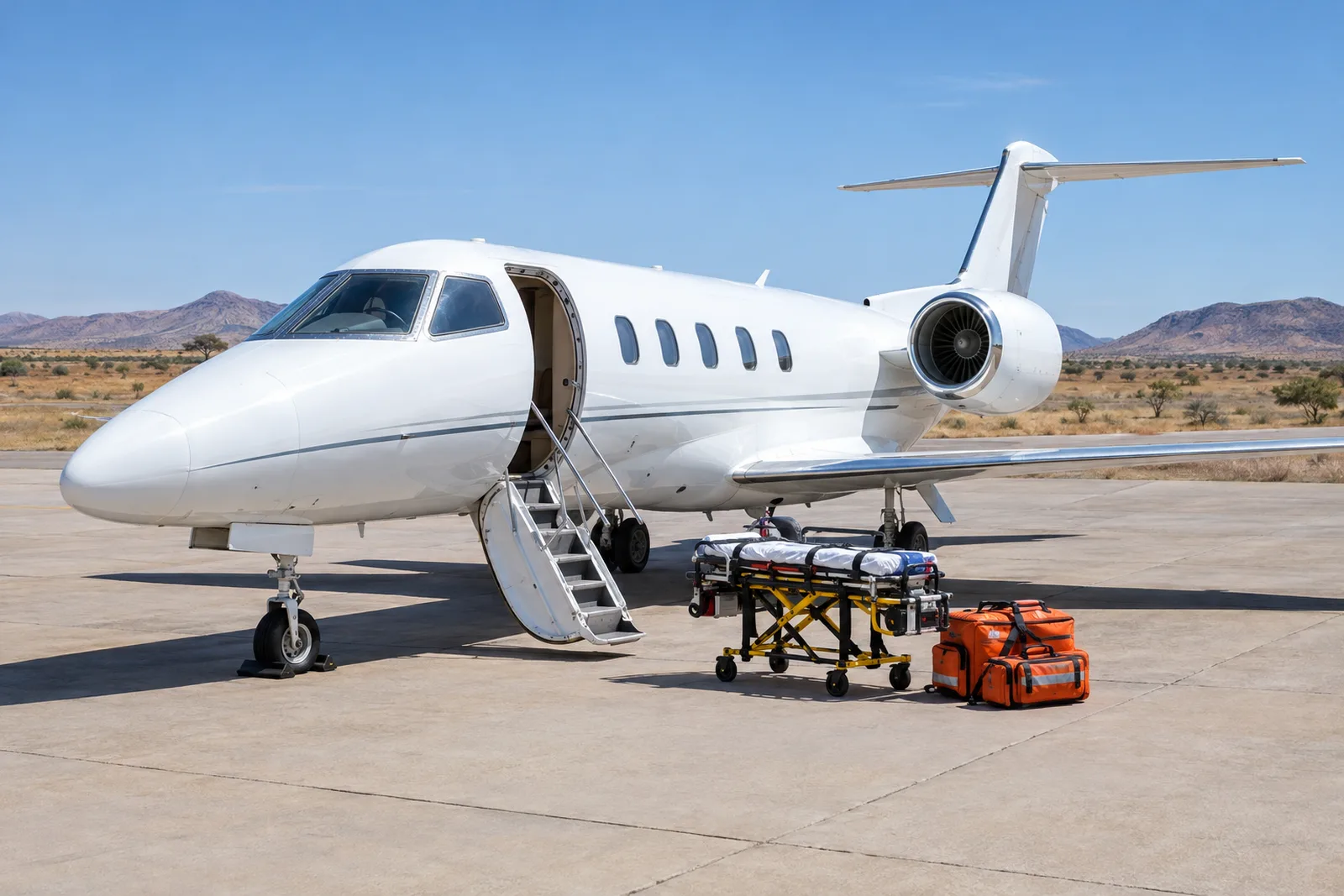
The service is built around a government Learjet 31A, fitted out as what officials called an intensive care unit in the air, and operated by Government Air Transport Services. Helicopter evacuations will be provided by the Namibian Police and the Namibian Defence Force, The Namibian reported. Executive director Penda Ithindi said the service was set up specifically for state patients without medical aid who need urgent evacuation, The Namibian later reported.
The Namibia Civil Aviation Authority handed the operating licence to Government Air Transport Services at the launch, NBC reported, after what ch-aviation described as a five-phase certification process. Ithindi said the ministry had spent about N$500,000 equipping the aircraft, according to The Namibian.
Why it matters
Namibia is one of the most sparsely populated countries in the world. Specialist care, including neurosurgery and cardiac care, is concentrated in Windhoek, and road transfers from remote regions can take many hours. “For many patients, a gruelling, hours-long journey by road will now be reduced to a matter of minutes or a few short hours by air, ensuring they reach the specialised care they need on time,” Witbooi said, according to The Namibian.
Health Minister Esperance Luvindao said the service was not for every patient. It is meant for patients needing time-critical neurosurgical, cardiac, trauma, obstetric or other specialist care where road transport would be too slow or risky, NBC reported. Requests will be checked and dispatched through a reactivated emergency call centre, and the ministry aims to set up a dedicated directorate for emergency services, the Windhoek Observer reported. Defending the spending, she said: “While we build those hospitals, Namibians want service,” according to New Era.
No Namibian should lose their life simply because they live far from a hospital.
Lucia Witbooi, Vice-President of Namibia, at the launch, as reported by The Namibian
The wider picture
The launch has not been free of criticism. Opposition MP Nelson Kalangula told The Namibian that the Learjet had not been in operation since 2003, after being kept in a hangar, and argued that several airports lack runway lights, instrument landing systems, firefighting services and ground support. “Most of our people we want to give health service are in the remote areas. For that you need a 4×4 vehicle or helicopter,” he said. ch-aviation identified the aircraft as V5-NAG, built in 1995.
New Era noted that the government had not given figures on how many patients the service expects to carry each year or on its annual operating budget. Witbooi herself set the bar: “The real work, and the tangible impact we seek to achieve, lies in ensuring that this service operates efficiently, safely and sustainably for decades to come,” she said, according to The Namibian.
In GGND’s view, the questions are fair and the step is still a real one. An older aircraft that has passed a fresh certification is not unusual in aviation, but maintenance, crew training and runway upgrades will decide whether the service saves lives or sits on the ground.
Could it work elsewhere?
Several African countries rely on private or donor-funded air ambulances that many patients cannot afford. Namibia’s model uses aircraft and crews the state already owns, with police and military helicopters filling the gaps, and puts the health ministry in charge of medical decisions. In GGND’s view, it could suit other large, thinly populated countries, provided they publish clear rules on who qualifies and fund maintenance properly, rather than only the launch.
What remains unresolved
- Running costs. The government has not published an annual budget for fuel, crews, medical staff and maintenance.
- Night and rural flights. Many airstrips lack lights and landing aids. Without upgrades, some emergencies may still have to travel by road.
- An ageing aircraft. The Learjet was built in 1995. How long it can fly reliably, and what will replace it, has not been explained.
- Measuring results. There are no public targets for flights, response times or lives saved, which makes the service hard to judge.
What happens next
Flights will be coordinated through the ministry’s emergency call centre, and a task force will explore agreements with medical aid schemes, starting with the public service scheme, The Namibian reported. GGND will look for the first figures on how many patients the service carries and how quickly it reaches them.
Sources
- NBC (Namibian Broadcasting Corporation) Namibia inaugurates first state-owned air ambulance (4 November 2026)
- The Namibian Namibia gets first state-owned air ambulances (5 November 2026)
- The Namibian Air ambulance ‘not used since 2003’ (9 November 2026)
- Windhoek Observer ‘Air ambulance not for every patient’ – Luvindao (November 2026)
- New Era, via allAfrica Namibia: Distance no longer a death sentence (6 November 2026)
- New Era, via allAfrica Namibia: Air ambulance to bridge healthcare gap in remote areas (9 November 2026)
- ch-aviation Namibia launches gov’t-operated air ambulance services (9 November 2026)
Analysis and context are by The GGND Team. Where we draw our own conclusions, we say so. To report an error, contact us.