What happened
For almost a century, everything science knew about the Ethiopian water mouse came from one animal. The US zoologist Wilfred Hudson Osgood caught an adult male in a mountain stream in the Ethiopian highlands in 1927 and described the species the following year, the German conservation group NABU said. Later searches found nothing, and the International Union for Conservation of Nature lists the species, Nilopegamys plumbeus, as critically endangered and possibly extinct.
In mid-October, during a wildlife survey in the Yayu Biosphere Reserve in south-western Ethiopia, Mengistu Wale, an ecologist at the Ethiopian Biodiversity Institute, checked one of his traps and found the animal inside. “When I saw it for the first time, I was very excited,” he told National Geographic. “I was 95 percent sure it was Nilopegamys.” The team then caught two more, and by comparing them with the 1928 description they say they are confident the animals belong to the lost species.
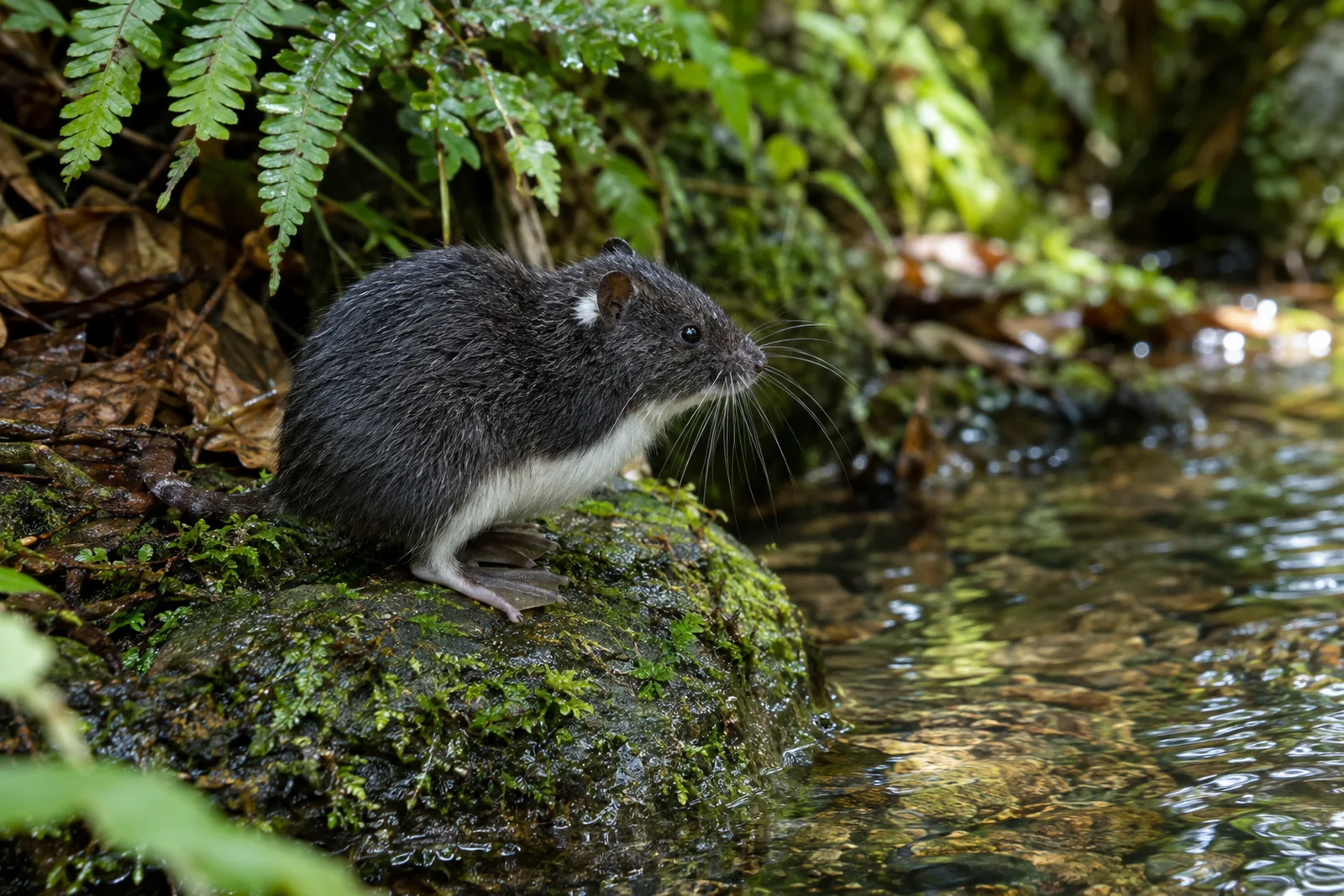
The mouse is about 15 centimetres long, with broad hind feet and a thick, water-repellent coat that is slate-black on top and white underneath, according to Keystone-SDA, citing NABU. NABU announced the find on 10 November.
Why it matters
A rediscovery turns a museum label back into a living animal that can be studied and protected. “Until now, virtually all of our knowledge about this species was based on a single animal,” said Katharina Kühnert, who leads NABU’s project in Yayu. “With this rediscovery, we now have the opportunity to learn more about its ecology, its distribution, and ultimately what is needed to protect the species and its habitat,” she said, as reported by Deutschlandfunk.
The location is a surprise. The new animals were found not at the historic site in the north-western highlands but hundreds of kilometres further south, NABU said. And they were not deep in the reserve. “It was in the stream where people were washing their clothes on the exact same spot,” Alena Fornuskova, a mammalogist at the Czech Academy of Sciences, told National Geographic. Fornuskova says this suggests the species may not be as vulnerable to development as once thought.
The discovery of such a little-known mammal shows just how much there is still to discover in Ethiopia’s forests and waters.
Dr Mengistu Wale, Ethiopian Biodiversity Institute
The wider picture
The find came from the first comprehensive wildlife survey of its kind in Yayu, said Getachew Mulualem, a mammalogist at the Ethiopian Biodiversity Institute, in National Geographic. NABU says the survey ran from 5 to 27 October and that its results are still being analysed by researchers from the Ethiopian Biodiversity Institute and the Institute of Vertebrate Biology of the Czech Academy of Sciences.
Yayu was recognised by UNESCO as a biosphere reserve in 2010. It protects Afromontane rainforest that includes wild populations of arabica coffee, and NABU has worked there since 2012 on forest protection and sustainable livelihoods, in a project funded by Germany’s development ministry and carried out with NABU Ethiopia, the group said.
Part of the reason the mouse stayed hidden may be how people look for small mammals. “Small, semi-aquatic mammals are notoriously elusive because standard mammal surveys tend to rely on dry-land traps, so aquatic species easily go undetected,” said Thomas Giarla, a mammalogist who was not part of the survey, in National Geographic. Wale, by contrast, often sets traps along streams and in wetlands. The bait that worked was peanut butter.
Could it work elsewhere?
In GGND’s view, the lesson travels well: many “lost” species have simply not been looked for in the right places, with the right methods. Targeted surveys of streams and wetlands, run with local scientists, are relatively cheap compared with most conservation work. Mulualem said that more surveys across other habitats would very likely turn up “many more surprises, including potentially new species and important range extensions”.
What remains unresolved
- Confirmation. The identification rests on the animals’ appearance. Genetic tests are under way. Giarla said an expert visual assessment “may well hold up”, but he wants to see the detailed data.
- Numbers. Three animals have been caught. Nobody yet knows how many water mice live in Yayu, or whether they survive anywhere else.
- Habitat. The area where the species was first found appears to have been almost entirely converted for livestock, National Geographic reported. The Yayu animals live by a village stream, so how farming and water use affect them is an open question.
- Protection status. Any change to the species’ IUCN listing will depend on surveys showing where it lives and how many there are.
What happens next
The researchers plan to use DNA from the animals’ droppings to find out what they eat, Fornuskova told National Geographic. NABU says the team will now draw up recommendations for the long-term protection of the area and its species. GGND will report on the genetic results when they are published.
Sources
- NABU Äthiopische Wassermaus wiederentdeckt (press release, 10 November 2026, in German)
- National Geographic Scientists thought this amphibious mouse was extinct. After almost a century, it’s reappeared (9 November 2026)
- Keystone-SDA via blue News Ethiopian water rat, believed to be extinct, spotted (10 November 2026)
- Deutschlandfunk Äthiopische Wassermaus nach mehr als 100 Jahren wieder aufgetaucht (11 November 2026, in German)
Analysis and context are by The GGND Team. Where we draw our own conclusions, we say so. To report an error, contact us.